Swissnoso, the National Center for Infection Control, Bern, Switzerland.
Department of Infectious Diseases, Bern University Hospital, University of Bern, Bern, Switzerland.
Antimicrob Resist Infect Control. 2023 Nov 24;12(1):134. doi: 10.1186/s13756-023-01336-7.
In Switzerland, the national surgical site infection (SSI) surveillance program showed a modest decrease in SSI rates for different procedures over the last decade. The study aimed to determine whether a multimodal, targeted intervention program in addition to existing SSI surveillance is associated with decreased SSI rates in the participating hospitals.
Prospective multicenter pre- and postintervention study conducted in eight Swiss acute care hospitals between 2013 and 2020. All consecutive patients > 18 years undergoing cardiac, colon, or hip/knee replacement surgery were included. The follow-up period was 30 days and one year for implant-related surgery. Patients with at least one follow-up were included. The intervention was to optimize three elements of preoperative management: (i) hair removal; (ii) skin disinfection; and (iii) perioperative antimicrobial prophylaxis. We compared SSI incidence rates (main outcome measure) pre- and postintervention (three years each) adjusted for potential confounders. Poisson generalized linear mixed models fitted to quarter-yearly confirmed SSIs and adjusted for baseline differences between hospitals and procedures. Adherence was routinely monitored through on-site visits.
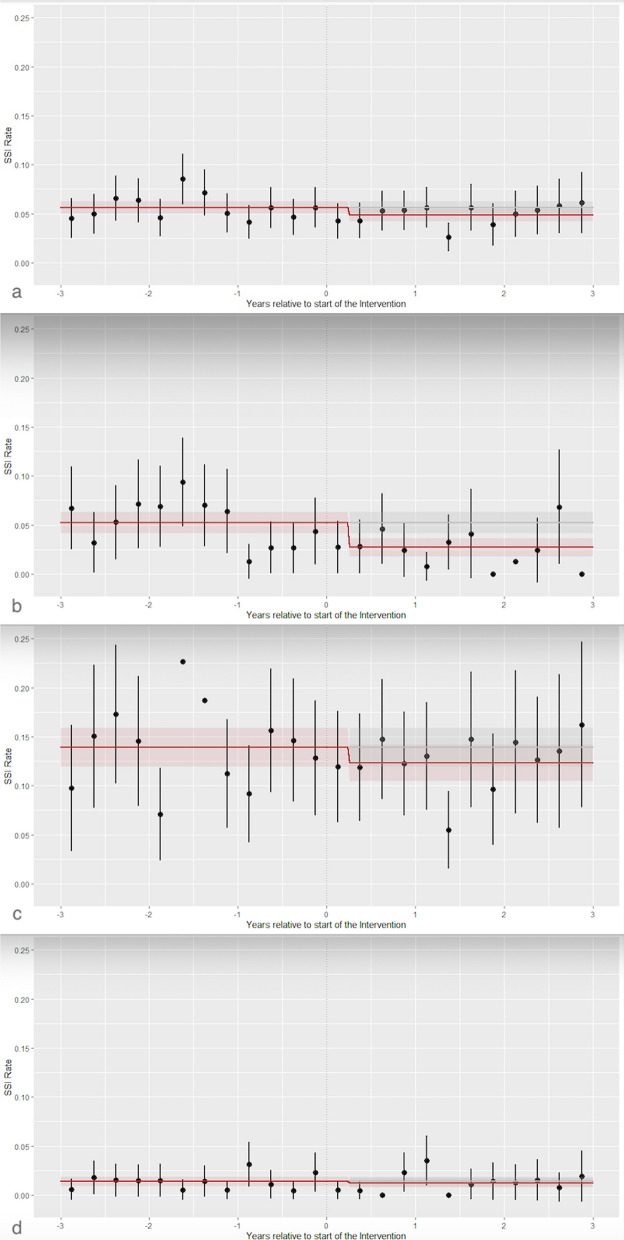
A total of 10 151 patients were included, with a similar median age pre- and postintervention (69.6 and IQR 60.9, 76.8 years, vs 69.5 and IQR 60.4, 76.8 years, respectively; P = 0.55) and similar proportions of females (44.8% vs. 46.1%, respectively; P = 0.227). Preintervention, 309 SSIs occurred in 5 489 patients (5.6%), compared to 226 infections in 4 662 cases (4.8%, P = 0.09) postintervention. The adjusted incidence rate ratio (aIRR) for overall SSI after intervention implementation was 0.81 (95% CI, 0.68 to 0.96, P = 0.02). For cardiac surgery (n = 2 927), the aIRR of SSI was 0.48 (95% CI, 0.32 to 0.72, P < 0.001). For hip/knee replacement surgery (n = 4 522), the aIRR was 0.88 (95% CI, 0.52 to 1.48, P = 0.63), and for colon surgery (n = 2 702), the aIRR was 0.92 (95% CI, 0.75 to 1.14, P = 0.49).
The SSI intervention bundle was associated with a statistically significant decrease in SSI cases. A significant association was observed for cardiac surgery. Adding a specific intervention program can add value compared to routine surveillance only. Further prevention modules might be necessary for colon and orthopedic surgery.
在瑞士,全国手术部位感染(SSI)监测计划显示,过去十年间,不同手术的 SSI 发生率略有下降。本研究旨在确定在现有 SSI 监测的基础上,增加多模式、有针对性的干预方案是否与参与医院的 SSI 发生率降低有关。
2013 年至 2020 年期间,在瑞士 8 家急性护理医院进行了前瞻性多中心干预前后研究。所有>18 岁的接受心脏、结肠或髋关节/膝关节置换术的连续患者均纳入研究。随访期为 30 天和植入物相关手术的 1 年。至少有一次随访的患者被纳入研究。干预措施是优化术前管理的三个要素:(i)脱毛;(ii)皮肤消毒;(iii)围手术期抗菌预防。我们比较了干预前后(各 3 年)的 SSI 发生率(主要观察指标),并对潜在混杂因素进行了调整。使用泊松广义线性混合模型对每季度确认的 SSI 进行拟合,并对医院和手术之间的基线差异进行了调整。通过现场访问定期监测依从性。
共纳入 10151 例患者,干预前后的中位年龄相似(分别为 69.6 和 IQR 60.9、76.8 岁和 69.5 和 IQR 60.4、76.8 岁;P=0.55),女性比例也相似(分别为 44.8%和 46.1%;P=0.227)。干预前,5489 例患者(5.6%)发生 309 例 SSI,而干预后 4662 例患者(4.8%)发生 226 例感染(P=0.09)。实施干预后,总体 SSI 的调整发病率比(aIRR)为 0.81(95%CI,0.68 至 0.96,P=0.02)。心脏手术(n=2927)的 SSI aIRR 为 0.48(95%CI,0.32 至 0.72,P<0.001)。髋关节/膝关节置换手术(n=4522)的 aIRR 为 0.88(95%CI,0.52 至 1.48,P=0.63),结肠手术(n=2702)的 aIRR 为 0.92(95%CI,0.75 至 1.14,P=0.49)。
SSI 干预方案与 SSI 病例的显著减少相关。心脏手术存在显著相关性。与仅常规监测相比,添加特定的干预方案可能会增加价值。对于结肠和骨科手术,可能需要进一步的预防模块。