Mastnak Lara, Herman Rok, Ferjan Simona, Janež Andrej, Jensterle Mojca
Faculty of Medicine, University of Ljubljana, 1000 Ljubljana, Slovenia.
Department of Endocrinology, Diabetes and Metabolic Diseases, University Medical Center Ljubljana, 1000 Ljubljana, Slovenia.
Life (Basel). 2023 Oct 26;13(11):2124. doi: 10.3390/life13112124.
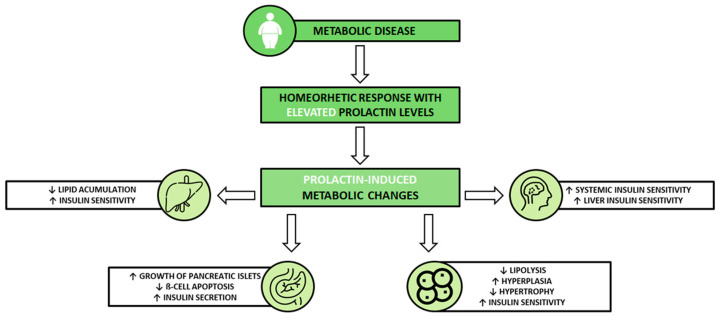
Polycystic ovary syndrome (PCOS) is the most prevalent endocrine and metabolic disorder in premenopausal women, characterized by hyperandrogenism, ovulatory dysfunction, and polycystic ovaries. Patients frequently present comorbidities, including obesity, insulin resistance, and impaired glucose and lipid metabolism. The diverse clinical presentation may mimic various endocrine disorders, making the diagnosis challenging in some clinical circumstances. Prolactin (PRL) is a recommended biomarker in the initial diagnostic workup to rule out hyperprolactinemia (HPRL). The traditional role of PRL is linked to lactation and the reproductive system. Recent research highlights PRL's emerging role in metabolic homeostasis. PRL influences metabolism directly by interacting with the pancreas, liver, hypothalamus, and adipose tissue. Its influence on an individual's metabolism is intricately tied to its serum concentration. While deficient and very high levels of PRL can negatively affect metabolism, intermediate-normal to moderately high levels may promote metabolic health. In women with PCOS, PRL levels may be altered. Research results on different aspects of the relationship between PCOS and the impact of various levels of PRL on metabolic homeostasis are limited and inconsistent. In this narrative literature review, we comprehensively examined data on serum PRL levels in PCOS patients. We investigated the correlation between a favorable metabolic profile and serum PRL levels in this population. Furthermore, we explored the concept of beneficial PRL effects on metabolism and discussed the potential therapeutic application of dopamine agonists in PCOS treatment. Lastly, we emphasized several promising avenues for future research in this field.
多囊卵巢综合征(PCOS)是绝经前女性中最常见的内分泌和代谢紊乱疾病,其特征为高雄激素血症、排卵功能障碍和多囊卵巢。患者常伴有肥胖、胰岛素抵抗以及糖脂代谢受损等合并症。其多样的临床表现可能与各种内分泌疾病相似,这使得在某些临床情况下诊断颇具挑战性。催乳素(PRL)是初始诊断检查中用于排除高催乳素血症(HPRL)的推荐生物标志物。PRL的传统作用与泌乳及生殖系统相关。近期研究凸显了PRL在代谢稳态中的新作用。PRL通过与胰腺、肝脏、下丘脑和脂肪组织相互作用直接影响代谢。其对个体代谢的影响与其血清浓度密切相关。PRL水平过低和过高都会对代谢产生负面影响,而处于正常至中度升高的中间水平可能促进代谢健康。在PCOS女性中,PRL水平可能会发生改变。关于PCOS与不同水平PRL对代谢稳态影响之间关系的不同方面的研究结果有限且不一致。在这篇叙述性文献综述中,我们全面研究了PCOS患者血清PRL水平的数据。我们调查了该人群中良好代谢状况与血清PRL水平之间的相关性。此外,我们探讨了PRL对代谢有益作用的概念,并讨论了多巴胺激动剂在PCOS治疗中的潜在治疗应用。最后,我们强调了该领域未来研究的几个有前景的方向。