Hongkailers Surachet, Pattiya Adisak, Hinchiranan Napida
Department of Chemical Technology, Faculty of Science, Chulalongkorn University, 254 Phyathai Road, Bangkok 10330, Thailand.
Bio-Energy and Renewable Resources Research Unit, Faculty of Engineering, Mahasarakham University, Kamriang, Kantharawichai, Maha Sarakham 44150, Thailand.
Molecules. 2023 Nov 7;28(22):7468. doi: 10.3390/molecules28227468.
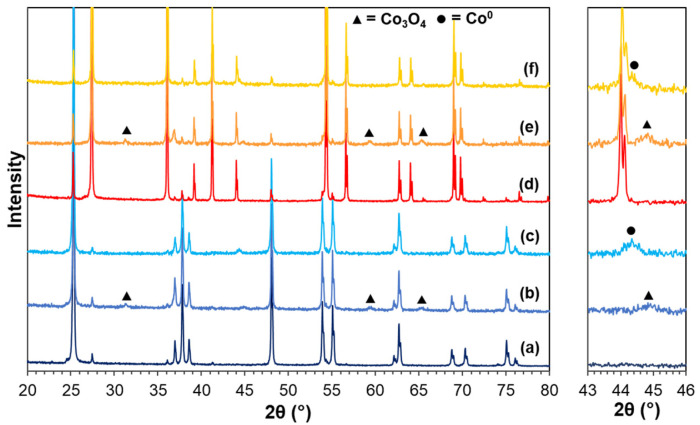
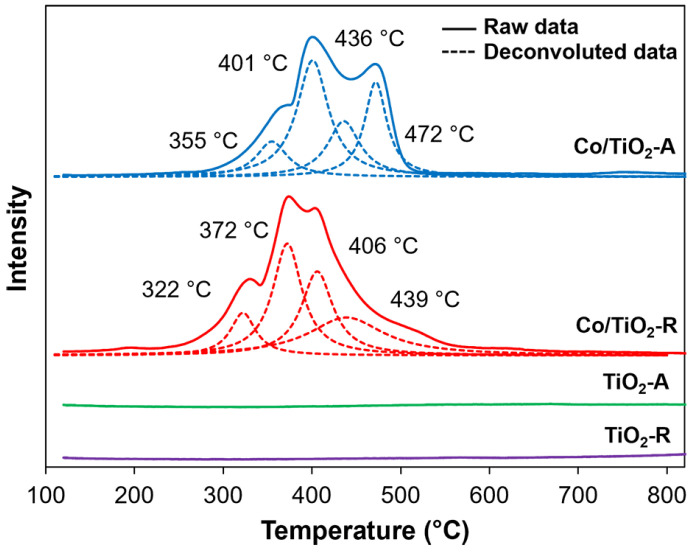
Bio-oil upgrading to produce biofuels and chemicals has become an attractive topic over the past decade. However, the design of cost- and performance-effective catalysts for commercial-scale production remains a challenge. Herein, commercial titania (TiO) was used as the support of cobalt (Co)-based catalysts (Co/TiO) due to its low cost, high availability, and practicability for commercialization in the future. The Co/TiO catalysts were made with two different forms of TiO (anatase [TiO-A] and rutile [TiO-R]) and comparatively evaluated in the hydrodeoxygenation (HDO) of 4-propylguaicol (4PG), a lignin-derived model compound. Both Co/TiO catalysts promoted the HDO of 4PG following a similar pathway, but the Co/TiO-R catalyst exhibited a higher activity in the early stages of the reaction due to the formation of abundant Ti species, as detected by X-ray photoelectron spectroscopy (XPS) and hydrogen-temperature programed reduction (H-TPR) analyses. On the other hand, the Co/TiO-A catalyst possessed a higher acidity that enhanced propylcyclohexane production at prolonged reaction times. In terms of reusability, the Co/TiO-A catalyst showed a higher stability (less Co leaching) and reusability compared to Co/TiO-R, as confirmed by transmission electron microscopy (TEM) and inductively coupled plasma optical emission spectroscopy (ICP-OES) analyses. The HDO of the real bio-oil derived from pyrolysis of revealed that the Co/TiO-A catalyst could convert high oxygenated aromatics (methoxyphenols, dimethoxyphenols, and benzenediols) to phenols and enhanced the phenols content, hinting at its potential to produce green chemicals from bio-feedstock.
在过去十年中,生物油升级生产生物燃料和化学品已成为一个备受关注的课题。然而,设计适用于商业规模生产的具有成本效益和高性能的催化剂仍然是一项挑战。在此,商业二氧化钛(TiO₂)因其低成本、高可用性以及未来商业化的实用性,被用作钴(Co)基催化剂(Co/TiO₂)的载体。Co/TiO₂催化剂由两种不同形式的TiO₂(锐钛矿型[TiO₂-A]和金红石型[TiO₂-R])制成,并在木质素衍生的模型化合物4-丙基愈创木酚(4PG)的加氢脱氧(HDO)反应中进行了比较评估。两种Co/TiO₂催化剂都通过类似的途径促进了4PG的HDO反应,但通过X射线光电子能谱(XPS)和氢程序升温还原(H-TPR)分析检测到,由于形成了丰富的Ti物种,Co/TiO₂-R催化剂在反应初期表现出更高的活性。另一方面,Co/TiO₂-A催化剂具有较高的酸度,在延长反应时间时提高了丙基环己烷的产量。在可重复使用性方面,通过透射电子显微镜(TEM)和电感耦合等离子体发射光谱(ICP-OES)分析证实,与Co/TiO₂-R相比,Co/TiO₂-A催化剂表现出更高的稳定性(较少的Co浸出)和可重复使用性。对热解得到的真实生物油进行HDO反应表明,Co/TiO₂-A催化剂可以将高氧化芳烃(甲氧基苯酚、二甲氧基苯酚和苯二醇)转化为苯酚,并提高了苯酚含量,这暗示了其从生物原料生产绿色化学品的潜力。