
蛋白质组网络分析鉴定脑衰老的潜在生物标志物。
Proteome Network Analysis Identifies Potential Biomarkers for Brain Aging.
机构信息
Glenn Biggs Institute for Alzheimer's & Neurodegenerative Diseases, University of Texas Health Science Center, San Antonio, TX, USA.
Institute for Clinical Research and Health Policy Studies, Tufts Medical Center, Boston, MA, USA.
出版信息
J Alzheimers Dis. 2023;96(4):1767-1780. doi: 10.3233/JAD-230145.
BACKGROUND
Alzheimer's disease and related dementias (ADRD) involve biological processes that begin years to decades before onset of clinical symptoms. The plasma proteome can offer insight into brain aging and risk of incident dementia among cognitively healthy adults.
OBJECTIVE
To identify biomarkers and biological pathways associated with neuroimaging measures and incident dementia in two large community-based cohorts by applying a correlation-based network analysis to the plasma proteome.
METHODS
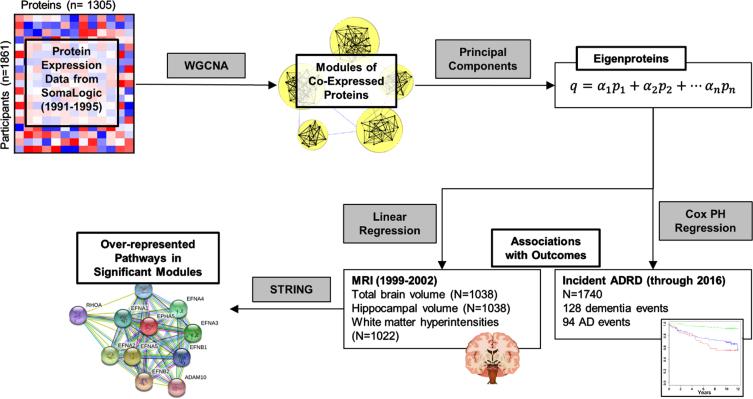
Weighted co-expression network analysis of 1,305 plasma proteins identified four modules of co-expressed proteins, which were related to MRI brain volumes and risk of incident dementia over a median 20-year follow-up in Framingham Heart Study (FHS) Offspring cohort participants (n = 1,861). Analyses were replicated in the Cardiovascular Health Study (CHS) (n = 2,117, mean 6-year follow-up).
RESULTS
Two proteomic modules, one related to protein clearance and synaptic maintenance (M2) and a second to inflammation (M4), were associated with total brain volume in FHS (M2: p = 0.014; M4: p = 4.2×10⁻⁵). These modules were not significantly associated with hippocampal volume, white matter hyperintensities, or incident all-cause or AD dementia. Associations with TCBV did not replicate in CHS, an older cohort with a greater burden of comorbidities.
CONCLUSIONS
Proteome networks implicate an early role for biological pathways involving inflammation and synaptic function in preclinical brain atrophy, with implications for clinical dementia.
背景
阿尔茨海默病和相关痴呆症(ADRD)涉及生物过程,这些过程在临床症状出现前数年至数十年就开始了。血浆蛋白质组可以深入了解大脑老化以及认知健康成年人发生痴呆的风险。
目的
通过对血浆蛋白质组进行基于相关性的网络分析,在两个大型基于社区的队列中,确定与神经影像学测量和认知健康成年人发生痴呆相关的生物标志物和生物学途径。
方法
对 1305 种血浆蛋白进行加权共表达网络分析,确定了四个共表达蛋白模块,这些模块与 Framingham 心脏研究(FHS)后代队列参与者(n = 1861)的 MRI 脑容量和 20 年中位随访期间发生痴呆的风险相关。在心血管健康研究(CHS)中(n = 2117,平均 6 年随访)对分析进行了复制。
结果
两个蛋白质组模块,一个与蛋白质清除和突触维持有关(M2),另一个与炎症有关(M4),与 FHS 中的总脑容量相关(M2:p = 0.014;M4:p = 4.2×10⁻⁵)。这些模块与海马体积、白质高信号或全因或 AD 痴呆的发生无显著相关性。在 CHS 中,与 TCBV 的关联没有复制,CHS 是一个年龄较大、合并症负担更大的队列。
结论
蛋白质组网络表明,涉及炎症和突触功能的生物学途径在临床前脑萎缩中早期发挥作用,这对临床痴呆具有重要意义。


 Zotero 插件