Programme National de Lutte Contre les Bilharzioses et les Géo-Helminthiases, Direction de la Lutte Contre la Maladie (DLM), Ministère de la Santé et de l'Action Sociale (MSAS), Dakar, Senegal.
Department of Parasitology and Mycology Faculty of Medicine, Pharmacy and Odontology, Université Cheikh Anta Diop de Dakar (UCAD), Dakar, Senegal.
Infect Dis Poverty. 2023 Nov 27;12(1):106. doi: 10.1186/s40249-023-01155-3.
Over the past two decades, preventive chemotherapy (PC) with praziquantel (PZQ) is the major strategy for controlling schistosomiasis in Senegal. The objective of this analysis was to update the endemicity of schistosomiasis at community level for better targeting mass treatment with PZQ in Senegal.
Demographic and epidemiological data from 1610 community health areas were analyzed using the schistosomiasis community data analysis tool of Expanded Special Project for Elimination of Neglected Tropical Diseases which developed by World Health Organization/Africa Office (WHO/AFRO). The tool uses a WHO/AFRO decision tree for areas without epidemiological data to determine whether mass treatment should be continued at community level. Descriptive analysis was performed.
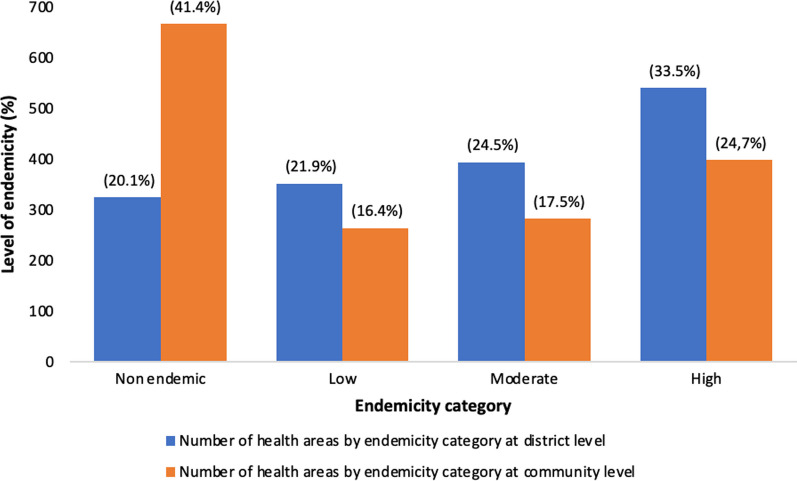
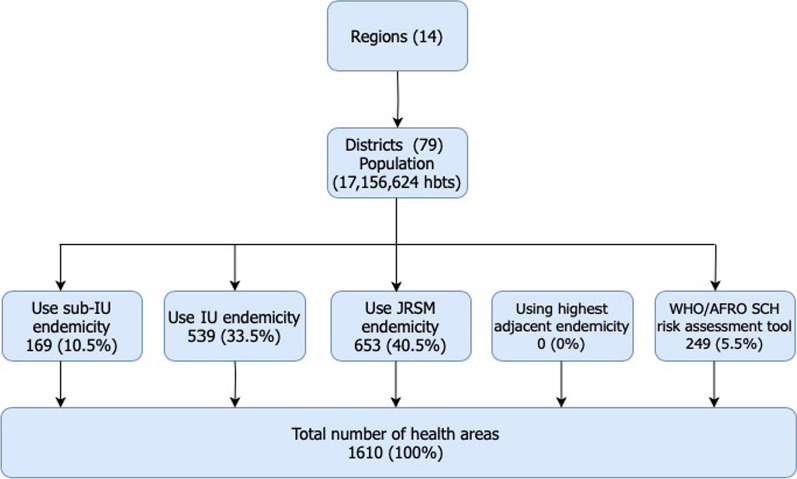
Overall, the endemicity of 1610 community health areas were updated based on the data from the district endemicity (33.5%) and the form of Join request for selected PC medicine (40.5%). Up to 282 (17.5%) and 398 (24.7%) of community health areas were classified as moderate and high endemicity. 41.1% of communities were non endemic. High endemicity was more important in Tambacounda, Saint Louis, Matam, Louga and Kedougou. A change in endemicity category was observed when data was disagregted from district level to community level. Implementation units classified non endemic were more important at community level (n = 666) compared to district level (n = 324). Among 540 areas previously classified high endemic at district level, 392 (72.6%) remained high prevalence category, while 92 (17.0%) became moderate, 43 (8.0%) low and 13 (2.4%) non-endemics at community level. Number of implementation units requiring PC was more important at district level (1286) compared to community level (944). Number of school aged children requiring treatment was also more important at district level compared to community level.
The analysis to disaggregate data from district level to community level using the WHO/AFRO schistosomiasis sub-district data optimization tool provide an update of schistosomiasis endemicity at community level. This study has allowed to better target schistosomiasis interventions, optimize use of available PZQ and exposed data gaps.
在过去的二十年中,用吡喹酮(PZQ)进行的预防性化疗(PC)一直是塞内加尔控制血吸虫病的主要策略。本分析的目的是更新社区层面的血吸虫病流行程度,以便更好地针对塞内加尔的大规模 PZQ 治疗。
使用世界卫生组织/非洲办事处(WHO/AFRO)开发的扩展消除被忽视热带病特别规划血吸虫病社区数据分析工具,对来自 1610 个社区卫生区的人口统计和流行病学数据进行了分析。该工具使用 WHO/AFRO 决策树来确定无流行病学数据的地区是否应继续在社区层面开展大规模治疗。进行了描述性分析。
总体而言,根据区流行程度(33.5%)和选定 PC 药物的联合请求形式(40.5%)更新了 1610 个社区卫生区的流行程度。多达 282 个(17.5%)和 398 个(24.7%)社区卫生区被归类为中度和高度流行区。41.1%的社区为非流行区。在坦巴昆达、圣路易、马塔姆、卢加和凯杜古,高度流行更为重要。当数据从区一级细分到社区一级时,流行程度类别发生了变化。在社区一级,被归类为非流行区的实施单位(n=666)比在区一级(n=324)更为重要。在以前被归类为区一级高度流行的 540 个地区中,392 个(72.6%)仍属于高流行类别,92 个(17.0%)变为中度,43 个(8.0%)变为低度,13 个(2.4%)变为非流行区。需要进行 PC 的实施单位数量在区一级(1286)比在社区一级(944)更为重要。需要治疗的学龄儿童数量在区一级也比在社区一级更为重要。
使用 WHO/AFRO 血吸虫病分区数据优化工具将数据从区一级细分到社区一级进行分析,提供了社区层面血吸虫病流行程度的更新。本研究使我们能够更好地针对血吸虫病干预措施,优化可用 PZQ 的使用,并揭示了数据差距。