Duan Naihua, Norman Daniel, Schmid Christopher, Sim Ida, Kravitz Richard L
Department of Psychiatry, Columbia University, New York, NY).
Santa Monica Sleep Disorders Center, Los Angeles, CA.
Harv Data Sci Rev. 2022;4(SI3). doi: 10.1162/99608f92.8439a336. Epub 2022 Sep 8.
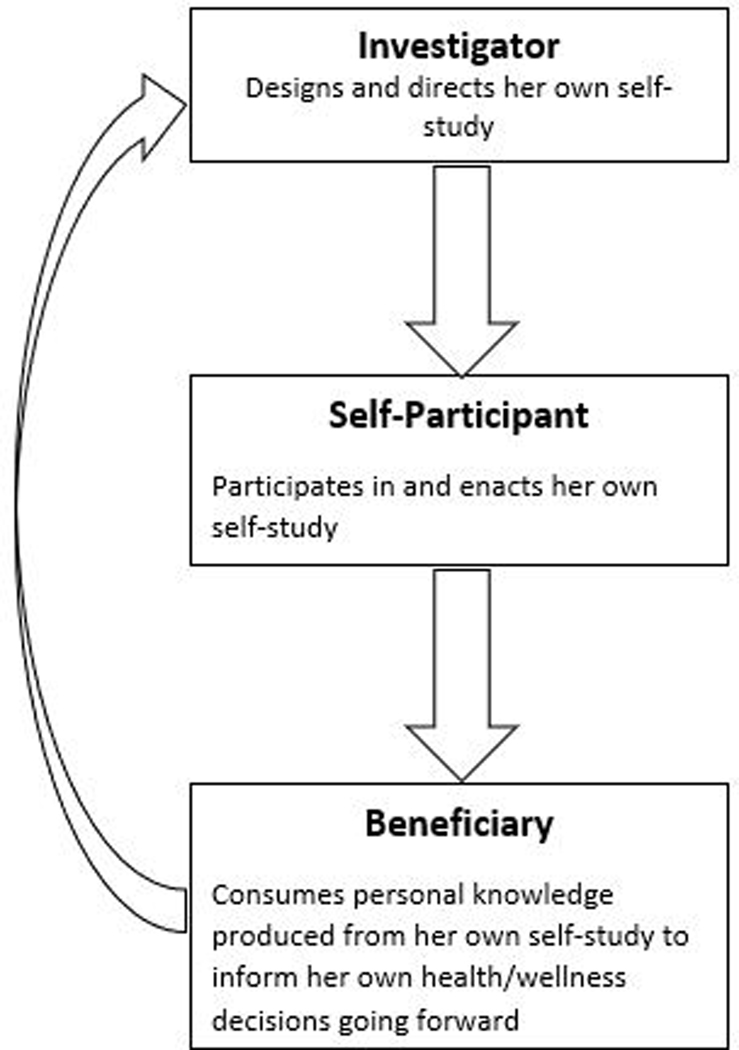
The term 'data science' usually refers to the process of extracting value from obtained from a large group of individuals. An alternative rendition, which we call (Per-DS), aims to collect, analyze, and interpret to inform decisions. This article describes the main features of Per-DS, and reviews its current state and future outlook. A Per-DS investigation is of, by, and for an individual, the Per-DS investigator, acting simultaneously as her own , , and , and making decisions for study design and implementation. The scope of Per-DS studies may include systematic monitoring of physiological or behavioral patterns, case-crossover studies for symptom triggers, pre-post trials for exposure-outcome relationships, and personalized (N-of-1) trials for effectiveness. Per-DS studies produce generalizable to the individual's future self (thus benefiting herself) rather than knowledge generalizable to an external population (thus benefiting others). This endeavor requires a pivot from or to , analogous to home gardeners producing food for home consumption-the Per-DS investigator needs to ' by setting goals, specifying study design, identifying necessary data elements, and assembling instruments and tools for data collection. Then, she can implement the study protocol, harvest her personal data, and the data to personal knowledge. To facilitate Per-DS studies, Per-DS investigators need support from community-based, scientific, philanthropic, business, and government entities, to develop and deploy resources such as peer forums, mobile apps, 'virtual field guides,' and scientific and regulatory guidance.
“数据科学”一词通常指从大量个体中获取数据并从中提取价值的过程。我们称之为“个体数据科学”(Per-DS)的另一种形式,旨在收集、分析和解读数据,为个体决策提供依据。本文描述了个体数据科学的主要特征,并对其当前状况和未来前景进行了综述。个体数据科学研究是为个体进行的、由个体进行的以及关于个体的研究,个体数据科学研究者同时充当自己的研究发起者、研究者和受益者,并为研究设计和实施做出个体决策。个体数据科学研究的范围可能包括对生理或行为模式的系统监测、针对症状触发因素的病例交叉研究、针对暴露-结果关系的前后试验以及针对有效性的个性化(单病例)试验。个体数据科学研究产生的是适用于个体未来自身的知识(从而使个体自身受益),而不是适用于外部人群的知识(从而使他人受益)。这一努力需要从传统的科学研究或公共卫生研究转向个体研究,类似于家庭园丁种植供家庭消费的食物——个体数据科学研究者需要通过设定目标、明确研究设计、确定必要的数据元素以及组装数据收集的仪器和工具来“种植自己的数据”。然后,她可以实施研究方案,收集个人数据,并将数据转化为个人知识。为了促进个体数据科学研究,个体数据科学研究者需要来自社区、科学、慈善、商业和政府实体的支持,以开发和部署诸如同行论坛、移动应用程序、“虚拟实地指南”以及科学和监管指导等资源。