Division of Systems Medicine, School of Medicine, University of Dundee, Dundee, UK.
Computing Science and Mathematics, Faculty of Natural Sciences, University of Stirling, Stirling, UK.
Diabetologia. 2024 Feb;67(2):392-402. doi: 10.1007/s00125-023-06051-x. Epub 2023 Nov 27.
AIMS/HYPOTHESIS: Impaired awareness of hypoglycaemia (IAH) in type 1 diabetes may develop through a process referred to as habituation. Consistent with this, a single bout of high intensity interval exercise as a novel stress stimulus improves counterregulatory responses (CRR) to next-day hypoglycaemia, referred to as dishabituation. This longitudinal pilot study investigated whether 4 weeks of high intensity interval training (HIIT) has sustained effects on counterregulatory and symptom responses to hypoglycaemia in adults with type 1 diabetes and IAH.
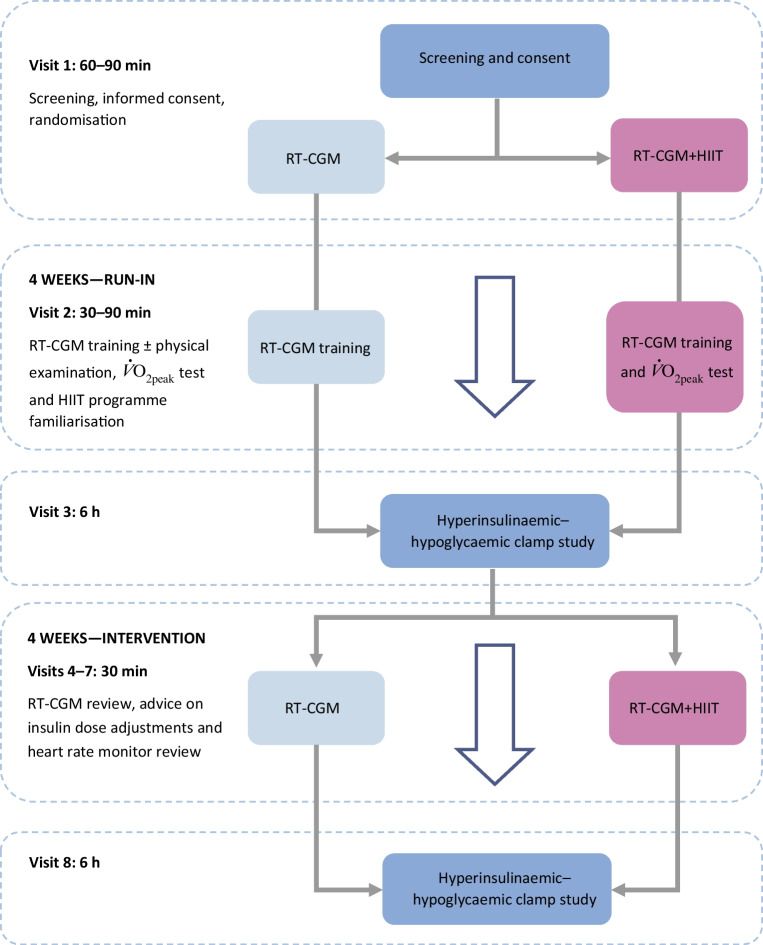
HIT4HYPOS was a single-centre, randomised, parallel-group study. Participants were identified using the Scottish Diabetes Research Network (SDRN) and from diabetes outpatient clinics in NHS Tayside, UK. The study took place at the Clinical Research Centre, Ninewells Hospital and Medical School, Dundee, UK. Participants were aged 18-55 years with type 1 diabetes of at least 5 years' duration and HbA levels <75 mmol/mol (<9%). They had IAH confirmed by a Gold score ≥4, modified Clarke score ≥4 or Dose Adjustment For Normal Eating [DAFNE] hypoglycaemia awareness rating of 2 or 3, and/or evidence of recurrent hypoglycaemia on flash glucose monitoring. Participants were randomly allocated using a web-based system to either 4 weeks of real-time continuous glucose monitoring (RT-CGM) or RT-CGM+HIIT. Participants and investigators were not masked to group assignment. The HIIT programme was performed for 20 min on a stationary exercise bike three times a week. Hyperinsulinaemic-hypoglycaemic (2.5 mmol/l) clamp studies with assessment of symptoms, hormones and cognitive function were performed at baseline and after 4 weeks of the study intervention. The predefined primary outcome was the difference in hypoglycaemia-induced adrenaline (epinephrine) responses from baseline following RT-CGM or RT-CGM+HIIT.
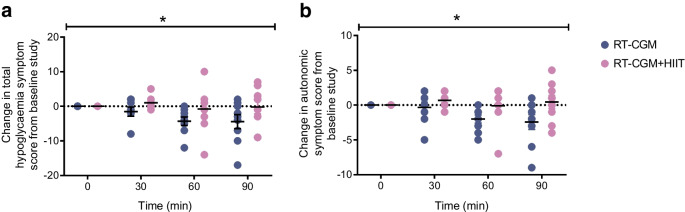
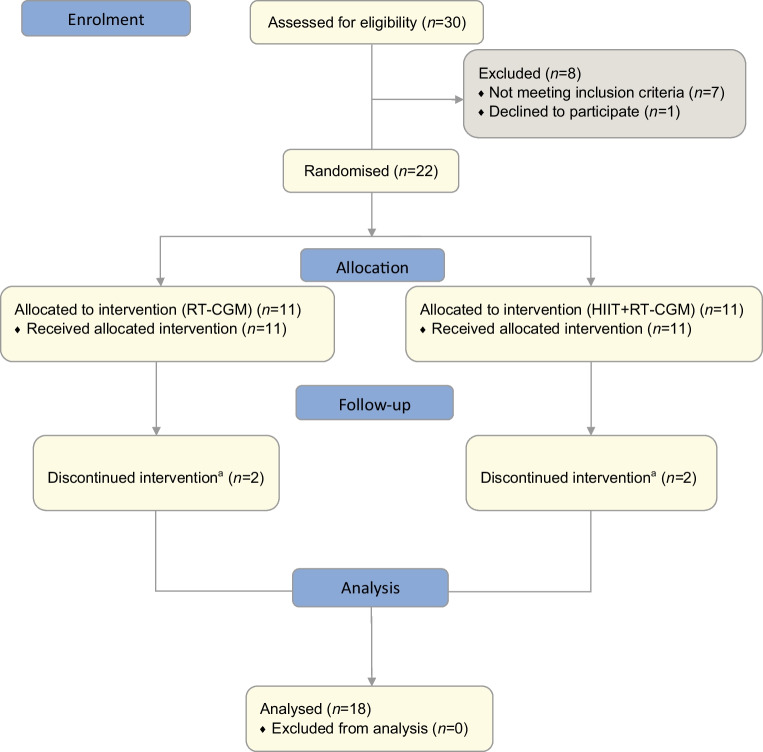
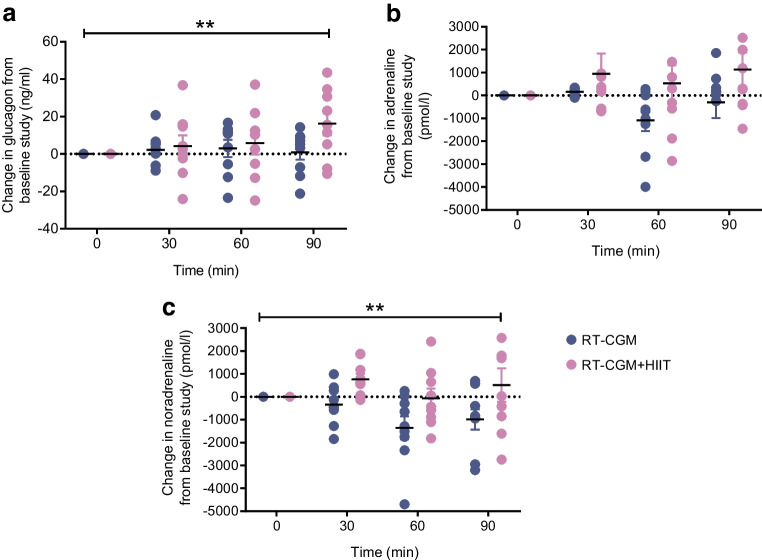
Eighteen participants (nine men and nine women) with type 1 diabetes (median [IQR] duration 27 [18.75-32] years) and IAH were included, with nine participants randomised to each group. Data from all study participants were included in the analysis. During the 4 week intervention there were no significant mean (SEM) differences between RT-CGM and RT-CGM+HIIT in exposure to level 1 (28 [7] vs 22 [4] episodes, p=0.45) or level 2 (9 [3] vs 4 [1] episodes, p=0.29) hypoglycaemia. The CGM-derived mean glucose level, SD of glucose and glucose management indicator (GMI) did not differ between groups. During the hyperinsulinaemic-hypoglycaemic clamp studies, mean (SEM) change from baseline was greater for the noradrenergic responses (RT-CGM vs RT-CGM+HIIT: -988 [447] vs 514 [732] pmol/l, p=0.02) but not the adrenergic responses (-298 [687] vs 1130 [747] pmol/l, p=0.11) in those participants who had undergone RT-CGM+HIIT. There was a benefit of RT-CGM+HIIT for mean (SEM) change from baseline in the glucagon CRR to hypoglycaemia (RT-CGM vs RT-CGM+HIIT: 1 [4] vs 16 [6] ng/l, p=0.01). Consistent with the hormone response, the mean (SEM) symptomatic response to hypoglycaemia (adjusted for baseline) was greater following RT-CGM+HIIT (RT-CGM vs RT-CGM+HIIT: -4 [2] vs 0 [2], p<0.05).
CONCLUSIONS/INTERPRETATION: In this pilot clinical trial in people with type 1 diabetes and IAH, we found continuing benefits of HIIT for overall hormonal and symptomatic CRR to subsequent hypoglycaemia. Our findings also suggest that HIIT may improve the glucagon response to insulin-induced hypoglycaemia.
ISRCTN15373978.
Sir George Alberti Fellowship from Diabetes UK (CMF) and the Juvenile Diabetes Research Foundation.
目的/假设:1 型糖尿病患者的低血糖意识受损(IAH)可能通过一种称为习惯化的过程发展。与此一致的是,单次高强度间歇运动作为一种新的应激刺激,可以改善第二天低血糖的代偿反应(CRR),称为脱敏。这项纵向试点研究调查了 4 周高强度间歇训练(HIIT)是否对 1 型糖尿病和 IAH 患者的低血糖时的代偿和症状反应有持续影响。
HIT4HYPOS 是一项单中心、随机、平行组研究。参与者是通过苏格兰糖尿病研究网络(SDRN)和英国泰赛德国民保健制度的糖尿病门诊确定的。该研究在英国邓迪九井医院和医学院的临床研究中心进行。参与者年龄在 18-55 岁之间,1 型糖尿病病程至少 5 年,糖化血红蛋白水平<75mmol/mol(<9%)。他们的 IAH 通过 Gold 评分≥4、改良 Clarke 评分≥4 或 Dose Adjustment For Normal Eating [DAFNE] 低血糖意识评分 2 或 3 得到证实,或在闪光葡萄糖监测中显示有反复发生的低血糖。参与者使用基于网络的系统随机分配到实时连续血糖监测(RT-CGM)或 RT-CGM+HIIT 组。参与者和研究人员对分组分配不知情。HIIT 方案在固定自行车上进行 20 分钟,每周三次。在研究干预的 4 周后,进行了 hyperinsulinaemic-hypoglycaemic(2.5mmol/l)钳夹研究,评估症状、激素和认知功能。预先确定的主要结局是 RT-CGM 或 RT-CGM+HIIT 后低血糖诱导的肾上腺素(epinephrine)反应的差异。
18 名 1 型糖尿病(中位[IQR]病程 27 [18.75-32]年)和 IAH 患者(9 名男性和 9 名女性)被纳入研究,每组 9 名参与者随机分组。所有研究参与者的数据均纳入分析。在 4 周的干预期间,RT-CGM 和 RT-CGM+HIIT 之间在 1 级(28 [7] vs 22 [4] 个事件,p=0.45)或 2 级(9 [3] vs 4 [1] 个事件,p=0.29)低血糖暴露方面无显著差异。CGM 衍生的平均血糖水平、血糖标准差和血糖管理指标(GMI)在组间无差异。在 hyperinsulinaemic-hypoglycaemic 钳夹研究中,从基线的平均(SEM)变化在去甲肾上腺素反应方面更大(RT-CGM 与 RT-CGM+HIIT:-988 [447] 与 514 [732] pmol/l,p=0.02),但肾上腺素反应没有差异(-298 [687] 与 1130 [747] pmol/l,p=0.11)在接受 RT-CGM+HIIT 的参与者中。在接受 RT-CGM+HIIT 的参与者中,低血糖时胰高血糖素 CRR 的平均(SEM)变化有获益(RT-CGM 与 RT-CGM+HIIT:1 [4] 与 16 [6] ng/l,p=0.01)。与激素反应一致,低血糖时症状反应的平均(SEM)(根据基线调整)在接受 RT-CGM+HIIT 后更大(RT-CGM 与 RT-CGM+HIIT:-4 [2] 与 0 [2],p<0.05)。
结论/解释:在这项针对 1 型糖尿病和 IAH 患者的试点临床试验中,我们发现 HIIT 对随后低血糖时的整体激素和症状 CRR 仍有持续获益。我们的研究结果还表明,HIIT 可能改善胰岛素诱导的低血糖时胰高血糖素的反应。
ISRCTN8315011。
英国糖尿病协会(CMF)和青少年糖尿病研究基金会的 Sir George Alberti 奖学金。