Srinivas College of Physiotherapy, Mangalore, Karnataka, India.
Core Health Physiotherapy & Spine Care Center, Ahmedabad, Gujarat, India.
Medicine (Baltimore). 2023 Nov 24;102(47):e35792. doi: 10.1097/MD.0000000000035792.
The present study aims to investigate the combined effect of slow breathing exercise (SBE) and progressive muscle relaxation (PMR) technique on blood pressure (BP), heart rate (HR), respiratory rate (RR), and anxiety in patients diagnosed with essential hypertension.
This study was based on a 4-arm parallel-group, randomized control design.
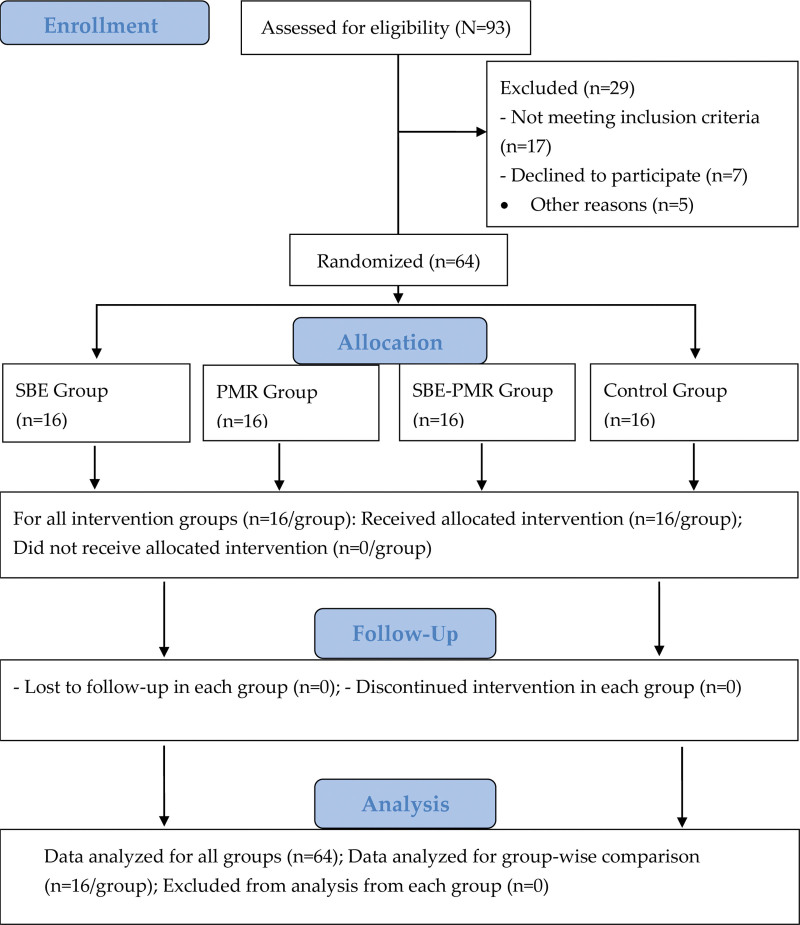
Sixty-four participants diagnosed with essential hypertension were randomly allocated into SBE, PMR, SBE-PMR, and Control groups, with 16 subjects each. All 3 groups received different treatments according to their name; however, the Control group received no treatment. Systolic and diastolic BP (SBP and DBP), HR, RR, and anxiety were all evaluated as the study outcomes using a digital sphygmomanometer and perceived stress scale (PSS) at baseline (pretest), 2nd week and 4th weeks post-intervention. A repeated measure analysis of variance test assessed intra-group comparison (overall) analyses across multiple time points. Bonferroni multiple comparison tests were used to analyze the mean differences between the groups. The confidence interval was kept at 95% for all the statistical analyses, that is, P < .05 is considered significant.
There was a significant change in the HR (F = 239.04, P = .0001), RR (F = 167.74, P = .0001), SBP (F = 266.64, P = .0001), DSP (F = 279.80, P = .0001), and PSS (F = 473.42, P = .0001) as an outcome of baseline measurements versus (vs) the following weeks. There were significant (F = 48.57, P = .001) differences among different training on HR. The SBE vs SBE-PMR showed an insignificant difference (F = 48.54, P = 1.000). The RR showed significant differences (F = 32.05, 0.0001) between the SBE vs PMR, SBE vs Control, PMR vs Control, and SBE-PMR vs Control groups and insignificant differences for the SBE vs SBE-PMR and PMR vs SBE-PMR groups. The SBE vs SBE-PMR groups showed insignificant differences for DPP and SBP. However, PSS showed significant differences (F = 67.12, P = .0001) among the intervention groups except for the PMR and SBE-PMR groups.
The combined interventions of SBEs and progressive muscle relaxation techniques can effectively reduce the heart rate, respiratory rate, BP, and anxiety in essential hypertensive patients compared to both techniques when given alone.
本研究旨在探讨深呼吸运动(SBE)与渐进性肌肉放松(PMR)技术联合对原发性高血压患者血压(BP)、心率(HR)、呼吸频率(RR)和焦虑的影响。
本研究基于 4 臂平行组、随机对照设计。
将 64 名被诊断为原发性高血压的患者随机分为 SBE、PMR、SBE-PMR 和对照组,每组 16 名患者。根据名称,所有 3 组均接受不同的治疗;然而,对照组未接受任何治疗。使用数字血压计和感知压力量表(PSS)在基线(预测试)、第 2 周和第 4 周干预后评估收缩压和舒张压(SBP 和 DBP)、HR、RR 和焦虑作为研究结果。重复测量方差分析检验评估了多个时间点的组内比较(整体)分析。采用 Bonferroni 多重比较检验分析组间均值差异。所有统计分析的置信区间保持在 95%,即 P <.05 被认为具有统计学意义。
HR(F = 239.04,P =.0001)、RR(F = 167.74,P =.0001)、SBP(F = 266.64,P =.0001)、DSP(F = 279.80,P =.0001)和 PSS(F = 473.42,P =.0001)作为基线测量结果与随后几周的结果相比均有显著变化。HR 方面存在显著差异(F = 48.57,P =.001)。SBE 与 SBE-PMR 之间无显著差异(F = 48.54,P = 1.000)。RR 显示 SBE 与 PMR、SBE 与对照组、PMR 与对照组以及 SBE-PMR 与对照组之间存在显著差异,而 SBE 与 SBE-PMR 和 PMR 与 SBE-PMR 之间无显著差异。SBE 与 SBE-PMR 组之间 DPP 和 SBP 无显著差异。然而,除 PMR 和 SBE-PMR 组外,干预组之间的 PSS 差异有统计学意义(F = 67.12,P =.0001)。
与单独使用时相比,SBE 和渐进性肌肉放松技术的联合干预可以有效降低原发性高血压患者的心率、呼吸频率、血压和焦虑。