Padane Abdou, Tegally Houriiyah, Ramphal Yajna, Seyni Ndiaye, Sarr Mariéma, Diop Mame Matar, Diedhiou Cyrille Kouligueul, Mboup Aminata, Diouf Ndèye Dieyna, Souaré Abdoulaye, Diagne Ndéye Diabou, Aza-Gnandji Marilyne, Dabo Ndèye Astou, Dia Yacine Amet, Diaw Ndeye Aminata, Leye Nafissatou, Diaw Papa Alassane, Ahouidi Ambroise, Cissé Badara, Diallo Abdoulaye Samba, Diop Ousmane, Diallo Abdou Aziz, Ndoye Souadou, Sanko Tomasz J, Baxter Cheryl, Wilkinson Eduan, San James E, Tshabuila Derek, Naidoo Yeshnee, Pillay Sureshnee, Lessells Richard, Cissé Khady, Leye Abdoulaye, Mbaye Khalifa Ababacar, Kania Dramane, Tinto Bachirou, Traoré Isidore, Kagone Sampawendé Thérèse, Ouedraogo Abdoul Salam, Gifford Robert J, Lourenço José, Giovanetti Marta, Giandhari Jennifer, de Oliveira Tulio, Mboup Souleymane
Institut de Recherche en Santé, de Surveillance Épidémiologique et de Formation (IRESSEF), Dakar, Senegal.
Centre for Epidemic Response and Innovation (CERI), School of Data Science and Computational Thinking, Stellenbosch University, Stellenbosch 7600, South Africa.
medRxiv. 2023 Nov 15:2023.11.14.23298527. doi: 10.1101/2023.11.14.23298527.
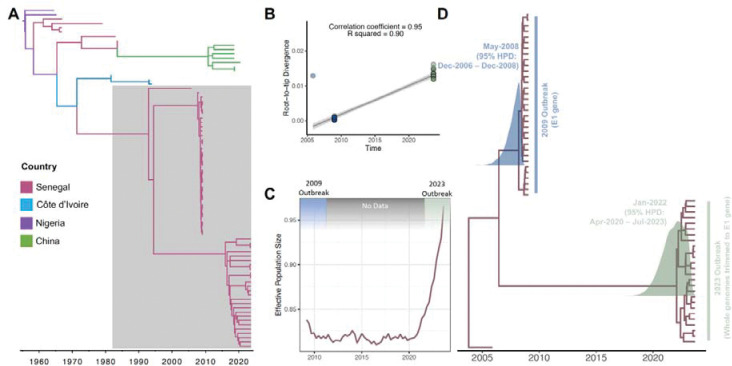
Chikungunya (CHIKV) is a re-emerging endemic arbovirus in West Africa. Since July 2023, Senegal and Burkina Faso have been experiencing an ongoing outbreak, with over 300 confirmed cases detected so far in the regions of Kédougou and Tambacounda in Senegal, the largest recorded outbreak yet. CHIKV is typically maintained in a sylvatic cycle in Senegal but its evolution and factors contributing to re-emergence are so far unknown in West Africa, leaving a gap in understanding and responding to recurrent epidemics. We produced, in real-time, the first locally-generated and publicly available CHIKV whole genomes in West Africa, to characterize the genetic diversity of circulating strains, along with phylodynamic analysis to estimate time of emergence and population growth dynamics. A novel strain of the West African genotype, phylogenetically distinct from strains circulating in previous outbreaks, was identified. This suggests a likely new spillover from sylvatic cycles in rural Senegal and potential of seeding larger epidemics in urban settings in Senegal and elsewhere.
基孔肯雅病毒(CHIKV)是西非一种再度出现的地方性虫媒病毒。自2023年7月以来,塞内加尔和布基纳法索一直处于持续疫情中,截至目前,在塞内加尔的凯杜古和坦巴昆达地区已检测到300多例确诊病例,这是有记录以来最大规模的疫情爆发。在塞内加尔,基孔肯雅病毒通常在野生环境中循环传播,但其进化以及导致再度出现的因素在西非至今仍不明确,这使得在理解和应对反复出现的疫情方面存在差距。我们实时产出了西非首个本地生成并公开可用的基孔肯雅病毒全基因组,以表征流行毒株的遗传多样性,并进行系统发育动力学分析,以估计病毒出现的时间和种群增长动态。我们鉴定出了一种新的西非基因型毒株,在系统发育上与先前疫情中传播的毒株不同。这表明可能是塞内加尔农村地区野生环境中的病毒出现了新的溢出,并有可能在塞内加尔及其他地区的城市环境中引发更大规模的疫情。