Kanakaraj Praitayini, Yao Tianyuan, Cai Leon Y, Lee Ho Hin, Newlin Nancy R, Kim Michael E, Gao Chenyu, Pechman Kimberly R, Archer Derek, Hohman Timothy, Jefferson Angela, Beason-Held Lori L, Resnick Susan M, Garyfallidis Eleftherios, Anderson Adam, Schilling Kurt G, Landman Bennett A, Moyer Daniel
Department of Computer Science, Vanderbilt University, Nashville, TN, USA.
Department of Biomedical Engineering, Vanderbilt University, Nashville, TN, USA.
Res Sq. 2023 Nov 13:rs.3.rs-3585882. doi: 10.21203/rs.3.rs-3585882/v1.
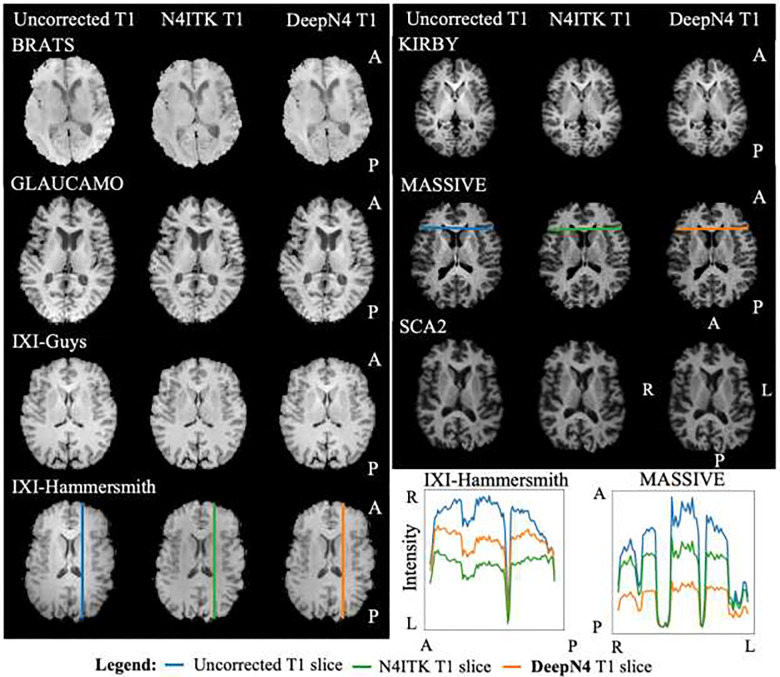
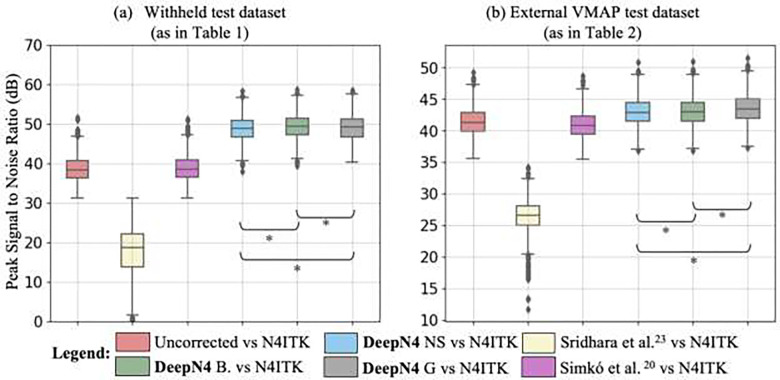
T1-weighted (T1w) MRI has low frequency intensity artifacts due to magnetic field inhomogeneities. Removal of these biases in T1w MRI images is a critical preprocessing step to ensure spatially consistent image interpretation. N4ITK bias field correction, the current state-of-the-art, is implemented in such a way that makes it difficult to port between different pipelines and workflows, thus making it hard to reimplement and reproduce results across local, cloud, and edge platforms. Moreover, N4ITK is opaque to optimization before and after its application, meaning that methodological development must work around the inhomogeneity correction step. Given the importance of bias fields correction in structural preprocessing and flexible implementation, we pursue a deep learning approximation / reinterpretation of the N4ITK bias fields correction to create a method which is portable, flexible, and fully differentiable. In this paper, we trained a deep learning network "DeepN4" on eight independent cohorts from 72 different scanners and age ranges with N4ITK-corrected T1w MRI and bias field for supervision in log space. We found that we can closely approximate N4ITK bias fields correction with naïve networks. We evaluate the peak signal to noise ratio (PSNR) in test dataset against the N4ITK corrected images. The median PSNR of corrected images between N4ITK and DeepN4 was 47.96 dB. In addition, we assess the DeepN4 model on eight additional external datasets and show the generalizability of the approach. This study establishes that incompatible N4ITK preprocessing steps can be closely approximated by naïve deep neural networks, facilitating more flexibility. All code and models are released at https://github.com/MASILab/DeepN4.
T1加权(T1w)磁共振成像(MRI)由于磁场不均匀性会产生低频强度伪影。去除T1w MRI图像中的这些偏差是确保空间一致的图像解释的关键预处理步骤。N4ITK偏差场校正作为当前的先进技术,其实现方式使得在不同的管道和工作流程之间移植变得困难,因此难以在本地、云和边缘平台上重新实现并重现结果。此外,N4ITK在应用前后对优化是不透明的,这意味着方法学的发展必须围绕不均匀性校正步骤进行。鉴于偏差场校正在结构预处理和灵活实现中的重要性,我们寻求对N4ITK偏差场校正进行深度学习近似/重新解释,以创建一种可移植、灵活且完全可微的方法。在本文中,我们使用经过N4ITK校正的T1w MRI和对数空间中的偏差场作为监督,在来自72台不同扫描仪和不同年龄范围的八个独立队列上训练了一个深度学习网络“DeepN4”。我们发现,我们可以用简单的网络紧密近似N4ITK偏差场校正。我们在测试数据集中针对N4ITK校正后的图像评估峰值信噪比(PSNR)。N4ITK和DeepN4校正图像的PSNR中位数为47.96 dB。此外,我们在另外八个外部数据集上评估了DeepN4模型,并展示了该方法的通用性。这项研究表明,不兼容的N4ITK预处理步骤可以通过简单的深度神经网络紧密近似,从而提高了灵活性。所有代码和模型都在https://github.com/MASILab/DeepN4上发布。