Department of Extracorporeal Life Support Center, The First Affiliated Hospital of Zhengzhou University, Zhengzhou, China.
Department of Cardiology, The First Affiliated Hospital of Zhengzhou University, Zhengzhou, China.
Immun Inflamm Dis. 2023 Nov;11(11):e1050. doi: 10.1002/iid3.1050.
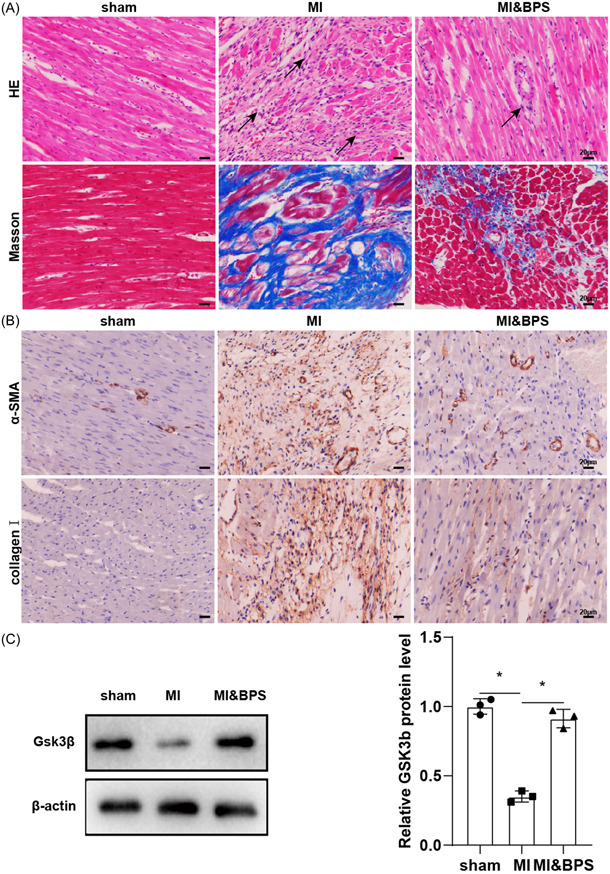
The aim of this study was to elucidate the mechanism of beraprost sodium (BPS) in the intervention of myocardial fibrosis after myocardial infarction (MI) through glycogen synthase kinase-3β (GSK-3β) and to provide new ideas for intervention in myocardial fibrosis.
MI model rats given BPS and cardiac fibroblasts (CFs) treated with BPS and TGF-β. HE staining and Masson staining were used to detect the pathological changes of myocardial tissue. Fibrotic markers were detected by immunohistochemical staining. The expressions of GSK-3β, cAMP response element binding protein (CREB), and p-CREB were analyzed by qPCR and western blot analysis. EDU staining was used to detect the proliferation of CFs. The promoter activity of GSK-3β was detected by luciferase assay. Chromatin immunoprecipitation assay was used to detect the binding levels of GSK-3β promoter and Y-box binding protein 1 (YBX1). The levels of intracellular cyclic adenosine monophosphate (cAMP) were analyzed by enzyme-linked immunosorbent assay (ELISA).
After operation, BPS improved myocardial fibrosis and upregulated GSK-3β protein expression in male SD rats. BPS can down-regulate α-smooth muscle actin (α-SMA) level and up-regulate GSK-3β protein expression in CFs after TGF-β stimulation. Furthermore, GSK-3β knockdown can reverse the effect of BPS on TGF-β-activated CFs, enhance α-SMA expression, and promote the proliferation of CFs. BPS could regulate GSK-3β expression by promoting the binding of GSK-3β promoter to YBX1. BPS induced upregulation of p-CREB and cAMP, resulting in reduced fibrosis, which was reversed by the knockdown of GSK-3β or prostaglandin receptor (IPR) antagonists.
BPS treatment increased the binding of YBX1 to the GSK-3β promoter, and GSK-3β protein expression was upregulated, which further caused the upregulation of p-CREB and cAMP, and finally inhibited myocardial fibrosis.
本研究旨在通过糖原合成酶激酶-3β(GSK-3β)阐明贝前列素钠(BPS)干预心肌梗死后心肌纤维化的机制,为心肌纤维化的干预提供新的思路。
给予 MI 模型大鼠 BPS 处理和 TGF-β刺激的心脏成纤维细胞(CFs)给予 BPS 处理。HE 染色和 Masson 染色用于检测心肌组织的病理变化。免疫组织化学染色检测纤维化标志物。qPCR 和 Western blot 分析检测 GSK-3β、cAMP 反应元件结合蛋白(CREB)和 p-CREB 的表达。EDU 染色检测 CFs 的增殖。通过荧光素酶测定法检测 GSK-3β启动子的启动子活性。染色质免疫沉淀测定法检测 GSK-3β启动子与 Y 盒结合蛋白 1(YBX1)的结合水平。通过酶联免疫吸附测定(ELISA)分析细胞内环磷酸腺苷(cAMP)的水平。
手术后,BPS 改善了雄性 SD 大鼠的心肌纤维化并上调了 GSK-3β 蛋白表达。BPS 可下调 TGF-β刺激后 CFs 中的α-平滑肌肌动蛋白(α-SMA)水平并上调 GSK-3β 蛋白表达。此外,GSK-3β 敲低可逆转 BPS 对 TGF-β 激活的 CFs 的作用,增强 α-SMA 表达,并促进 CFs 的增殖。BPS 可通过促进 GSK-3β 启动子与 YBX1 的结合来调节 GSK-3β 的表达。BPS 诱导 p-CREB 和 cAMP 的上调,导致纤维化减少,而 GSK-3β 的敲低或前列腺素受体(IPR)拮抗剂的使用则会逆转这种情况。
BPS 处理增加了 YBX1 与 GSK-3β 启动子的结合,上调了 GSK-3β 蛋白表达,进而导致 p-CREB 和 cAMP 的上调,最终抑制了心肌纤维化。