The First Hospital of Hunan University of Chinese Medicine, Changsha, Hunan, China.
Graduate School of Hunan University of Chinese Medicine, Changsha, Hunan, China.
PLoS One. 2023 Nov 29;18(11):e0292113. doi: 10.1371/journal.pone.0292113. eCollection 2023.
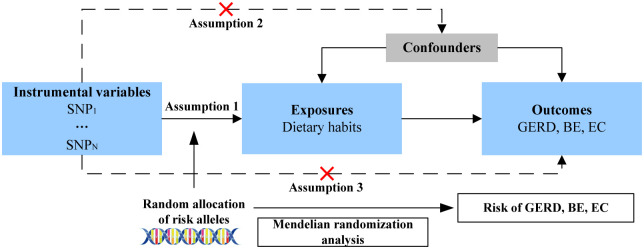
Using Mendelian randomization (MR) approach, our objective was to determine whether there was a causal association between dietary factors and gastroesophageal reflux disease (GERD), Barrett's esophagus (BE), or esophageal cancer (EC).
Genome-wide association study (GWAS) data for eighteen types of dietary intake were obtained from the UK Biobank. GWAS data for GERD, BE, and EC were sourced from the FinnGen consortium. We performed univariable and multivariable MR analysis to assess the cause effect between dietary factors and esophageal diseases. MR results were expressed as odds ratios (OR) with 95% confidence intervals (CI).
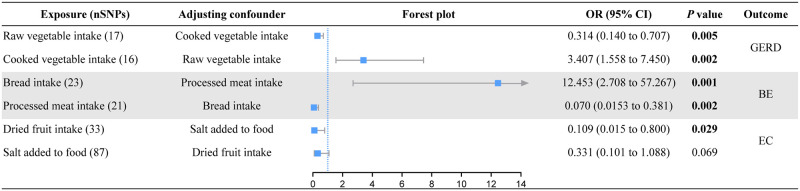
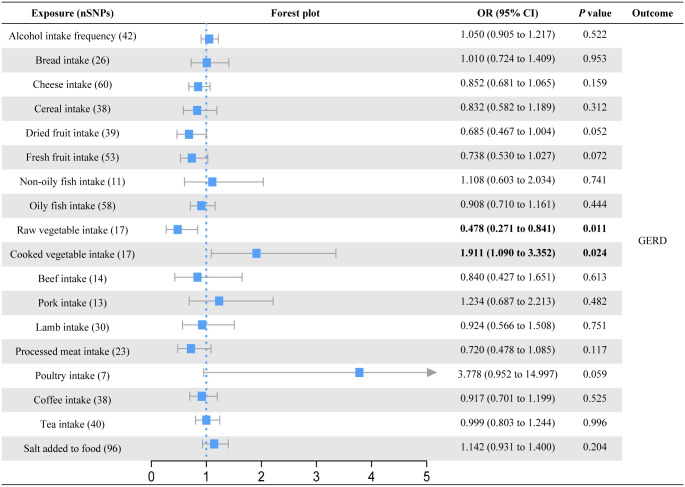
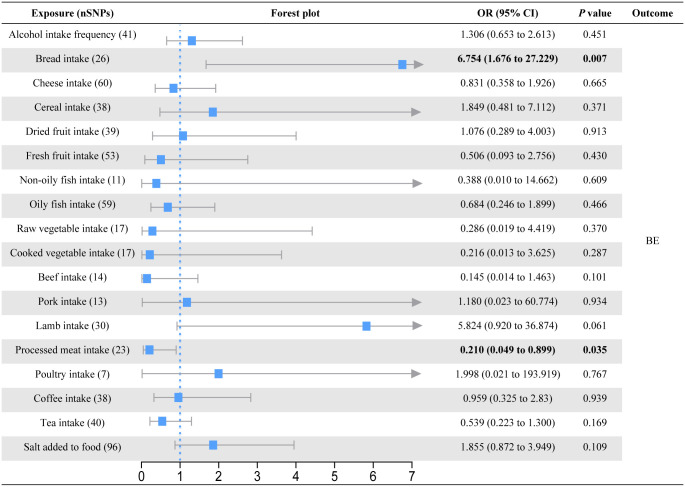
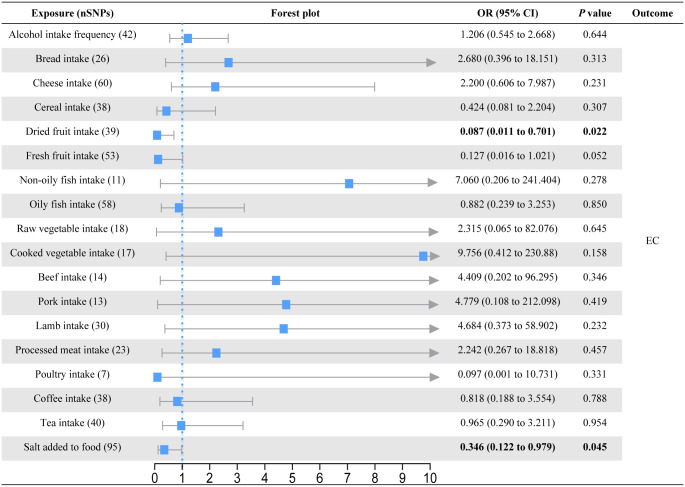
Raw vegetable intake was associated with a lower risk of GERD (OR = 0.478; P = 0.011). On the contrary, cooked vegetable intake increased the risk of GERD (OR = 1.911; P = 0.024). Bread intake was associated with increased odds of BE (OR = 6.754; P = 0.007), while processed meat intake was associated with reduced risk of BE (OR = 0.210; P = 0.035). We also observed evidence that increased consumption of dried fruit (OR = 0.087; P = 0.022) and salt added to food (OR = 0.346; P = 0.045) could prevent EC. The results of multivariable MR showed that the protective effect of consumption of salt added to food on EC was no longer significant after adjusting for the consumption of dried fruit.
Vegetable consumption was associated with GERD, whereas consumption of bread and processed meat was associated with BE. Dried fruit intake was associated with a lower risk of EC, and the protective effect of consumption of salt added food on EC may also be mediated by consumption of dried fruit. Future research should be performed to investigate the mechanisms behind these cause-and-effect relationships to reduce the burden of disease caused by dietary habits.
本研究采用孟德尔随机化(MR)方法,旨在确定饮食因素与胃食管反流病(GERD)、巴雷特食管(BE)或食管癌(EC)之间是否存在因果关联。
本研究从英国生物银行(UK Biobank)获取了 18 种饮食类型的全基因组关联研究(GWAS)数据。GERD、BE 和 EC 的 GWAS 数据来自芬兰遗传(FinnGen)联盟。我们进行了单变量和多变量 MR 分析,以评估饮食因素与食管疾病之间的因果关系。MR 结果表示为比值比(OR)及其 95%置信区间(CI)。
生蔬菜摄入量与 GERD 风险降低相关(OR=0.478;P=0.011)。相反,熟蔬菜摄入量增加 GERD 风险(OR=1.911;P=0.024)。面包摄入量与 BE 患病风险增加相关(OR=6.754;P=0.007),而加工肉类摄入量与 BE 患病风险降低相关(OR=0.210;P=0.035)。我们还观察到,增加干果(OR=0.087;P=0.022)和食物中添加盐(OR=0.346;P=0.045)的摄入量可能有助于预防 EC。多变量 MR 结果表明,在调整干果摄入量后,食物中添加盐的摄入量对 EC 的保护作用不再显著。
蔬菜摄入量与 GERD 相关,而面包和加工肉类的摄入量与 BE 相关。干果摄入量与 EC 风险降低相关,食物中添加盐的摄入量对 EC 的保护作用可能也与干果摄入量相关。未来的研究应进一步探讨这些因果关系背后的机制,以减轻饮食习惯导致的疾病负担。