
描述东非地区当前和未来气候条件下用于普通菜豆育种的季节性干旱胁迫模式。
Characterizing patterns of seasonal drought stress for use in common bean breeding in East Africa under present and future climates.
作者信息
Jha Prakash K, Beebe Steve, Alvarez-Toro Patricia, Mukankusi Clare, Ramirez-Villegas Julian
机构信息
International Center for Tropical Agriculture (CIAT), Km 17, Recta Cali-Palmira, Cali, Colombia.
Division of Agriculture and Natural Resources, University of California, Merced, CA, United States.
出版信息
Agric For Meteorol. 2023 Nov 15;342:109735. doi: 10.1016/j.agrformet.2023.109735.
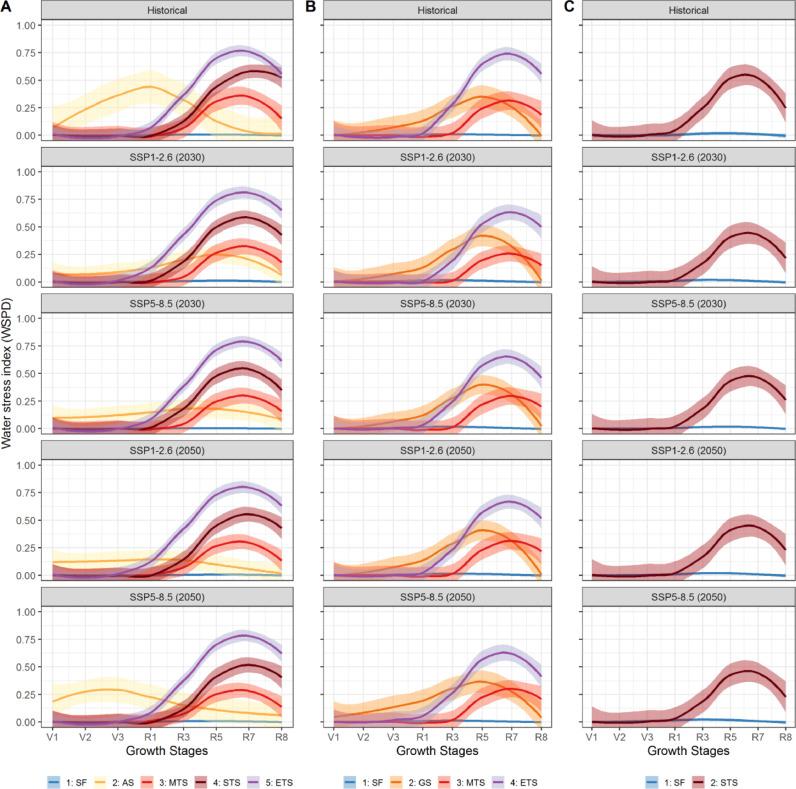
Common bean ( L.) is the second most important source of dietary protein and the third most important source of calories in Africa, especially for the poor. In East Africa, drought is an important constraint to bean production. Therefore, breeding programs in East Africa have been trying to develop drought resistant varieties of common bean. To do this, breeders need information about seasonal drought stress patterns including their onset, intensity, and duration in the target area of the breeding program, so that they can mimic this pattern during field trials. Using the Decision Support for Agrotechnology Transfer (DSSAT) v4.7 model together with historical and future (Coupled Model Inter-comparison Project 6, CMIP6) climate data, this study categorized Ethiopia, Tanzania, and Uganda into different target population of environments (TPEs) based on historical and future seasonal drought stress patterns. We find that stress-free conditions generally dominate across the three countries under historical conditions (50-80% frequency). These conditions are projected to increase in frequency in Ethiopia by 2-10% but the converse is true for Tanzania (2-8% reduction) and Uganda (17-20% reduction) by 2050 depending on the Shared Socioeconomic Pathway (SSP). Accordingly, by 2050, terminal drought stresses of various intensities (moderate, severe, extreme) are prevalent in 34% of Uganda, around a quarter of Ethiopia, and 40% of the bean growing environments in Tanzania. The TPEs identified in each country serve as a basis for prioritizing breeding activities in national programs. However, to optimize resource use in international breeding programs to develop genotypes that are resilient to future projected stress patterns, we argue that common bean breeding programs should focus primarily on identifying genotypes with tolerance to severe terminal drought, with co-benefits in relation to adaptation to moderate and extreme terminal drought. Little to no emphasis on heat stress is warranted by 2050s.
普通菜豆(Phaseolus vulgaris L.)是非洲第二重要的膳食蛋白质来源和第三重要的热量来源,对贫困人口尤为重要。在东非,干旱是菜豆生产的一个重要制约因素。因此,东非的育种计划一直在努力培育抗旱的普通菜豆品种。为此,育种者需要了解季节性干旱胁迫模式的信息,包括其在育种计划目标地区的开始时间、强度和持续时间,以便他们能够在田间试验中模拟这种模式。本研究使用农业技术转移决策支持(DSSAT)v4.7模型以及历史和未来(耦合模型比较计划6,CMIP6)气候数据,根据历史和未来季节性干旱胁迫模式,将埃塞俄比亚、坦桑尼亚和乌干达划分为不同的目标环境群体(TPEs)。我们发现,在历史条件下(频率为50 - 80%),三国普遍处于无胁迫状态。到2050年,根据共享社会经济路径(SSP),埃塞俄比亚这些条件的频率预计将增加2 - 10%,而坦桑尼亚(减少2 - 8%)和乌干达(减少17 - 20%)则相反。因此,到2050年,不同强度(中度、重度、极端)的终末干旱胁迫在乌干达34%的地区、埃塞俄比亚约四分之一的地区以及坦桑尼亚40%的菜豆种植环境中普遍存在。每个国家确定的TPEs为国家计划中的育种活动确定优先次序提供了基础。然而,为了优化国际育种计划中的资源利用,以培育适应未来预测胁迫模式的基因型,我们认为普通菜豆育种计划应主要侧重于鉴定对严重终末干旱具有耐受性的基因型,同时在适应中度和极端终末干旱方面具有协同效益。到2050年代,几乎不需要关注热胁迫。




 Zotero 插件