College of Agronomy, Department of Agricultural Entomology, Sichuan Agricultural University, Chegndu, Sichuan, China.
Department of Zoology, TKM College of Arts and Science, Kollam, Kerala, India.
PeerJ. 2023 Nov 27;11:e16461. doi: 10.7717/peerj.16461. eCollection 2023.
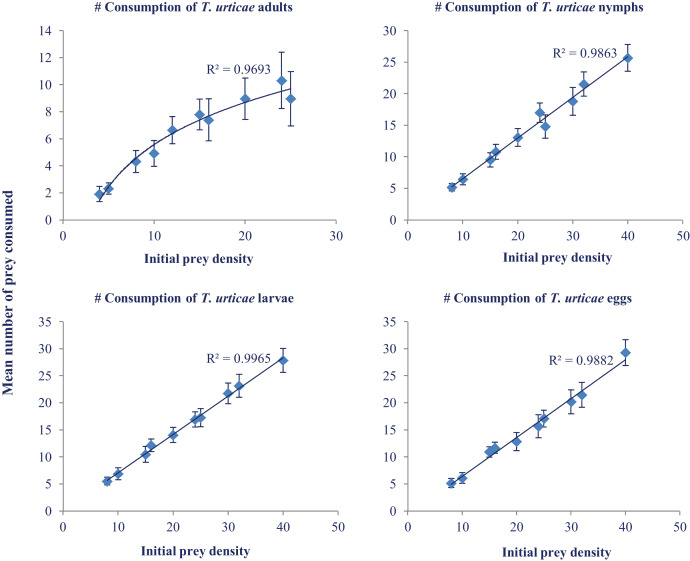
Environmental factors like temperature have a great impact on the predation potential of biological control agents. In the present study, the functional response of the predatory mite (Acari: Phytoseiidae) to the pest mite (Acari: Tetranychidae) at moderate to high temperatures under laboratory conditions was determined. The study aimed to understand the prey-predator interaction under different temperatures and prey densities. Five constant temperatures (24 °C, 27 °C, 30 °C, 33 °C, and 36 °C), and thirteen prey densities (4, 5, 8, 10, 12, 15, 16, 20, 24, 25, 30, 32, and 40) of each stage (adult, nymph, larvae, and egg stage) were employed in the experiment. Observations were made 24 h after the start of each experiment. Results revealed that the predatory mites showed type II functional response to adult females of , whereas type I to other stages (nymphs, larvae, and eggs) of . The predation capability of adult predatory mites on was significant at 24-36 °C. The instantaneous attack rate () of increased and the handling time () decreased with an increase in temperature. The maximum attack rate was recorded at 36 °C (1.28) for the egg stage. The longest handling time was (0.78) for the larval stage of at 30 °C. Daily consumption increased with increasing prey density. Maximum daily consumption was observed at 33 °C (30.00) at the prey density of 40. Searching efficiency decreased with the increase in prey density but was found to increase with the rise in temperature. was found to be voracious on the larval and egg stages. Conclusively, the incorporation of at earlier stages (larvae and eggs) of would be beneficial under warm conditions because managing a pest at its initial stage will save the crop from major losses. The results presented in this study at various temperatures will be helpful in different areas with different temperature extremes. The results of the functional response can also be applied to mass rearing, quality testing, and integrated pest management programmes.
环境因素,如温度,对生物防治剂的捕食潜力有很大的影响。本研究旨在探讨实验室条件下,捕食螨在中高温下对害螨(蜱螨目:植绥螨科)的功能反应。研究旨在了解不同温度和猎物密度下的猎物-捕食者相互作用。实验采用五个恒温(24°C、27°C、30°C、33°C 和 36°C)和 13 种猎物密度(每个阶段(成虫、若虫、幼虫和卵期)的 4、5、8、10、12、15、16、20、24、25、30、32 和 40)。每个实验开始后 24 小时进行观察。结果表明,捕食螨对 成虫表现出 II 型功能反应,而对其他阶段(若虫、幼虫和卵期)表现出 I 型功能反应。24-36°C 时,捕食螨对 成虫的捕食能力显著。捕食螨对 的瞬时攻击率(a)随着温度的升高而增加,处理时间(T)随着温度的升高而降低。在 36°C 时,卵期的最大攻击率记录为 1.28。30°C 时, 幼虫期的最长处理时间为 0.78。随着猎物密度的增加,日消耗量增加。在猎物密度为 40 时,在 33°C 时观察到最大日消耗量(30.00)。随着猎物密度的增加,搜索效率降低,但随着温度的升高而增加。 对幼虫和卵期特别贪婪。综上所述,在温暖条件下,在 早期阶段(幼虫和卵期)引入 将是有益的,因为在初始阶段管理害虫将使作物免受重大损失。本研究在不同温度下的功能反应结果将有助于不同温度极端地区。功能反应的结果也可以应用于大规模繁殖、质量测试和综合虫害管理计划。