THYROSCOPE INC., Ulsan, Republic of Korea.
Department of Internal Medicine, Seoul National University Bundang Hospital and Seoul National University College of Medicine, Seongnam, Republic of Korea.
Sci Rep. 2023 Nov 30;13(1):21096. doi: 10.1038/s41598-023-48199-x.
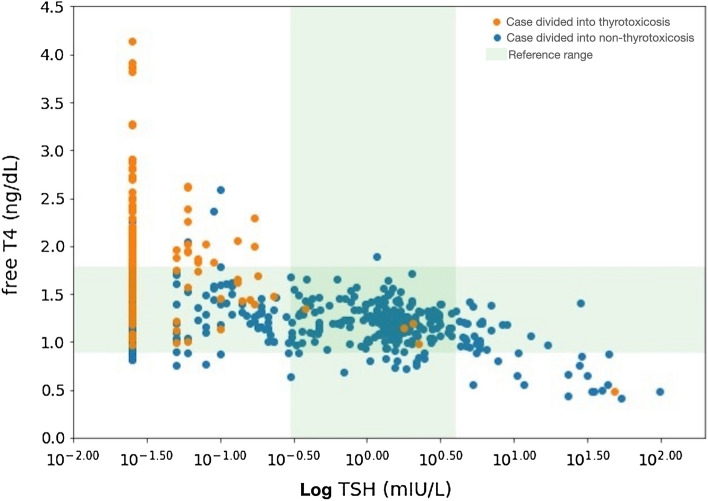
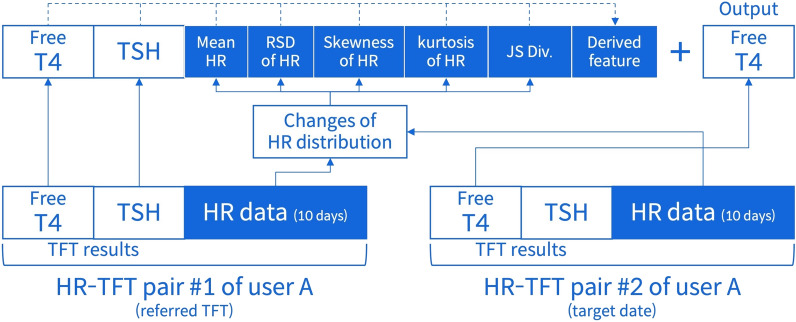
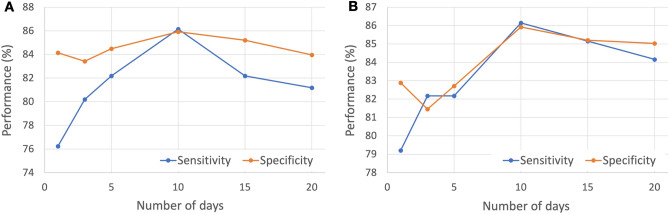
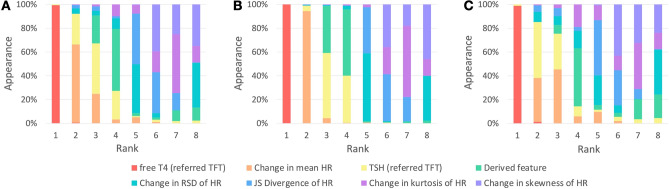
Previous studies have shown a correlation between resting heart rate (HR) measured by wearable devices and serum free thyroxine concentration in patients with thyroid dysfunction. We have developed a machine learning (ML)-assisted system that uses HR data collected from wearable devices to predict the occurrence of thyrotoxicosis in patients. HR monitoring data were collected using a wearable device for a period of 4 months in 175 patients with thyroid dysfunction. During this period, 3 or 4 thyroid function tests (TFTs) were performed on each patient at intervals of at least one month. The HR data collected during the 10 days prior to each TFT were paired with the corresponding TFT results, resulting in a total of 662 pairs of data. Our ML-assisted system predicted thyrotoxicosis of a patient at a given time point based on HR data and their HR-TFT data pair at another time point. Our ML-assisted system divided the 662 cases into either thyrotoxicosis and non-thyrotoxicosis and the performance was calculated based on the TFT results. The sensitivity, specificity, positive predictive value (PPV), and negative predictive value (NPV) of our system for predicting thyrotoxicosis were 86.14%, 85.92%, 52.41%, and 97.18%, respectively. When subclinical thyrotoxicosis was excluded from the analysis, the sensitivity, specificity, PPV, and NPV of our system for predicting thyrotoxicosis were 86.14%, 98.28%, 94.57%, and 95.32%, respectively. Our ML-assisted system used the change in mean, relative standard deviation, skewness, and kurtosis of HR while sleeping, and the Jensen-Shannon divergence of sleep HR and TFT distribution as major parameters for predicting thyrotoxicosis. Our ML-assisted system has demonstrated reasonably accurate predictions of thyrotoxicosis in patients with thyroid dysfunction, and the accuracy could be further improved by gathering more data. This predictive system has the potential to monitor the thyroid function status of patients with thyroid dysfunction by collecting heart rate data, and to determine the optimal timing for blood tests and treatment intervention.
先前的研究表明,可穿戴设备测量的静息心率(HR)与甲状腺功能障碍患者的血清游离甲状腺素浓度之间存在相关性。我们开发了一种机器学习(ML)辅助系统,该系统使用可穿戴设备收集的 HR 数据来预测甲状腺功能亢进症患者的发病情况。使用可穿戴设备收集了 175 例甲状腺功能障碍患者的 HR 监测数据,为期 4 个月。在此期间,对每位患者至少间隔一个月进行 3 或 4 次甲状腺功能测试(TFT)。在每次 TFT 前的 10 天内收集 HR 数据,并将相应的 TFT 结果与这些 HR 数据配对,共得到 662 对数据。我们的 ML 辅助系统根据 HR 数据和另一个时间点的相应 HR-TFT 数据对来预测患者在给定时间点的甲状腺功能亢进症。我们的 ML 辅助系统将 662 例病例分为甲状腺功能亢进症和非甲状腺功能亢进症,并根据 TFT 结果计算性能。我们的系统预测甲状腺功能亢进症的敏感性、特异性、阳性预测值(PPV)和阴性预测值(NPV)分别为 86.14%、85.92%、52.41%和 97.18%。当排除亚临床甲状腺功能亢进症进行分析时,我们的系统预测甲状腺功能亢进症的敏感性、特异性、PPV 和 NPV 分别为 86.14%、98.28%、94.57%和 95.32%。我们的 ML 辅助系统使用 HR 在睡眠期间的均值、相对标准偏差、偏度和峰度变化,以及睡眠 HR 和 TFT 分布的 Jensen-Shannon 散度作为主要参数来预测甲状腺功能亢进症。我们的 ML 辅助系统在预测甲状腺功能障碍患者的甲状腺功能亢进症方面表现出了相当准确的预测结果,通过收集更多的数据可以进一步提高准确性。该预测系统通过收集心率数据,有可能监测甲状腺功能障碍患者的甲状腺功能状态,并确定进行血液检查和治疗干预的最佳时机。