Department of Rehabilitation Medicine, Affiliated Qingdao Central Hospital of Qingdao University, Qingdao Cancer Hospital, Qingdao, Shandong Province, China.
Department of Pulmonary and Critial Care Medicine (PCCM), Affiliated Qingdao Central Hospital of Qingdao University, Qingdao Cancer Hospital, Qingdao, Shandong Province, China.
J Musculoskelet Neuronal Interact. 2023 Dec 1;23(4):498-505.
Osteoarthritis (OA) has been the common cause to lead to chronic pain. Transcranial direct current stimulation (tDCS) is effective in the treatment of chronic pain, but its analgesic mechanism is still unclear. This study observed the analgesic effects of tDCS in rats to explore the top-down analgesic modulation mechanism of tDCS.
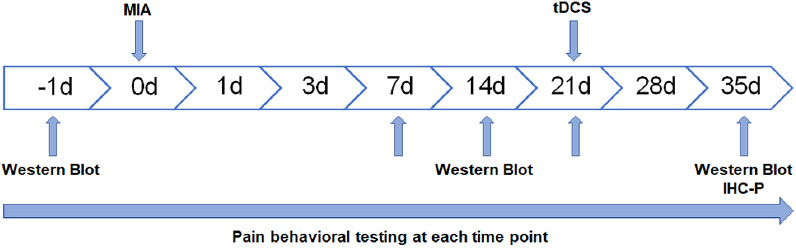
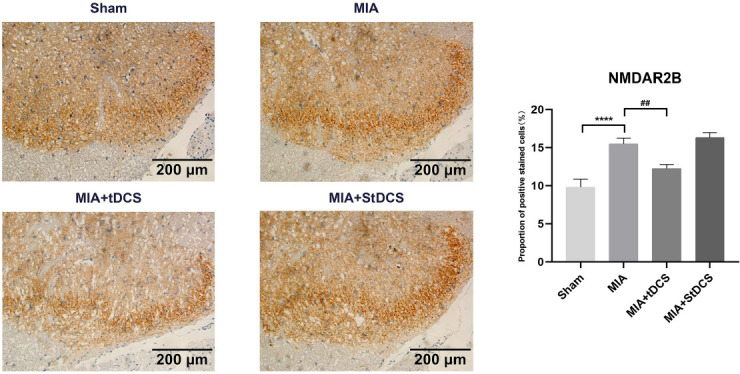
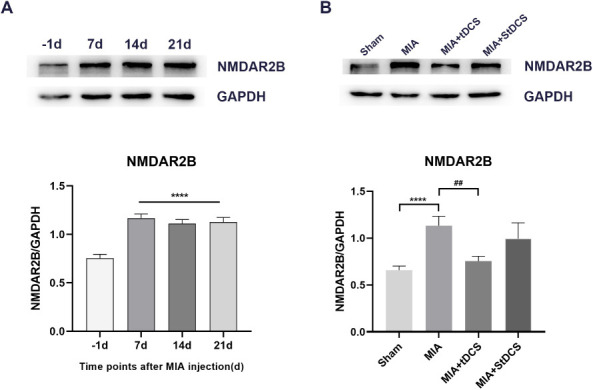
Monosodium iodoacetate (MIA) was used to establish OA chronic pain model. After 21 days, the rats received tDCS for 14 consecutive days (20 min/day). We assessed the pain-related behaviors of rats at different time points. Western blot and Immunohistochemistry were performed to observe the expression level of NMDAR2B in the spinal cord after tDCS treatment.
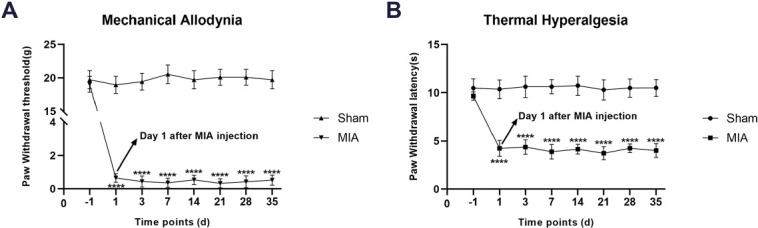
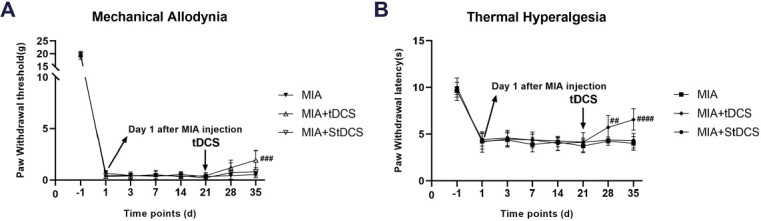
After MIA injection, rats developed apparent mechanical hyperalgesia and thermal hyperalgesia. However, the pain-related behaviors of rats were significantly improved after tDCS treatment. In addition, the expression of NMDAR2B and the proportion of positive stained cells of NMDAR2B were reversed by tDCS treatment.
The results demonstrated that tDCS can attenuate OA-induced chronic pain in rats via reducing NMDAR2B expressions in the spinal cord. We believe that this may be the result of tDCS participating in the top-down modulation of pain pathway in the endogenous analgesic system.
骨关节炎(OA)是导致慢性疼痛的常见原因。经颅直流电刺激(tDCS)在治疗慢性疼痛方面有效,但其镇痛机制尚不清楚。本研究观察 tDCS 对大鼠的镇痛作用,以探讨 tDCS 的自上而下镇痛调制机制。
采用碘乙酸单钠(MIA)建立 OA 慢性疼痛模型。21 天后,大鼠接受 tDCS 治疗 14 天(每天 20 分钟)。我们在不同时间点评估大鼠的疼痛相关行为。Western blot 和免疫组织化学观察 tDCS 治疗后脊髓中 NMDAR2B 的表达水平。
MIA 注射后,大鼠出现明显的机械性痛觉过敏和热痛觉过敏。然而,tDCS 治疗后大鼠的疼痛相关行为明显改善。此外,tDCS 治疗可逆转 NMDAR2B 的表达和 NMDAR2B 阳性染色细胞的比例。
结果表明,tDCS 通过降低脊髓中 NMDAR2B 的表达来减轻大鼠 OA 诱导的慢性疼痛。我们认为,这可能是 tDCS 参与内源性镇痛系统中疼痛通路的自上而下调制的结果。