
哈里亚纳邦索纳帕特地区与女性不孕症相关的生殖风险因素:一项基于社区的横断面研究。
Reproductive Risk Factors Associated with Female Infertility in Sonepat District of Haryana: A Community Based Cross-Sectional Study.
作者信息
Kataria Deepika, Rani Babita, Punia Anita, Jha S K, Narendran M, Singh Jagmohan
机构信息
Department of Community Medicine, BPS GMC (W), Sonepat, Haryana, India.
出版信息
J Hum Reprod Sci. 2023 Jul-Sep;16(3):204-211. doi: 10.4103/jhrs.jhrs_82_23. Epub 2023 Sep 29.
BACKGROUND
Infertility is a disease of the male or female reproductive system defined by the failure to achieve a pregnancy after 12 months or more of regular unprotected sexual intercourse.
AIMS
The aim of this study was to estimate the prevalence of infertility and its association with reproductive risk factors amongst women of reproductive age group (18-49 years) in district Sonepat, Haryana.
SETTINGS AND DESIGN
This observational community-based cross-sectional study was conducted amongst 444 reproductive age group (18-49 years) women residing in district Sonepat, from August 2021 to May 2022.
MATERIALS AND METHODS
A simple random sampling technique was used to select the study subjects. After taking written informed consent, all the participants were interviewed using a pre-designed, pre-tested semi-structured questionnaire for desired information.
STATISTICAL ANALYSIS USED
Mean and standard deviation (SD) were calculated for quantitative data. Percentages and proportions were calculated for qualitative data.
RESULTS
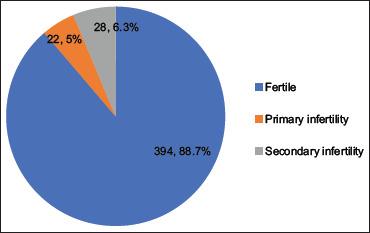
Out of 444 study population, majority of women were fertile (88.7%), while 6.3% of women were secondary infertile and 5% of women were primary infertile. Most women were aged between 30 and 39 years. The difference of occurrence of infertility in relation to genital discharge ( = 0.049), genital ulcer/sores ( ≤ 0.001), groin swelling ( ≤ 0.001), warts ( = 0.015), menstrual cycle duration ( ≤ 0.001) and menstrual flow amount ( = 0.048) was statistically significant. The mean age of menarche for the female with infertility was 14.34 years (standard deviation = 1.40).
CONCLUSION
Almost all of the symptoms of sexually transmitted infection/reproductive tract infection were high amongst infertile females. Awareness generation about the preventable risk factors and provision of infertility care services at primary healthcare facilities will be of use in addressing infertility in Sonepat.
背景
不孕症是一种男性或女性生殖系统疾病,定义为在规律无保护性交12个月或更长时间后仍未怀孕。
目的
本研究的目的是估计哈里亚纳邦索纳帕特地区育龄组(18 - 49岁)女性中不孕症的患病率及其与生殖风险因素的关联。
设置与设计
本基于社区的观察性横断面研究于2021年8月至2022年5月在索纳帕特地区居住的444名育龄组(18 - 49岁)女性中进行。
材料与方法
采用简单随机抽样技术选择研究对象。在获得书面知情同意后,使用预先设计、预先测试的半结构化问卷对所有参与者进行访谈以获取所需信息。
所用统计分析方法
对定量数据计算均值和标准差(SD)。对定性数据计算百分比和比例。
结果
在444名研究人群中,大多数女性可生育(88.7%),而6.3%的女性为继发性不孕,5%的女性为原发性不孕。大多数女性年龄在30至39岁之间。不孕症的发生在与白带异常(P = 0.049)、生殖器溃疡/疮(P≤0.001)、腹股沟肿胀(P≤0.001)、疣(P = 0.015)、月经周期时长(P≤0.001)和月经量(P = 0.048)方面的差异具有统计学意义。不孕女性的初潮平均年龄为14.34岁(标准差 = 1.40)。
结论
不孕女性中几乎所有性传播感染/生殖道感染症状的发生率都很高。提高对可预防风险因素的认识并在初级卫生保健机构提供不孕症护理服务,将有助于解决索纳帕特地区的不孕症问题。

 Zotero 插件