Department of Endocrinology, Shandong Provincial Hospital, Shandong University, Jinan, Shandong, China.
Key Laboratory of Endocrine Glucose & Lipids Metabolism and Brain Aging, Ministry of Education; Department of Endocrinology, Shandong Provincial Hospital Affiliated to Shandong First Medical University, Jinan, Shandong, China.
Clin Mol Hepatol. 2024 Jan;30(1):80-97. doi: 10.3350/cmh.2023.0343. Epub 2023 Dec 7.
BACKGROUND/AIMS: To evaluate the causal correlation between complement components and non-viral liver diseases and their potential use as druggable targets.
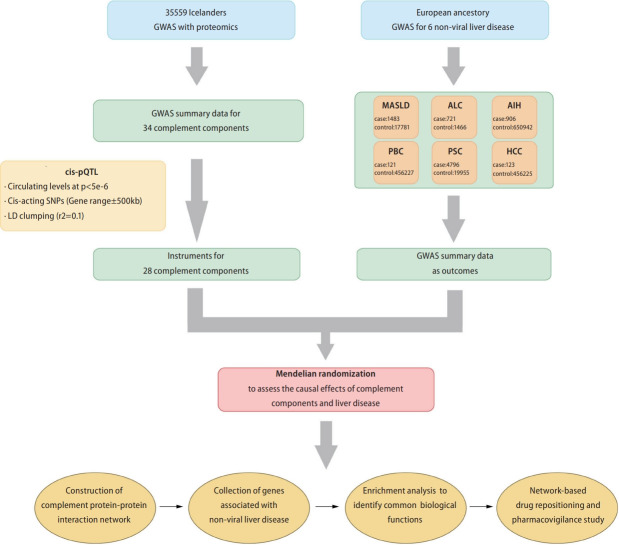
We conducted Mendelian randomization (MR) to assess the causal role of circulating complements in the risk of non-viral liver diseases. A complement-centric protein interaction network was constructed to explore biological functions and identify potential therapeutic options.
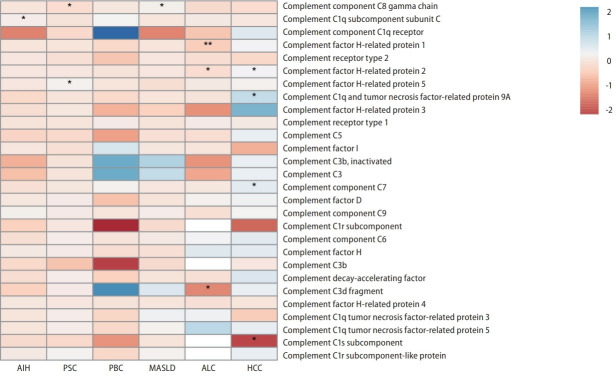
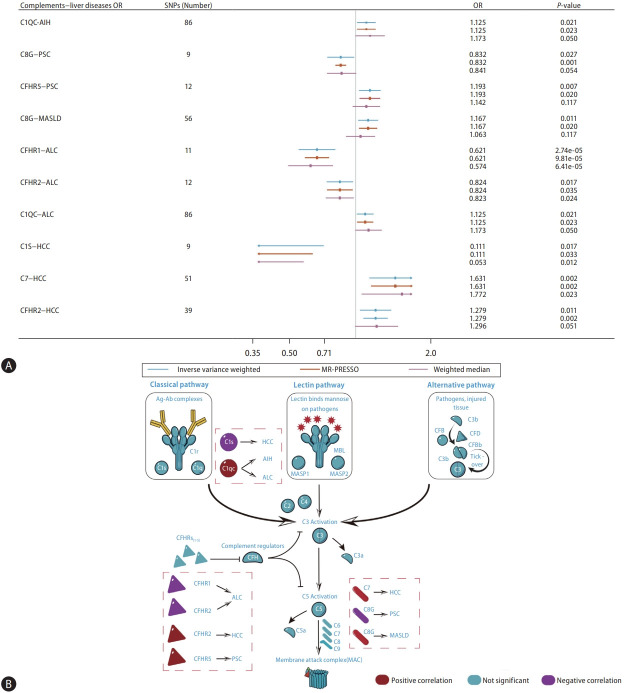
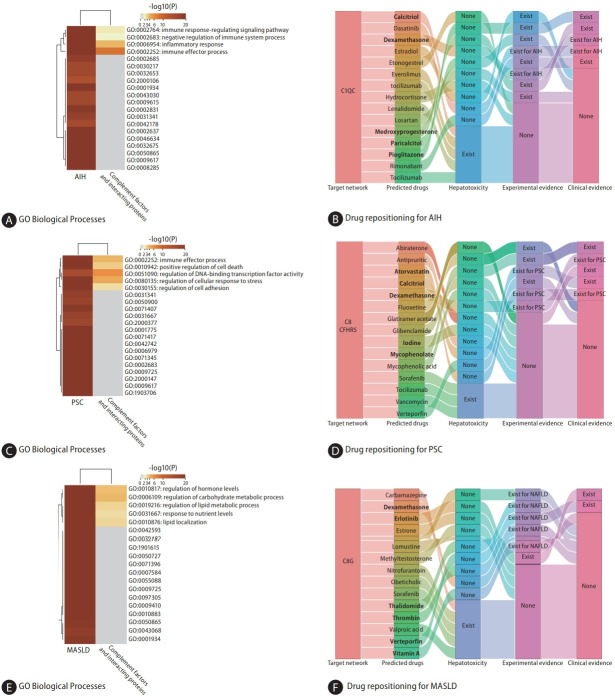
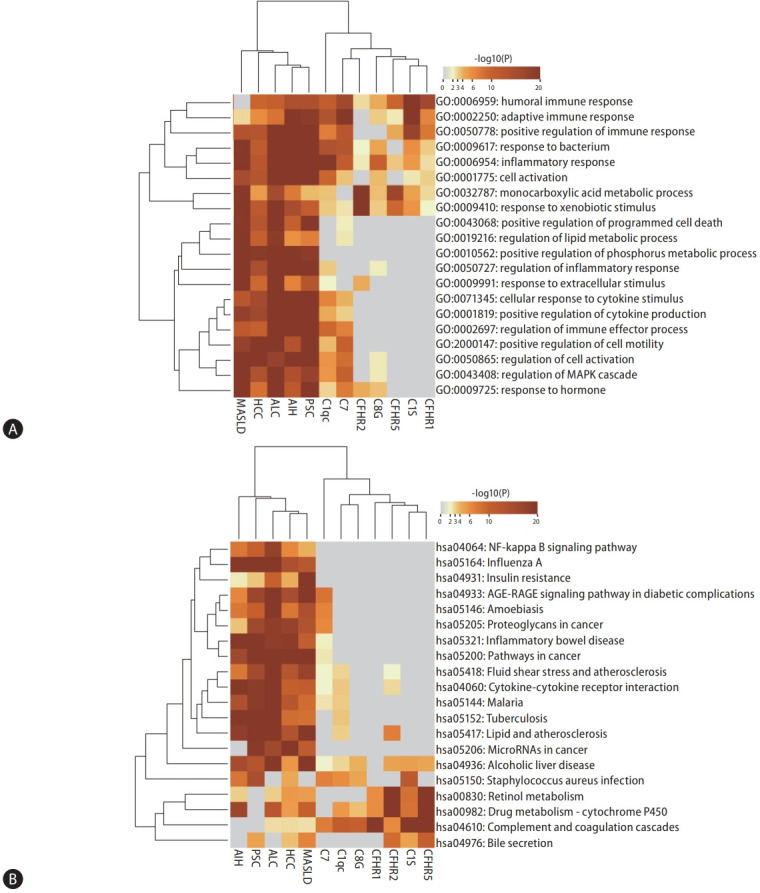
In the MR analysis, genetically predicted levels of complement C1q C chain (C1QC) were positively associated with the risk of autoimmune hepatitis (odds ratio 1.125, 95% confidence interval 1.018-1.244), while complement factor H-related protein 5 (CFHR5) was positively associated with the risk of primary sclerosing cholangitis (PSC;1.193, 1.048- 1.357). On the other hand, CFHR1 (0.621, 0.497-0.776) and CFHR2 (0.824, 0.703-0.965) were inversely associated with the risk of alcohol-related cirrhosis. There were also significant inverse associations between C8 gamma chain (C8G) and PSC (0.832, 0.707-0.979), as well as the risk of metabolic dysfunction-associated steatotic liver disease (1.167, 1.036-1.314). Additionally, C1S (0.111, 0.018-0.672), C7 (1.631, 1.190-2.236), and CFHR2 (1.279, 1.059-1.546) were significantly associated with the risk of hepatocellular carcinoma. Proteins from the complement regulatory networks and various liver diseaserelated proteins share common biological processes. Furthermore, potential therapeutic drugs for various liver diseases were identified through drug repurposing based on the complement regulatory network.
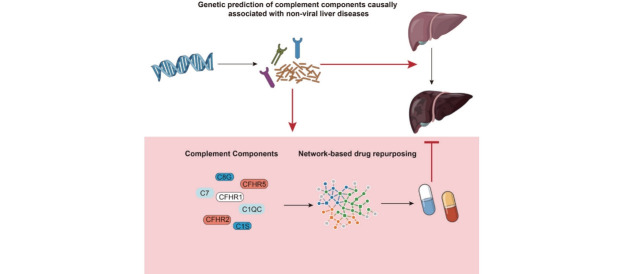
Our study suggests that certain complement components, including C1S, C1QC, CFHR1, CFHR2, CFHR5, C7, and C8G, might play a role in non-viral liver diseases and could be potential targets for drug development.
背景/目的:评估补体成分与非病毒性肝病之间的因果关联及其作为潜在治疗靶点的应用。
我们进行了孟德尔随机化(MR)分析,以评估循环补体在非病毒性肝病风险中的因果作用。构建了一个以补体为中心的蛋白质相互作用网络,以探索生物学功能并确定潜在的治疗选择。
在 MR 分析中,遗传预测的补体 C1q C 链(C1QC)水平与自身免疫性肝炎的风险呈正相关(比值比 1.125,95%置信区间 1.018-1.244),而补体因子 H 相关蛋白 5(CFHR5)与原发性硬化性胆管炎(PSC;1.193,1.048-1.357)的风险呈正相关。另一方面,CFHR1(0.621,0.497-0.776)和 CFHR2(0.824,0.703-0.965)与酒精相关肝硬化的风险呈负相关。C8γ链(C8G)与 PSC(0.832,0.707-0.979)以及代谢功能障碍相关脂肪性肝病(1.167,1.036-1.314)的风险之间也存在显著的负相关关系。此外,C1S(0.111,0.018-0.672)、C7(1.631,1.190-2.236)和 CFHR2(1.279,1.059-1.546)与肝细胞癌的风险显著相关。来自补体调节网络和各种肝病相关蛋白的蛋白质具有共同的生物学过程。此外,通过基于补体调节网络的药物再利用,确定了各种肝病的潜在治疗药物。
我们的研究表明,某些补体成分,包括 C1S、C1QC、CFHR1、CFHR2、CFHR5、C7 和 C8G,可能在非病毒性肝病中发挥作用,并且可能成为药物开发的潜在靶点。