Bowden Molly, Beswick Emily, Tam Johnny, Perry David, Smith Alice, Newton Judy, Chandran Siddharthan, Watts Oliver, Pal Suvankar
College of Medicine and Veterinary Medicine, University of Edinburgh, Edinburgh, UK.
Anne Rowling Regenerative Neurology Clinic, University of Edinburgh, Edinburgh, UK.
NPJ Digit Med. 2023 Dec 7;6(1):228. doi: 10.1038/s41746-023-00959-9.
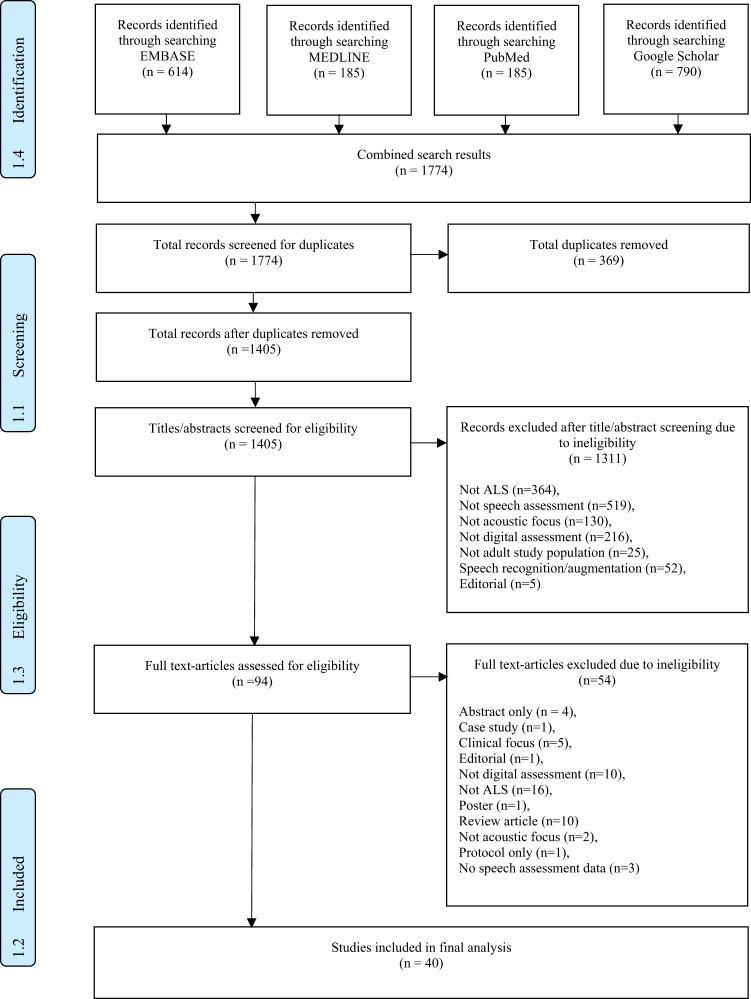
Motor Neuron Disease (MND) is a progressive and largely fatal neurodegeneritve disorder with a lifetime risk of approximately 1 in 300. At diagnosis, up to 25% of people with MND (pwMND) exhibit bulbar dysfunction. Currently, pwMND are assessed using clinical examination and diagnostic tools including the ALS Functional Rating Scale Revised (ALS-FRS(R)), a clinician-administered questionnaire with a single item on speech intelligibility. Here we report on the use of digital technologies to assess speech features as a marker of disease diagnosis and progression in pwMND. Google Scholar, PubMed, Medline and EMBASE were systematically searched. 40 studies were evaluated including 3670 participants; 1878 with a diagnosis of MND. 24 studies used microphones, 5 used smartphones, 6 used apps, 2 used tape recorders and 1 used the Multi-Dimensional Voice Programme (MDVP) to record speech samples. Data extraction and analysis methods varied but included traditional statistical analysis, CSpeech, MATLAB and machine learning (ML) algorithms. Speech features assessed also varied and included jitter, shimmer, fundamental frequency, intelligible speaking rate, pause duration and syllable repetition. Findings from this systematic review indicate that digital speech biomarkers can distinguish pwMND from healthy controls and can help identify bulbar involvement in pwMND. Preliminary evidence suggests digitally assessed acoustic features can identify more nuanced changes in those affected by voice dysfunction. No one digital speech biomarker alone is consistently able to diagnose or prognosticate MND. Further longitudinal studies involving larger samples are required to validate the use of these technologies as diagnostic tools or prognostic biomarkers.
运动神经元病(MND)是一种进行性且大多致命的神经退行性疾病,终生患病风险约为1/300。在确诊时,高达25%的运动神经元病患者(pwMND)表现出延髓功能障碍。目前,对pwMND的评估采用临床检查和诊断工具,包括修订版肌萎缩侧索硬化功能评定量表(ALS-FRS(R)),这是一份由临床医生填写的问卷,其中有一项关于言语清晰度的内容。在此,我们报告使用数字技术评估言语特征作为pwMND疾病诊断和进展标志物的情况。我们系统检索了谷歌学术、PubMed、Medline和EMBASE。评估了40项研究,包括3670名参与者;其中1878人被诊断为MND。24项研究使用了麦克风,5项使用了智能手机,6项使用了应用程序,2项使用了录音机,1项使用了多维度嗓音程序(MDVP)来记录言语样本。数据提取和分析方法各不相同,但包括传统统计分析、CSpeech、MATLAB和机器学习(ML)算法。所评估的言语特征也各不相同,包括抖动、闪烁、基频、可理解语速、停顿持续时间和音节重复。这项系统评价的结果表明,数字言语生物标志物可以区分pwMND与健康对照,并有助于识别pwMND中的延髓受累情况。初步证据表明,数字评估的声学特征可以识别受语音功能障碍影响者更细微的变化。没有一种单一的数字言语生物标志物能够始终如一地诊断或预测MND。需要进行涉及更大样本的进一步纵向研究,以验证这些技术作为诊断工具或预后生物标志物的用途。