Department of Chemical and Biomolecular Engineering, Yonsei University, Seoul, 03722, Republic of Korea.
Division of Bioengineering, Incheon National University, Incheon, 22012, Republic of Korea.
Nat Commun. 2023 Dec 9;14(1):8153. doi: 10.1038/s41467-023-43995-5.
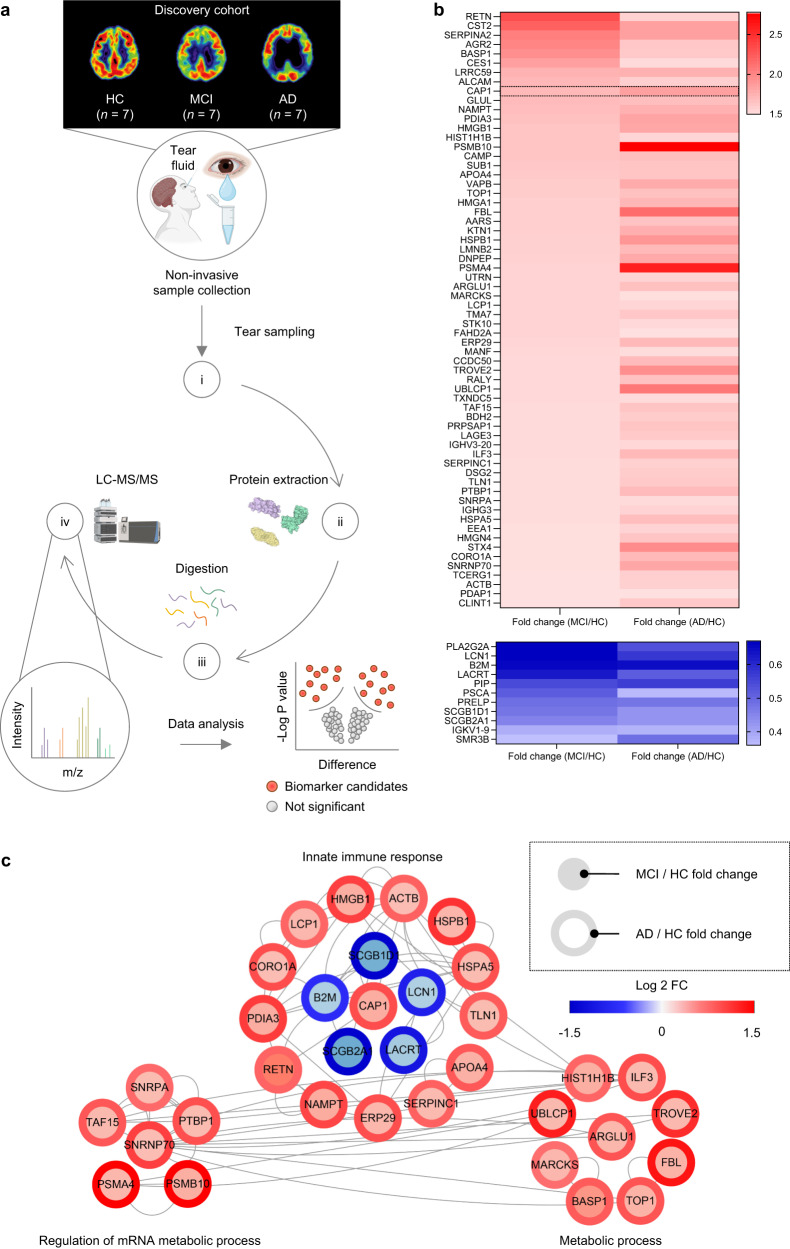
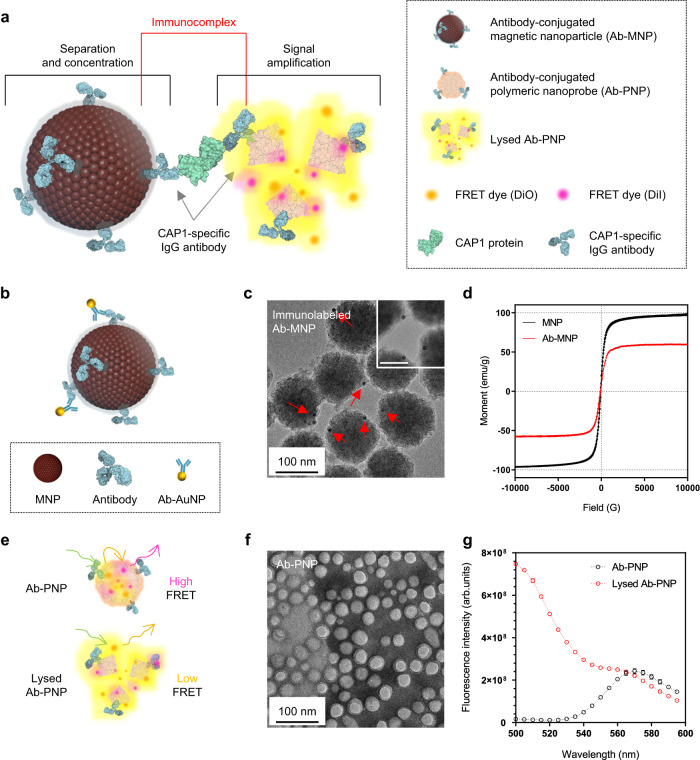
Accurate diagnosis of Alzheimer's disease (AD) in its earliest stage can prevent the disease and delay the symptoms. Therefore, more sensitive, non-invasive, and simple screening tools are required for the early diagnosis and monitoring of AD. Here, we design a self-assembled nanoparticle-mediated amplified fluorogenic immunoassay (SNAFIA) consisting of magnetic and fluorophore-loaded polymeric nanoparticles. Using a discovery cohort of 21 subjects, proteomic analysis identifies adenylyl cyclase-associated protein 1 (CAP1) as a potential tear biomarker. The SNAFIA demonstrates a low detection limit (236 aM), good reliability (R = 0.991), and a wide analytical range (0.320-1000 fM) for CAP1 in tear fluid. Crucially, in the verification phase with 39 subjects, SNAFIA discriminates AD patients from healthy controls with 90% sensitivity and 100% specificity in under an hour. Utilizing tear fluid as a liquid biopsy, SNAFIA could potentially aid in long-term care planning, improve clinical trial efficiency, and accelerate therapeutic development for AD.
准确诊断阿尔茨海默病(AD)的早期阶段可以预防疾病并延缓症状。因此,需要更敏感、非侵入性和简单的筛选工具来进行 AD 的早期诊断和监测。在这里,我们设计了一种由磁性和荧光负载聚合物纳米粒子组成的自组装纳米粒子介导的放大荧光免疫分析(SNAFIA)。使用包含 21 个对象的发现队列,蛋白质组学分析确定腺苷酸环化酶相关蛋白 1(CAP1)是一种潜在的泪液生物标志物。SNAFIA 在泪液中对 CAP1 的检测限低(236 aM)、可靠性好(R=0.991)、分析范围宽(0.320-1000 fM)。至关重要的是,在包含 39 个对象的验证阶段,SNAFIA 在不到一个小时的时间内以 90%的灵敏度和 100%的特异性将 AD 患者与健康对照者区分开来。利用泪液作为液体活检,SNAFIA 可能有助于长期护理计划、提高临床试验效率并加速 AD 的治疗开发。