Le Roy Barbara, Martin-Krumm Charles, Gille Adèle, Jacob Sandrine, Vigier Cécile, Laborde Sylvain, Claverie Damien, Besnard Stéphane, Trousselard Marion
Stress Neurophysiology Unit, French Armed Forces Biomedical Research Institute, Brétigny-sur-Orge, France.
CNES, Paris, France.
Front Neurol. 2023 Nov 22;14:1286919. doi: 10.3389/fneur.2023.1286919. eCollection 2023.
Long-duration space missions will be a real challenge for maintaining astronauts' adaptability. Research on transcutaneous vagus nerve stimulation (taVNS) is expanding rapidly, and its modalities constitute a major research challenge. A growing number of reviews stress the need to validate biomarkers for monitoring effects to enhance our understanding of the processes by which taVNS acts. Heart rate variability (HRV) appears to be a relevant candidate that informs on the autonomic nervous system (ANS). This is a promising technique to minimize the pathogenic effects of such large-scale missions and thus might be a relevant countermeasure. This study aimed to investigate the impact of taVNS on cognitive, psychological, and physiological functioning, including ANS functioning, and the benefits of increasing the number of taVNS sessions.
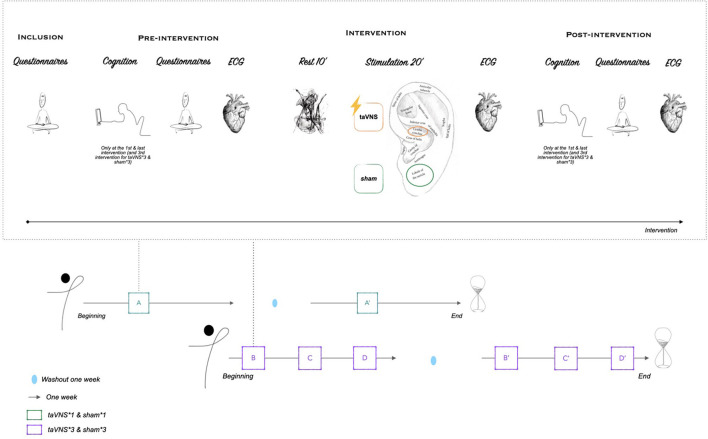
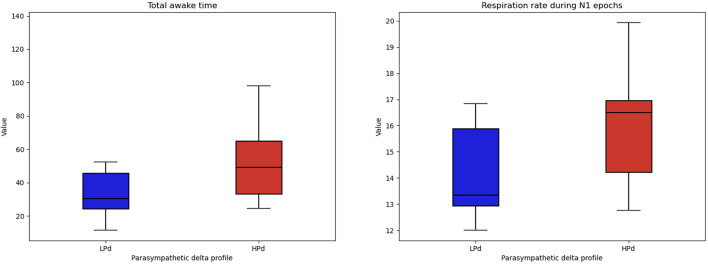
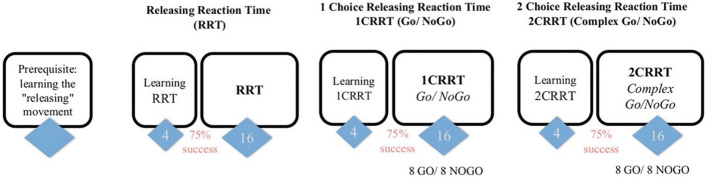
A total of 44 healthy participants were randomly assigned to one of the two cross-over protocols: a single session protocol (one taVNS and one sham simulation) or a repeated session protocol (three taVNS and three sham simulations). Cognitive, psychological, and physiological measures were performed before (pre) and after (post) each intervention. Sleep monitoring was only recorded before the first and after the last intervention in each protocol. For the repeated session protocol only, participants were allocated to two groups according to their parasympathetic activation gain during the three interventions: high parasympathetic delta (HPd) and low parasympathetic delta (LPd).
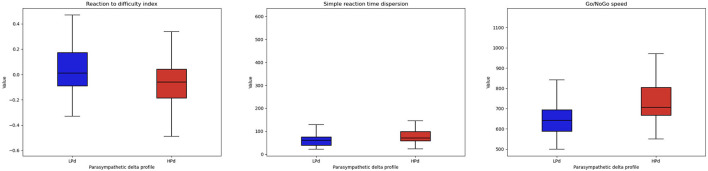
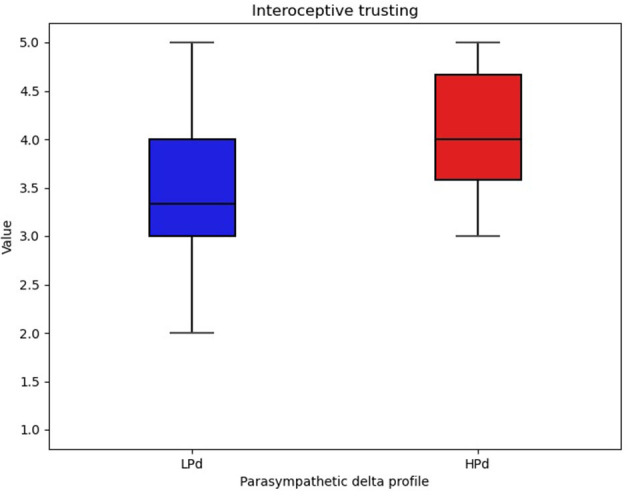
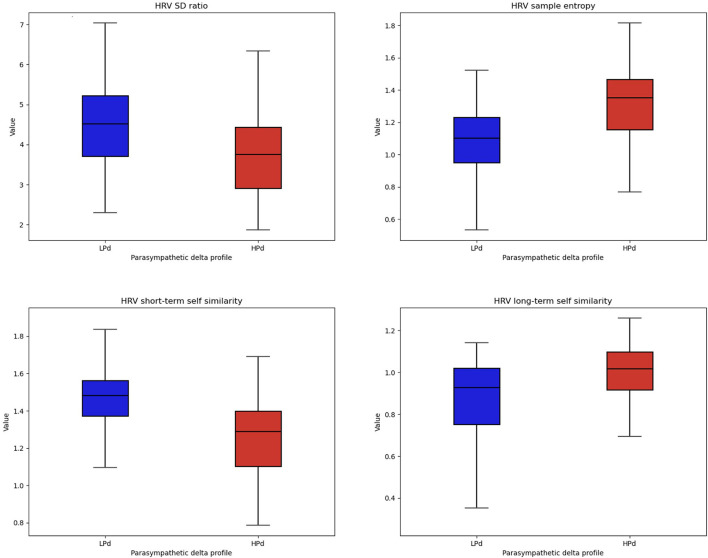
Participants in the repeated session protocol increased their HRV, cognitive performance, and sleep efficiency. In particular, taVNS induced higher parasympathetic activation and cardiac flexibility compared to the sham simulation in the repeated session protocol. Nevertheless, the perception of stress may indicate a nocebo effect of the repeated session. The HPd profile had higher interoceptive awareness, HRV highlighted by non-linear measures, and cognitive performance, but presented a decrease in some indicators of sleep efficiency compared to the LPd profile.
taVNS seems to induce positive health outcomes, especially when the stimulation is repeated three times per week. Our findings highlight the benefits of parasympathetic activation during taVNS on psychophysiological and cognitive functioning. Further research is needed to validate these results on a large sample, using longitudinal measures over several months. This intervention appears promising as a countermeasure to extreme missions and occupations.
长期太空任务对维持宇航员的适应性将是一项真正的挑战。经皮迷走神经刺激(taVNS)的研究正在迅速扩展,其模式构成了一项重大研究挑战。越来越多的综述强调需要验证生物标志物以监测其效果,从而增进我们对taVNS作用过程的理解。心率变异性(HRV)似乎是一个相关的候选指标,可反映自主神经系统(ANS)的情况。这是一种有前景的技术,可将此类大规模任务的致病影响降至最低,因此可能是一种相关的应对措施。本研究旨在调查taVNS对认知、心理和生理功能(包括ANS功能)的影响,以及增加taVNS治疗次数的益处。
总共44名健康参与者被随机分配到两种交叉方案之一:单次治疗方案(一次taVNS和一次假刺激模拟)或重复治疗方案(三次taVNS和三次假刺激模拟)。在每次干预前(pre)和后(post)进行认知、心理和生理测量。仅在每个方案的第一次干预前和最后一次干预后记录睡眠监测情况。仅对于重复治疗方案,根据参与者在三次干预期间的副交感神经激活增益将其分为两组:高副交感神经δ波(HPd)组和低副交感神经δ波(LPd)组。
重复治疗方案的参与者提高了他们的HRV、认知表现和睡眠效率。特别是,与重复治疗方案中的假刺激模拟相比,taVNS诱导了更高的副交感神经激活和心脏灵活性。然而,压力感知可能表明重复治疗存在反安慰剂效应。与LPd组相比,HPd组具有更高的内感受性意识、由非线性测量突出显示的HRV和认知表现,但在一些睡眠效率指标上有所下降。
taVNS似乎能带来积极的健康结果,尤其是当每周重复刺激三次时。我们的研究结果突出了taVNS期间副交感神经激活对心理生理和认知功能的益处。需要进一步的研究,使用数月的纵向测量方法,在大样本上验证这些结果。作为应对极端任务和职业的一种措施,这种干预似乎很有前景。