Ren Wenhua, Qi Yumeng, Liu Yan, Yan YaYun, Zheng Xiaoqi, Jin ShuXian, Chang Ying
The Department of Neurology, China-Japan Union Hospital, Jilin University, Changchun, China.
Departments of Biostatistics, Columbia University, New York, NY, United States.
Front Aging Neurosci. 2023 Nov 21;15:1257618. doi: 10.3389/fnagi.2023.1257618. eCollection 2023.
Impulse control disorder (ICD) is a common non-motor symptom of Parkinson's disease (PD), but its risk factors are still controversial. This study aimed to determine the prevalence of ICD in northern China and analyze the risk factors associated with ICD, multiple ICDs, and four subtypes.
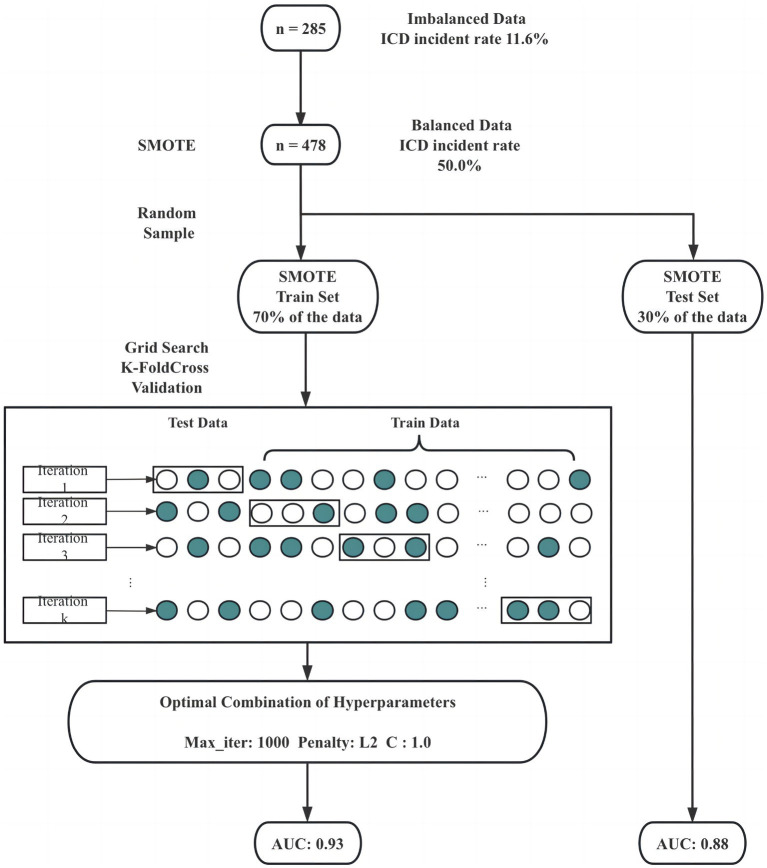
A total of 285 PD patients were enrolled in this study. Each patient was screened using the Questionnaire for Impulse and Compulsive Control Disorders (QUIP). Stepwise regression analysis was performed to identify independent risk factors, and a prediction model was developed.
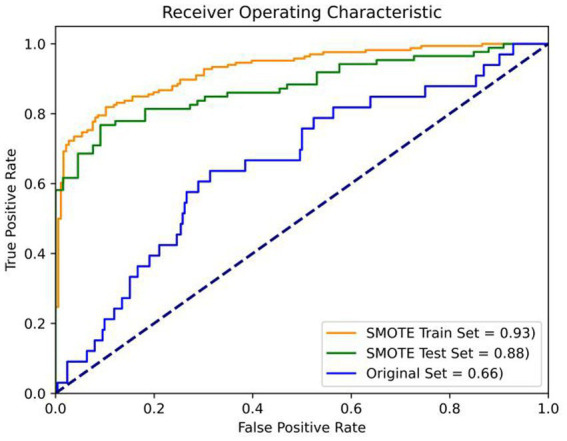
The prevalence of ICD in the study population was 11.6%. Stepwise regression analysis showed that ICD was associated with disease duration, motor symptoms, dyskinesia, depression, REM sleep behavior disorder (RBD) and cognitive decline; multiple ICDs were related to coffee history, motor symptoms, dyskinesia, depression, apathy and RBD. The prediction model demonstrated good performance with AUC values of 0.93, 0.88, and 0.66 on the balanced train set, balanced test set, and the original imbalanced data set, respectively.
The risk factors for PD-ICD are complex and influenced by regional economic and cultural backgrounds. Clarifying these factors and developing predictive models can help to delay or even prevent the development of ICD through early screening and intervention.
冲动控制障碍(ICD)是帕金森病(PD)常见的非运动症状,但其危险因素仍存在争议。本研究旨在确定中国北方地区ICD的患病率,并分析与ICD、多重ICD及四种亚型相关的危险因素。
本研究共纳入285例PD患者。采用冲动与强迫控制障碍问卷(QUIP)对每位患者进行筛查。进行逐步回归分析以确定独立危险因素,并建立预测模型。
研究人群中ICD的患病率为11.6%。逐步回归分析显示,ICD与病程、运动症状、异动症、抑郁、快速眼动睡眠行为障碍(RBD)及认知功能减退有关;多重ICD与咖啡饮用史、运动症状、异动症、抑郁、淡漠及RBD有关。该预测模型在平衡训练集、平衡测试集及原始不平衡数据集上的AUC值分别为0.93、0.88和0.66,表现良好。
PD-ICD的危险因素复杂,且受区域经济文化背景影响。明确这些因素并建立预测模型有助于通过早期筛查和干预延缓甚至预防ICD的发生。