Department of Experimental Psychology, University of Oxford, Oxford, OX1 3PH, UK.
Nuffield Department of Clinical Neurosciences, University of Oxford, Oxford, OX3 9DU, UK.
Sci Rep. 2021 Mar 1;11(1):4830. doi: 10.1038/s41598-021-84364-w.
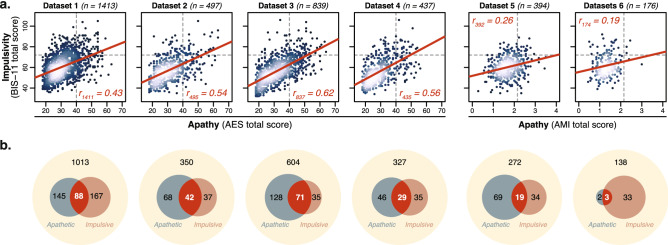
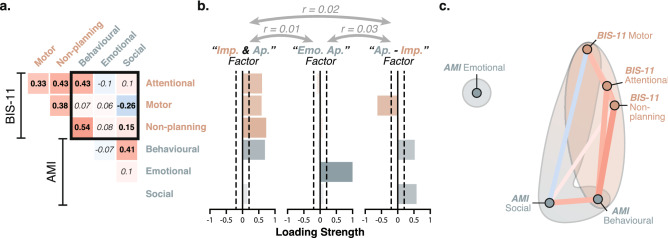
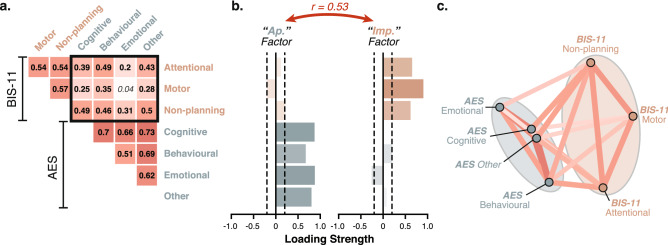
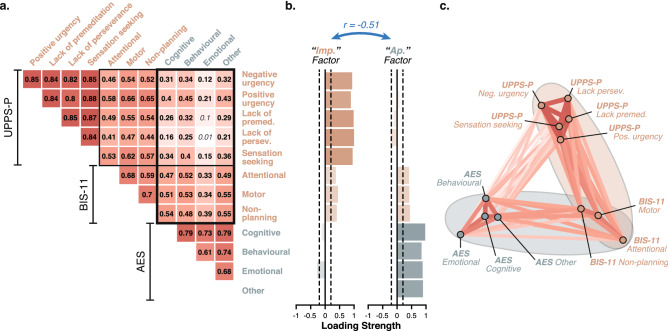
Apathy and impulsivity are debilitating conditions associated with many neuropsychiatric conditions, and expressed to variable degrees in healthy people. While some theories suggest that they lie at different ends of a continuum, others suggest their possible co-existence. Surprisingly little is known, however, about their empirical association in the general population. Here, gathering data from six large studies ([Formula: see text]), we investigated the relationship between measures of apathy and impulsivity in young adults. The questionnaires included commonly used self-assessment tools-Apathy Evaluation Scale, Barratt Impulsiveness Scale (BIS-11) and UPPS-P Scale-as well as a more recent addition, the Apathy Motivation Index (AMI). Remarkably, across datasets and assessment tools, global measures of apathy and impulsivity correlated positively. However, analysis of sub-scale scores revealed a more complex relationship. Although most dimensions correlated positively with one another, there were two important exceptions revealed using the AMI scale. Social apathy was mostly negatively correlated with impulsive behaviour, and emotional apathy was orthogonal to all other sub-domains. These results suggest that at a global level, apathy and impulsivity do not exist at distinct ends of a continuum. Instead, paradoxically, they most often co-exist in young adults. Processes underlying social and emotional apathy, however, appear to be different and dissociable from behavioural apathy and impulsivity.
冷漠和冲动是与许多神经精神疾病相关的使人虚弱的状况,在健康人群中表现出不同程度的存在。虽然一些理论表明它们位于连续体的不同两端,而另一些理论则表明它们可能同时存在。然而,关于它们在普通人群中的实证关联,人们知之甚少。在这里,我们从六个大型研究中收集数据([公式:见文本]),研究了年轻人中冷漠和冲动之间的关系。调查问卷包括常用的自我评估工具——冷漠评估量表、巴瑞特冲动量表(BIS-11)和 UPPS-P 量表,以及最近新增的冷漠动机指数(AMI)。值得注意的是,在不同的数据集和评估工具中,冷漠和冲动的总体测量值呈正相关。然而,对子量表得分的分析揭示了更复杂的关系。尽管大多数维度彼此之间呈正相关,但使用 AMI 量表揭示了两个重要的例外。社会冷漠与冲动行为大多呈负相关,而情感冷漠与其他所有子领域正交。这些结果表明,在全局水平上,冷漠和冲动并不存在于连续体的不同两端。相反,矛盾的是,它们在年轻人中最常同时存在。然而,社会和情感冷漠的潜在过程似乎与行为冷漠和冲动不同,并且可以分离。