Doctoral School of Psychology, ELTE Eötvös Loránd University, Budapest, Hungary.
MTA-ELTE Lendület Adaptation Research Group, Institute of Psychology, ELTE Eötvös Loránd University, Budapest, Hungary.
J Prev (2022). 2024 Apr;45(2):237-267. doi: 10.1007/s10935-023-00760-0. Epub 2023 Dec 14.
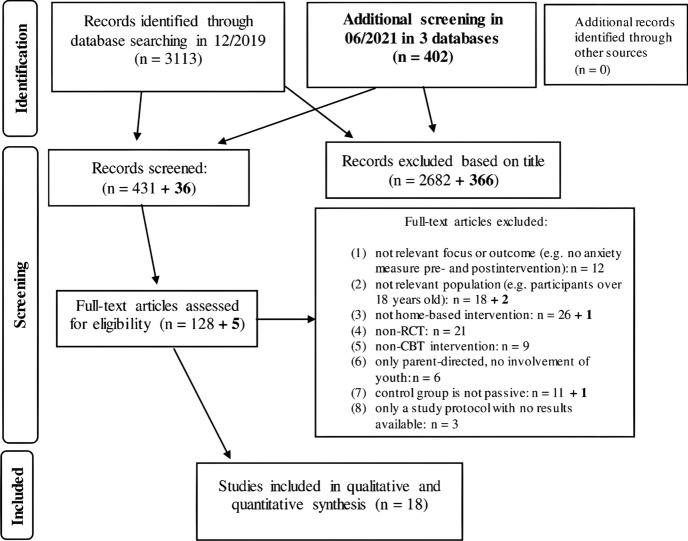
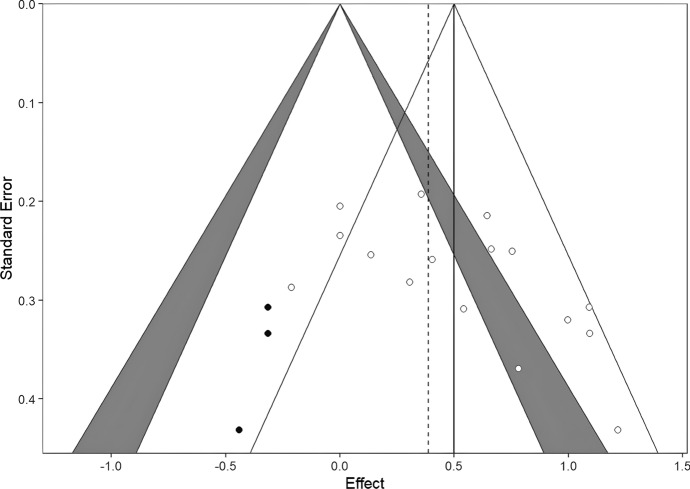
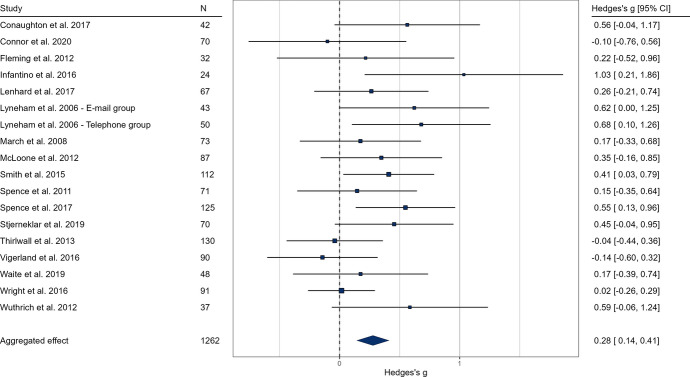
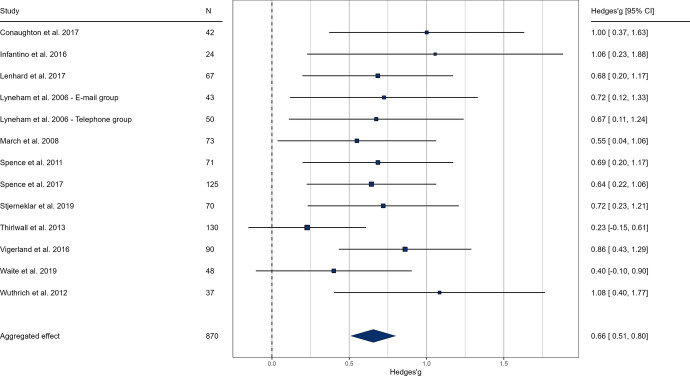
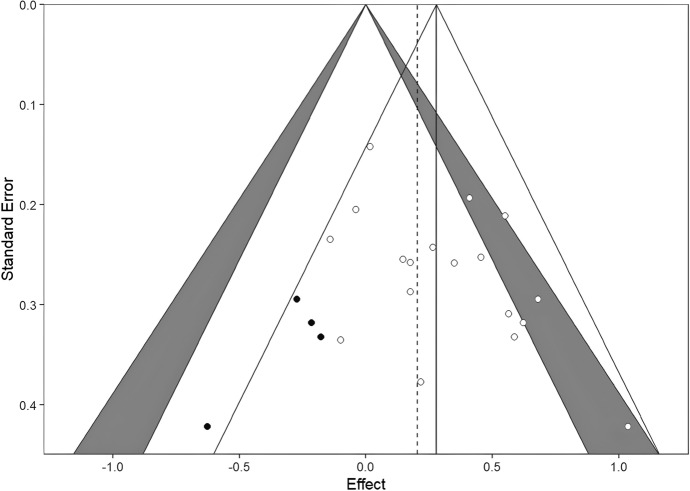
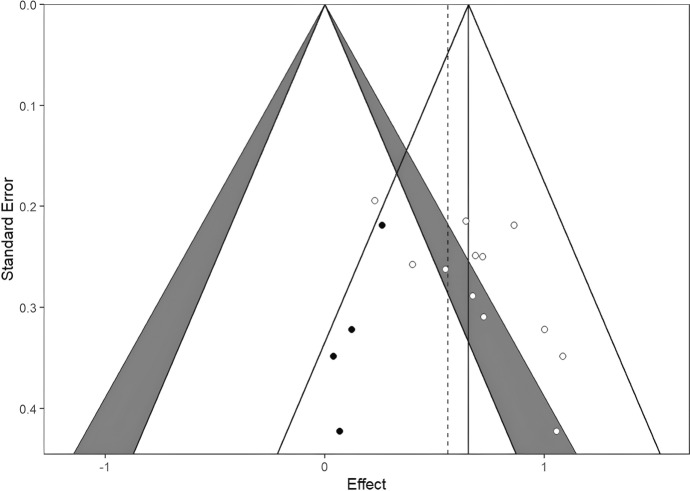
Anxiety disorders are the most prevalent mental health issues in childhood, yet most children do not receive treatment. With recent advances in technology, a growing number of digital anxiety interventions are becoming accessible. This study is the first meta-analysis to evaluate the effectiveness and usefulness of digital cognitive-behavioral anxiety interventions for individuals under the age of 18. Five electronic databases (PsycNET, Web of Science, Science Direct, Pub Med, SAGE Journals.) were systematically searched in 2021. Inclusion criteria were: randomized control trials with a wait list no treatment control, standalone to blended care with minimal therapist involvement, diagnosed anxiety disorder or elevated levels of anxiety, outcome anxiety levels had to be assessed by a clinician, or the patients themselves by a validated anxiety measure. We assessed and controlled for publication bias, and considered the risk of bias using the Cochrane risk-of-bias tool. Eighteen studies were found eligible, which examined 1290 participants in total. Pooled effect sizes using a random-effects model yielded low overall effect for self-ratings (g = 0.28, k = 18, p < 0.001, 95% CI [0.14; 0.41]), and medium effect for ratings of clinicians (g = 0.66, k = 13, p < 0.001, 95% CI [0.50; 0.80]) as well as for parental report (g = 0.49, k = 16, p < 0.001, 95% CI [0.29; 0.69]). We found that the effects were homogenous across studies. Further examining potential moderating factors of treatment efficacy is needed in future research, as well as conducting studies that compare traditional methods of care to their digital counterparts. Digital interventions could contribute to the well-being of children regardless of age, minimizing therapist involvement. We conclude that digital cognitive-behavioral interventions may provide an accessible, cost-effective, and scalable anxiety treatment option for children and adolescents.
焦虑障碍是儿童中最常见的心理健康问题,但大多数儿童并未得到治疗。随着技术的进步,越来越多的数字焦虑干预措施变得可及。本研究是第一项评估 18 岁以下个体的数字认知行为焦虑干预措施的有效性和实用性的荟萃分析。2021 年系统地在五个电子数据库(PsycNET、Web of Science、Science Direct、Pub Med、SAGE Journals)中进行了搜索。纳入标准为:随机对照试验,有等待名单对照(无治疗对照)、独立的或混合护理(最小治疗师参与)、诊断为焦虑障碍或焦虑水平升高、结果焦虑水平必须由临床医生评估,或由患者自身使用经过验证的焦虑量表评估。我们评估并控制了发表偏倚,并使用 Cochrane 风险偏倚工具考虑了偏倚风险。共发现 18 项符合条件的研究,总共检查了 1290 名参与者。使用随机效应模型计算的汇总效应大小表明,自我评估的总体效果较低(g=0.28,k=18,p<0.001,95%CI [0.14;0.41]),临床医生评估的效果中等(g=0.66,k=13,p<0.001,95%CI [0.50;0.80])以及父母报告的效果中等(g=0.49,k=16,p<0.001,95%CI [0.29;0.69])。我们发现这些效果在研究间是同质的。未来的研究需要进一步检查治疗效果的潜在调节因素,以及开展将传统护理方法与数字护理方法进行比较的研究。数字干预措施可以为儿童的福祉做出贡献,无论其年龄大小,最大限度地减少治疗师的参与。我们的结论是,数字认知行为干预措施可能为儿童和青少年提供一种易于获得、具有成本效益且可扩展的焦虑治疗选择。