Department of Otorhinolaryngology, Radboudumc, Nijmegen, The Netherlands.
Department of Clinical Genetics, Radboudumc, Nijmegen, The Netherlands.
J Otolaryngol Head Neck Surg. 2023 Dec 15;52(1):82. doi: 10.1186/s40463-023-00680-3.
The spiral ganglion hypothesis suggests that pathogenic variants in genes preferentially expressed in the spiral ganglion nerves (SGN), may lead to poor cochlear implant (CI) performance. It was long thought that TMPRSS3 was particularly expressed in the SGNs. However, this is not in line with recent reviews evaluating CI performance in subjects with TMPRSS3-associated sensorineural hearing loss (SNHL) reporting overall beneficial outcomes. These outcomes are, however, based on variable follow-up times of, in general, 1 year or less. Therefore, we aimed to 1. evaluate long-term outcomes after CI implantation of speech recognition in quiet in subjects with TMPRSS3-associated SNHL, and 2. test the spiral ganglion hypothesis using the TMPRSS3-group.
This retrospective, multicentre study evaluated long-term CI performance in a Dutch population with TMPRSS3-associated SNHL. The phoneme scores at 70 dB with CI in the TMPRSS3-group were compared to a control group of fully genotyped cochlear implant users with post-lingual SNHL without genes affecting the SGN, or severe anatomical inner ear malformations. CI-recipients with a phoneme score ≤ 70% at least 1-year post-implantation were considered poor performers and were evaluated in more detail.
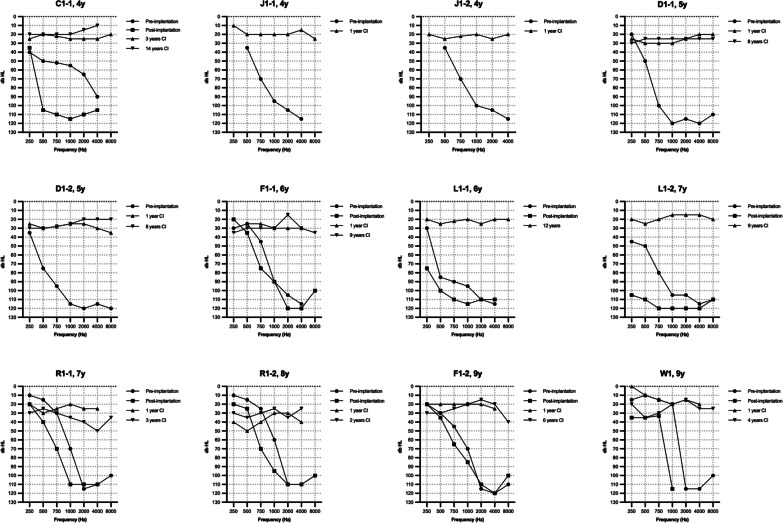
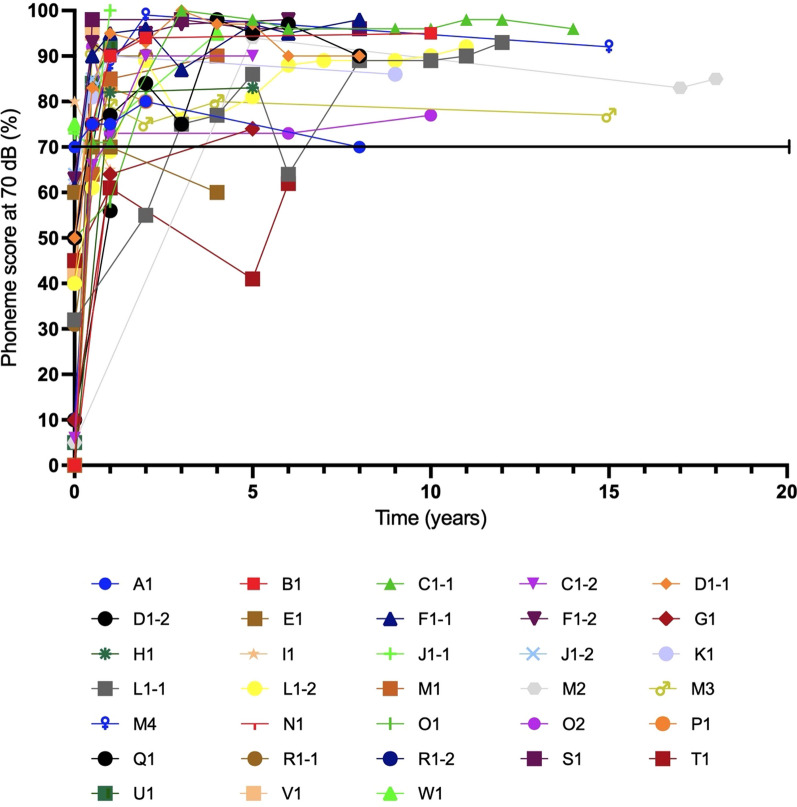
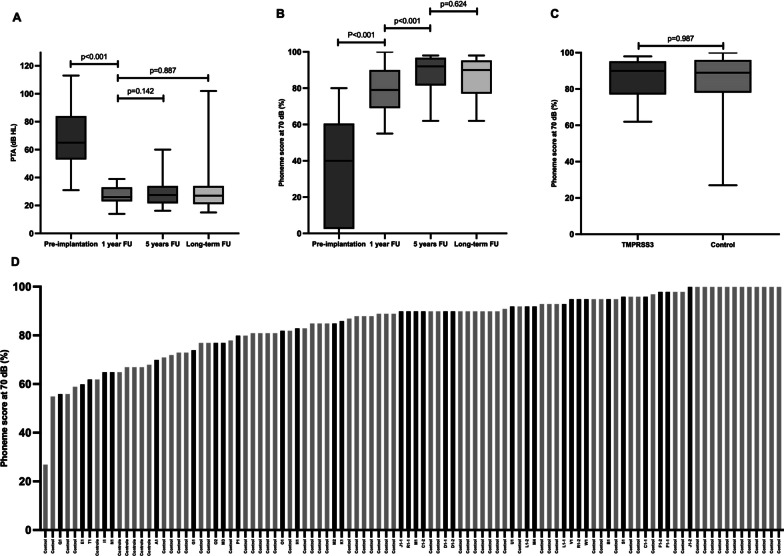
The TMPRSS3 group consisted of 29 subjects (N = 33 ears), and the control group of 62 subjects (N = 67 ears). For the TMPRSS3-group, we found an average phoneme score of 89% after 5 years, which remained stable up to 10 years post-implantation. At both 5 and 10-year follow-up, no difference was found in speech recognition in quiet between both groups (p = 0.830 and p = 0.987, respectively). Despite these overall adequate CI outcomes, six CI recipients had a phoneme score of ≤ 70% and were considered poor performers. The latter was observed in subjects with residual hearing post-implantation or older age at implantation.
Subjects with TMPRSS3-associated SNHL have adequate and stable long-term outcomes after cochlear implantation, equal to the performance of genotyped patient with affected genes not expressed in the SGN. These findings are not in line with the spiral ganglion hypothesis. However, more recent studies showed that TMPRSS3 is mainly expressed in the hair cells with only limited SGN expression. Therefore, we cannot confirm nor refute the spiral ganglion hypothesis.
螺旋神经节假说表明,在螺旋神经节神经(SGN)中优先表达的致病变异可能导致人工耳蜗(CI)性能不佳。长期以来,人们一直认为 TMPRSS3 特别表达在 SGN 中。然而,这与最近的综述评估 TMPRSS3 相关感音神经性听力损失(SNHL)患者的 CI 性能不一致,这些综述报告总体上有益的结果。然而,这些结果是基于一般为 1 年或更短的可变随访时间。因此,我们旨在 1. 评估 TMPRSS3 相关 SNHL 患者 CI 植入后安静言语识别的长期结果,2. 使用 TMPRSS3 组检验螺旋神经节假说。
本回顾性多中心研究评估了荷兰 TMPRSS3 相关 SNHL 人群的长期 CI 性能。将 TMPRSS3 组在 70dB 时使用 CI 的语音得分与完全基因分型的后天性 SNHL 且不影响 SGN 的基因或严重解剖内耳畸形的人工耳蜗植入者的对照组进行比较。在植入后至少 1 年至少有 70%语音得分的 CI 接受者被认为是表现不佳者,并进行了更详细的评估。
TMPRSS3 组由 29 名患者(N=33 耳)组成,对照组由 62 名患者(N=67 耳)组成。对于 TMPRSS3 组,我们发现 5 年后平均语音得分 89%,植入后 10 年仍保持稳定。在 5 年和 10 年随访时,两组的安静言语识别均无差异(p=0.830 和 p=0.987)。尽管这些整体 CI 结果良好,但有 6 名 CI 接受者的语音得分≤70%,被认为表现不佳。在植入后有残余听力或植入时年龄较大的患者中观察到这种情况。
TMPRSS3 相关 SNHL 患者在植入后具有适当且稳定的长期结果,与未在 SGN 中表达基因的基因分型患者的表现相当。这些发现与螺旋神经节假说不一致。然而,最近的研究表明,TMPRSS3 主要表达在毛细胞中,仅在 SGN 中有有限的表达。因此,我们无法证实或反驳螺旋神经节假说。