Ball Laymon D, Bedoya Ana M, Taylor Charlotte M, Lagomarsino Laura P
Department of Biological Sciences Louisiana State University Baton Rouge Louisiana 70803 USA.
Missouri Botanical Garden 4344 Shaw Blvd. Saint Louis Missouri 63110 USA.
Appl Plant Sci. 2023 Nov 17;11(6):e11554. doi: 10.1002/aps3.11554. eCollection 2023 Nov-Dec.
Rubiaceae is among the most species-rich plant families, as well as one of the most morphologically and geographically diverse. Currently available phylogenies have mostly relied on few genomic and plastid loci, as opposed to large-scale genomic data. Target enrichment provides the ability to generate sequence data for hundreds to thousands of phylogenetically informative, single-copy loci, which often leads to improved phylogenetic resolution at both shallow and deep taxonomic scales; however, a publicly accessible Rubiaceae-specific probe set that allows for comparable phylogenetic inference across clades is lacking.
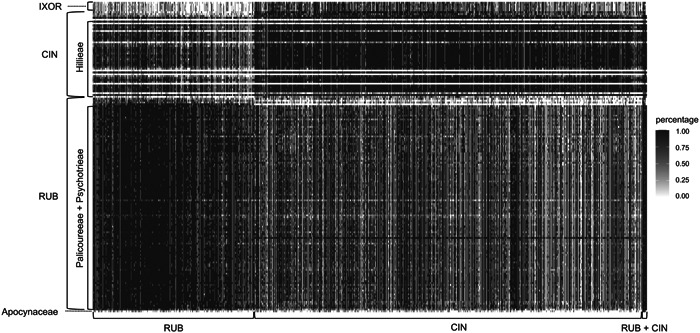
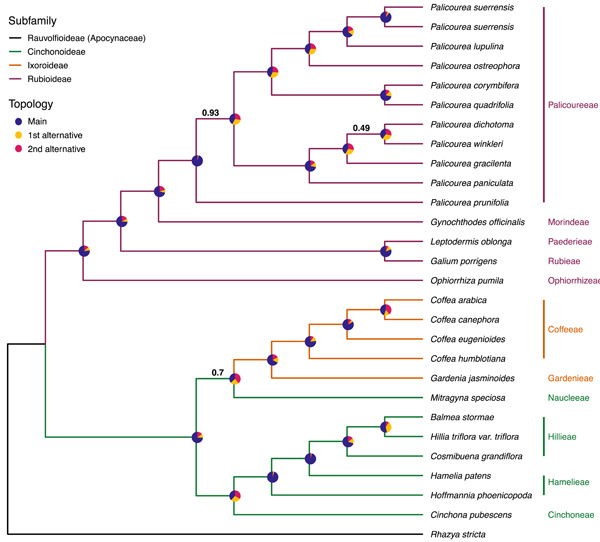
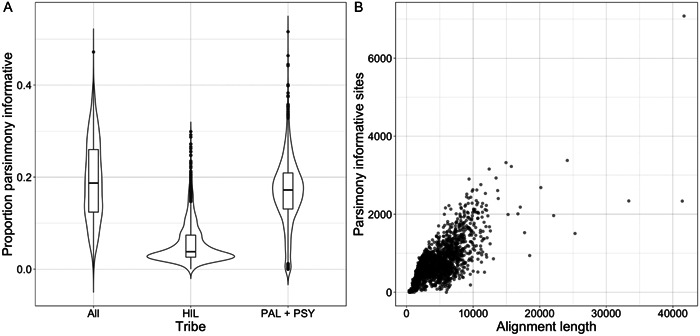
Here, we use publicly accessible genomic resources to identify putatively single-copy nuclear loci for target enrichment in two Rubiaceae groups: tribe Hillieae (Cinchonoideae) and tribal complex Palicoureeae+Psychotrieae (Rubioideae). We sequenced 2270 exonic regions corresponding to 1059 loci in our target clades and generated in silico target enrichment sequences for other Rubiaceae taxa using our designed probe set. To test the utility of our probe set for phylogenetic inference across Rubiaceae, we performed a coalescent-aware phylogenetic analysis using a subset of 27 Rubiaceae taxa from 10 different tribes and three subfamilies, and one outgroup in Apocynaceae.
We recovered an average of 75% and 84% of targeted exons and loci, respectively, per Rubiaceae sample. Probes designed using genomic resources from a particular subfamily were most efficient at targeting sequences from taxa in that subfamily. The number of paralogs recovered during assembly varied for each clade. Phylogenetic inference of Rubiaceae with our target regions resolves relationships at various scales. Relationships are largely consistent with previous studies of relationships in the family with high support (≥0.98 local posterior probability) at nearly all nodes and evidence of gene tree discordance.
Our probe set, which we call Rubiaceae2270x, was effective for targeting loci in species across and even outside of Rubiaceae. This probe set will facilitate phylogenomic studies in Rubiaceae and advance systematics and macroevolutionary studies in the family.
茜草科是物种最丰富的植物科之一,也是形态和地理多样性最高的科之一。目前可用的系统发育树大多依赖于少数基因组和质体基因座,而非大规模基因组数据。靶向富集能够为数百至数千个系统发育信息丰富的单拷贝基因座生成序列数据,这通常会在浅层和深层分类尺度上提高系统发育分辨率;然而,目前缺乏一个可公开获取的、能在不同分支间进行可比系统发育推断的茜草科特异性探针集。
在此,我们利用可公开获取的基因组资源,为茜草科的两个类群鉴定可能的单拷贝核基因座以进行靶向富集:希利族(金鸡纳亚科)和帕利库里族+九节族复合群(茜草亚科)。我们对目标类群中对应1059个基因座的2270个外显子区域进行了测序,并使用我们设计的探针集为其他茜草科分类群生成了虚拟靶向富集序列。为测试我们的探针集在茜草科系统发育推断中的效用,我们使用了来自10个不同族和3个亚科的27个茜草科分类群的子集以及夹竹桃科的一个外类群进行了合并感知系统发育分析。
每个茜草科样本平均分别回收了75%和84%的靶向外显子和基因座。使用来自特定亚科的基因组资源设计的探针在靶向该亚科分类群的序列时效率最高。组装过程中回收的旁系同源物数量因每个类群而异。利用我们的目标区域对茜草科进行系统发育推断,解决了不同尺度上的关系。这些关系在很大程度上与该科先前的关系研究一致,几乎所有节点的支持度都很高(局部后验概率≥0.98),并且有基因树不一致的证据。
我们的探针集,我们称之为茜草科2270x,对于靶向茜草科及以外物种的基因座是有效的。这个探针集将促进茜草科的系统发育基因组学研究,并推动该科的系统学和宏观进化研究。