Kitchens William H, Larsen Christian P, Badell I Raul
Division of Transplantation, Department of Surgery, Emory University School of Medicine, Atlanta, Georgia, USA.
Kidney Int Rep. 2023 Sep 3;8(12):2529-2545. doi: 10.1016/j.ekir.2023.08.037. eCollection 2023 Dec.
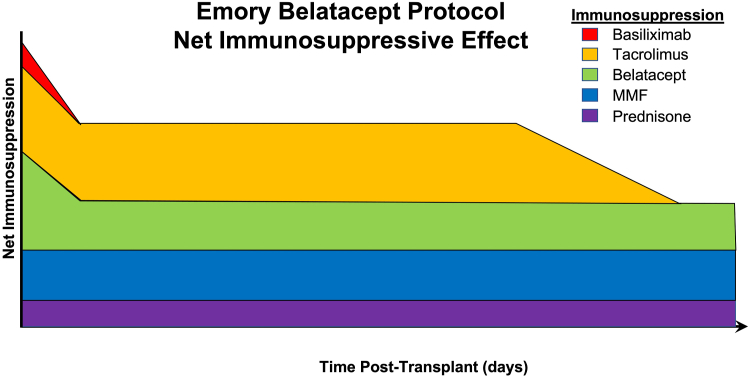
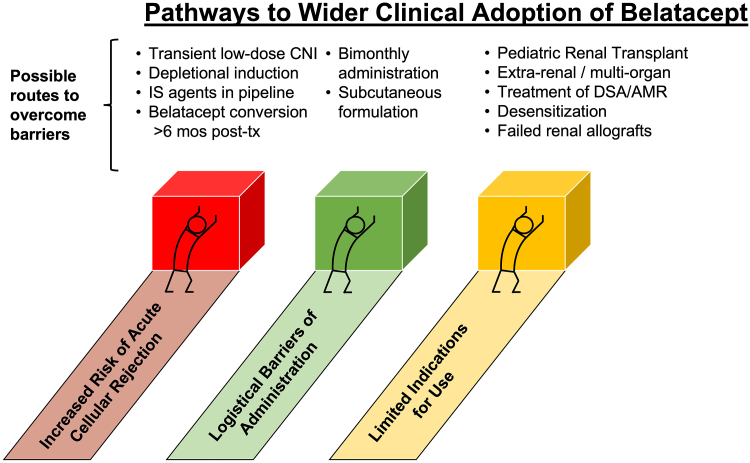
Belatacept is the first costimulatory blockade agent clinically approved for transplant immunosuppression. Although more than 10 years of study have demonstrated that belatacept offers superior long-term renal allograft and patient survival compared to conventional calcineurin inhibitor (CNI)-based immunosuppression regimens, the clinical adoption of belatacept has continued to lag because of concerns of an early risk of acute cellular rejection (ACR) and various logistical barriers to its administration. In this review, the history of the clinical development of belatacept is examined, along with the findings of the seminal BENEFIT and BENEFIT-EXT trials culminating in the clinical approval of belatacept. Recent efforts to incorporate belatacept into novel CNI-free immunosuppression regimens are reviewed, as well as the experience of the Emory Transplant Center in using a tapered course of low-dose tacrolimus in belatacept-treated renal allograft patients to garner the long-term outcome benefits of belatacept without the short-term increased risks of ACR. Potential avenues to increase the clinical adoption of belatacept in the future are explored, including surmounting the logistical barriers of belatacept administration through subcutaneous administration or more infrequent belatacept dosing. In addition, belatacept conversion strategies and potential expanded clinical indications of belatacept are discussed for pediatric transplant recipients, extrarenal transplant recipients, treatment of antibody-mediated rejection (AMR), and in patients with failed renal allografts. Finally, we discuss the novel immunosuppressive drugs currently in the development pipeline that may aid in the expansion of costimulation blockade utilization.
贝拉西普是首个获得临床批准用于移植免疫抑制的共刺激阻断剂。尽管十多年的研究表明,与传统的基于钙调神经磷酸酶抑制剂(CNI)的免疫抑制方案相比,贝拉西普能为肾移植受者提供更优的长期存活以及患者生存率,但由于担心其早期存在急性细胞排斥反应(ACR)风险以及给药方面的各种后勤障碍,贝拉西普在临床上的应用一直滞后。在本综述中,我们将审视贝拉西普的临床研发历程,以及最终促成贝拉西普获批的具有开创性意义的BENEFIT和BENEFIT-EXT试验结果。我们还将回顾近期将贝拉西普纳入新型无CNI免疫抑制方案的努力,以及埃默里移植中心在贝拉西普治疗的肾移植受者中使用低剂量他克莫司递减疗程的经验,以在不增加ACR短期风险的情况下获得贝拉西普的长期疗效。我们探讨了未来增加贝拉西普临床应用的潜在途径,包括通过皮下给药或减少贝拉西普给药频率来克服其给药方面的后勤障碍。此外,还讨论了贝拉西普在儿科移植受者、肾外移植受者、抗体介导排斥反应(AMR)治疗以及肾移植失败患者中的转换策略和潜在扩大的临床适应证。最后,我们讨论了目前正在研发中的新型免疫抑制药物,这些药物可能有助于扩大共刺激阻断的应用。