Ye Yuzhong, Zheng Yongqiang, Li Junteng, Miao Qi, Lin Mei, Chen Jiawei, Ruan Hailong, Zhang Xiaoping
Department of Urology, Union Hospital, Tongji Medical College, Huazhong University of Science and Technology, Wuhan, 430022, China.
Department of Medical Oncology, State Key Laboratory of Oncology in South China, Collaborative Innovation Center for Cancer Medicine, Sun Yat-sen University Cancer Center, Sun Yat-sen University, Guangzhou, 510060, China.
Heliyon. 2023 Nov 17;9(12):e22408. doi: 10.1016/j.heliyon.2023.e22408. eCollection 2023 Dec.
As an important kidney-sparing treatment for upper urothelial carcinoma (UTUC), whether endoscopic excision can be performed without sacrificing oncologic outcomes remains indefinite. This study aimed to investigate the prevalence and efficacy of endoscopic excision, in patients with non-muscle invasive UTUC (NMIUTUC) and compare them to those of radical nephroureterectomy (RNU).
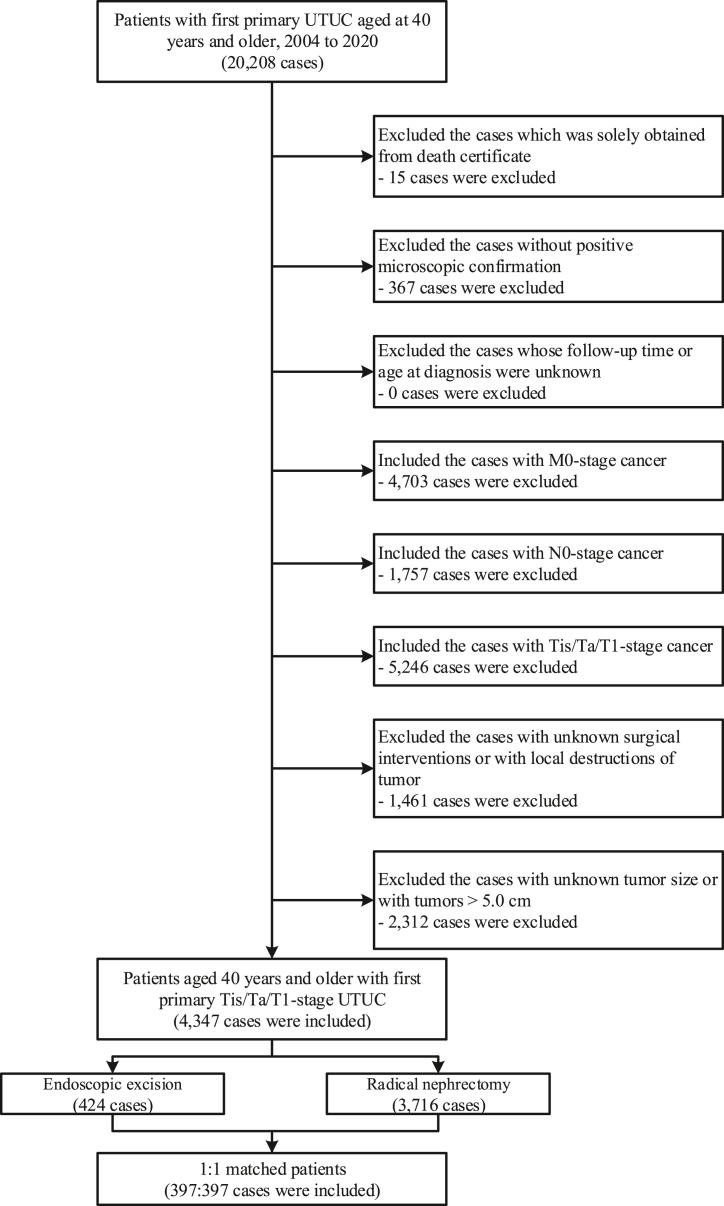
Using the Surveillance, Epidemiology, and End Results database, we reviewed 4347 cases with NMIUTUC (cTis/Ta/T1-N0-M0,≤ 5.0 cm) between 2004 and 2020. Surgical treatment modalities included endoscopic excision and RNU. Propensity score matching analysis was used to minimize the selection bias between endoscopic excision and RNU, selecting 1:1 matched patients in the two group.
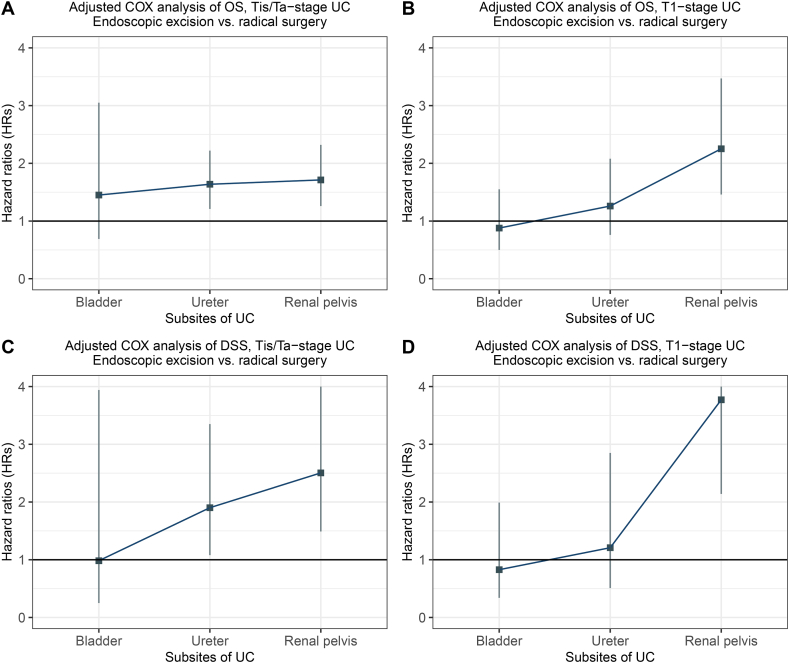
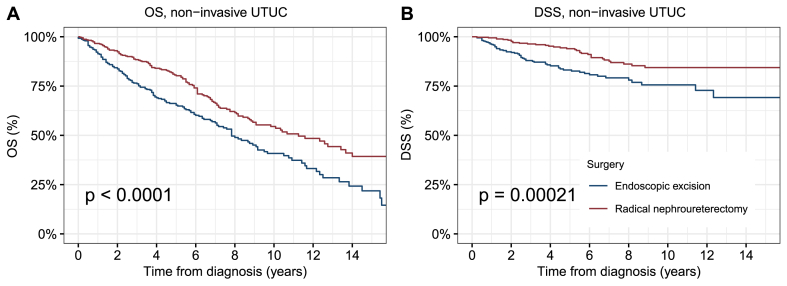
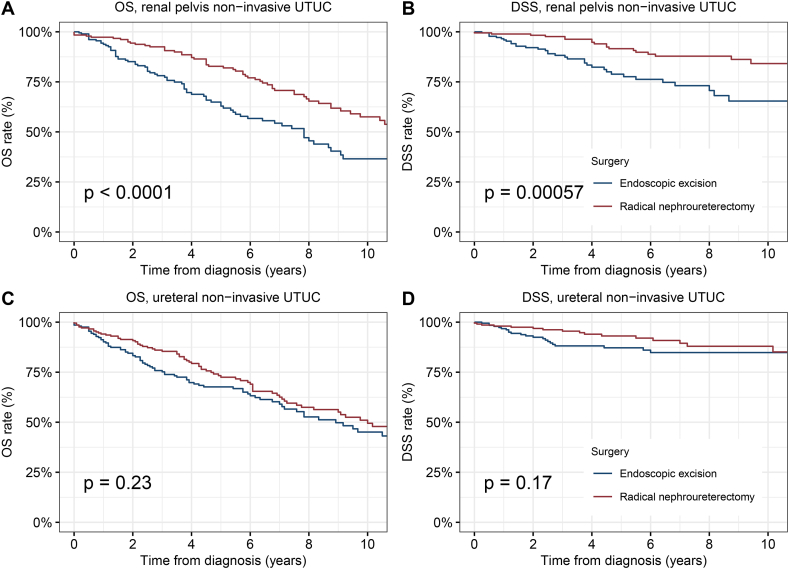
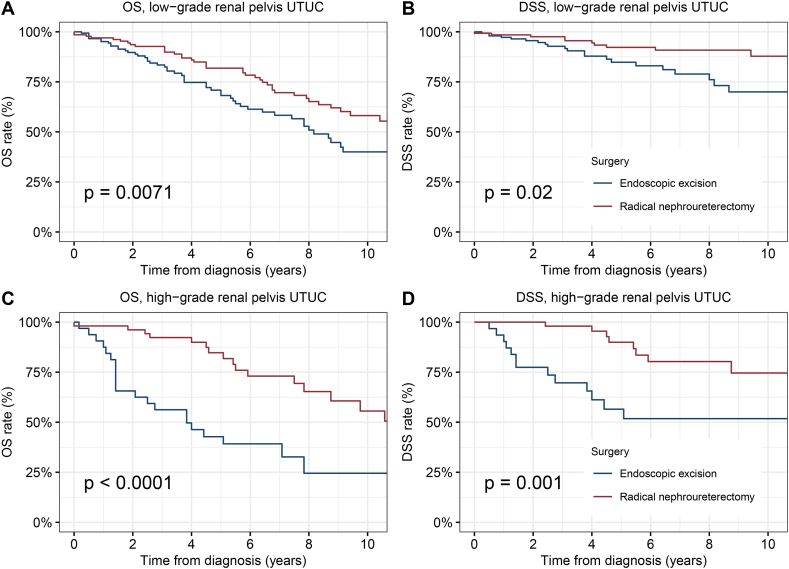
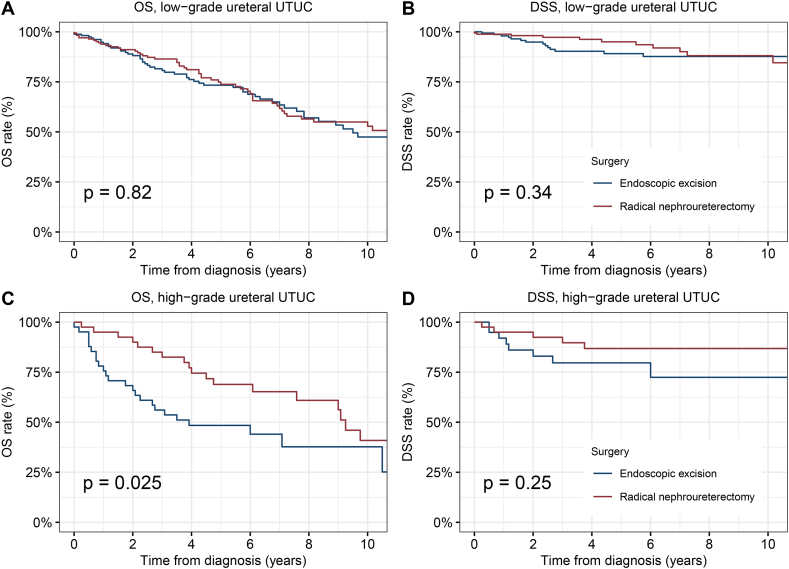
A total of 794 patients with NMIUTUC were included after matching (397:397). Patients who underwent endoscopic excision had worse survival outcomes compared with those of patients who underwent RNU (5-year OS: 65.3 % vs. 80.3 %, p < 0.0001; 5-year DSS: 83.2 % vs. 94.0 %, p = 0.00021). After stratification by anatomical sites, the effect of endoscopic excision for NMI renal pelvis cancer was worse than RNU (5-year OS, 62.9 % vs. 82.8 %; 5-year DSS, 78.8 % vs. 91.6 %), while in NMI ureteral cancer, there is no statistically significant difference in OS and DSS between endoscopic excision and RNU. Further stratification according to tumor grade revealed equivalent tumor control effects of endoscopic excision and RNU in low-grade NMI ureteral cancer (5-year OS: 67.7 % vs. 72.5 %, p = 0.23; 5-year DSS: 87.2 % vs. 93.1 %, p = 0.17); while for renal pelvis tumor and high-grade ureteral tumor, endoscopic excision was related with significantly inferior prognosis.
Only for low-grade NMI ureteral cancer, endoscopic excision and RNU are oncologically equivalent, indicating that endoscopic excision might be an effective option for low-grade NMI ureteral cancer. This result needs to be further verified in randomized controlled trials.
作为上尿路上皮癌(UTUC)重要的保肾治疗方法,内镜下切除能否在不影响肿瘤学预后的情况下进行仍不明确。本研究旨在调查非肌层浸润性UTUC(NMIUTUC)患者内镜下切除的发生率和疗效,并与根治性肾输尿管切除术(RNU)进行比较。
利用监测、流行病学和最终结果数据库,我们回顾了2004年至2020年间4347例NMIUTUC(cTis/Ta/T1-N0-M0,≤5. $0$ cm)患者。手术治疗方式包括内镜下切除和RNU。采用倾向评分匹配分析以尽量减少内镜下切除和RNU之间的选择偏倚,在两组中选择1:1匹配的患者。
匹配后共纳入794例NMIUTUC患者($397:397$)。与接受RNU的患者相比,接受内镜下切除的患者生存结局更差(5年总生存率:$65.3%$对$80.3%$,$p < 0.0001$;5年疾病特异性生存率:$83.2%$对$94.0%$,$p = 0.00021$)。按解剖部位分层后,内镜下切除治疗NMI肾盂癌的效果比RNU差(5年总生存率,$62.9%$对$82.8%$;5年疾病特异性生存率,$78.8%$对$91.6%$),而在NMI输尿管癌中,内镜下切除与RNU在总生存率和疾病特异性生存率方面无统计学显著差异。根据肿瘤分级进一步分层显示,内镜下切除和RNU在低级别NMI输尿管癌中的肿瘤控制效果相当(5年总生存率:$67.7%$对$72.5%$,$p = 0.23$;5年疾病特异性生存率:$87.2%$对$93.1%$,$p = 0.17$);而对于肾盂肿瘤和高级别输尿管肿瘤,内镜下切除与明显较差的预后相关。
仅对于低级别NMI输尿管癌,内镜下切除和RNU在肿瘤学上相当,表明内镜下切除可能是低级别NMI输尿管癌的一种有效选择。这一结果需要在随机对照试验中进一步验证。