Department of Orthopedics, Beijing Chaoyang Hospital, Capital Medical University, Beijing, China.
Orthop Surg. 2024 Feb;16(2):471-480. doi: 10.1111/os.13965. Epub 2023 Dec 19.
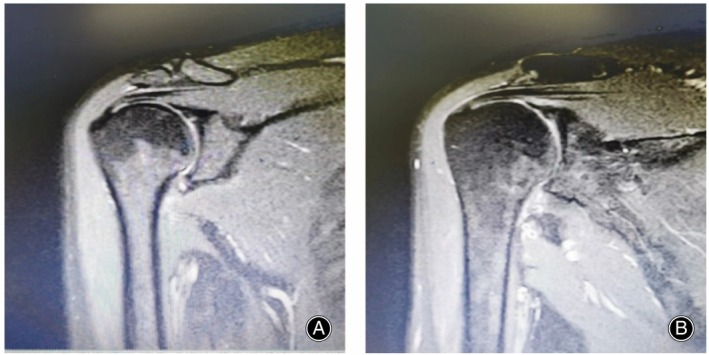
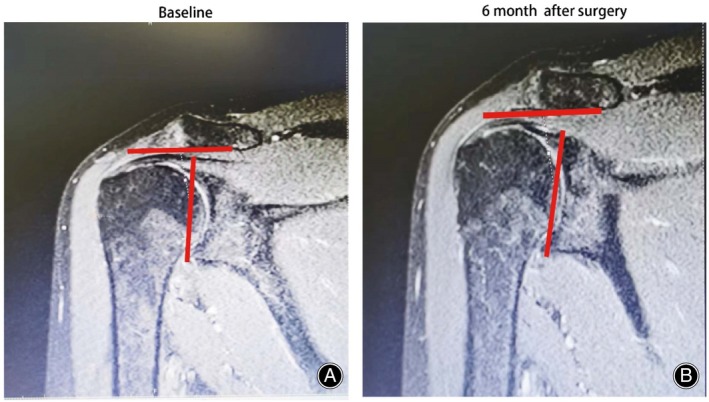
Arthroscopic surgery has been established as an efficacious intervention for the treatment of rotator cuff tears. The primary aim of this study was to analyze the modifications in the lateral acromial angle (LAA) subsequent to rotator cuff repair surgery using single-row rivet fixation and double-row rivet fixation techniques. Furthermore, we sought to investigate the influence of LAA on the prognosis of rotator cuff repair surgery.
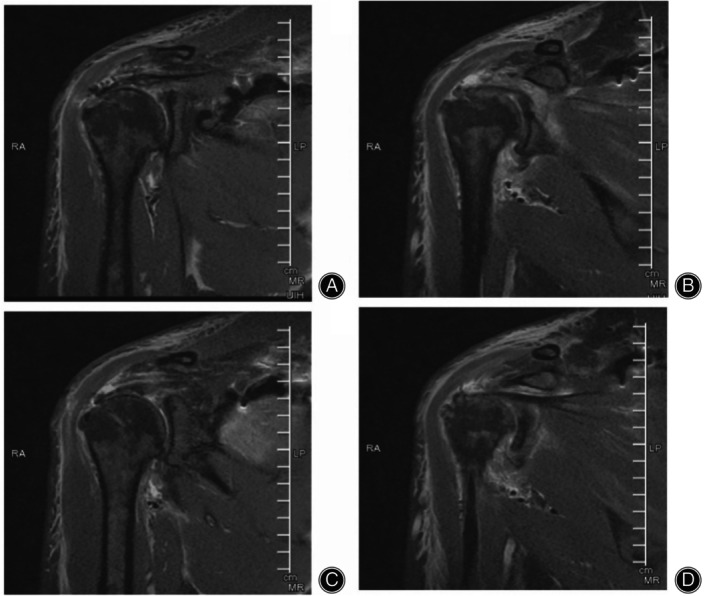
This observational study retrospectively enrolled 105 patients diagnosed with degenerative rotator cuff tears who underwent arthroscopic rotator cuff repair between 2016 and 2019. Following the exclusion of two patients with subscapularis or superior labrum anterior and posterior (SLAP) tears, as well as three patients who were lost to follow-up, a cohort of 100 patients was included for clinical and imaging evaluation. Among these individuals, 50 were assigned to the double-row repair group, whereas the remaining 50 comprised the single-row repair group. Bilateral shoulder magnetic resonance imaging (MRI) scans were conducted no less than 24 months post-surgery. Experienced arthroscopic surgeons, blinded to the LAA measurements, assessed the rotator interval (RI) using a control MRI. Functional assessment was performed using the University of California, Los Angeles (UCLA) quick disability of the shoulder and arm, shoulder and hand (qDASH) score. The Wilcoxon signed-rank test for dependent samples was employed to compare data between the pre- and post-intervention groups. Pearson correlation coefficients were calculated to evaluate the relationship between different parameters.
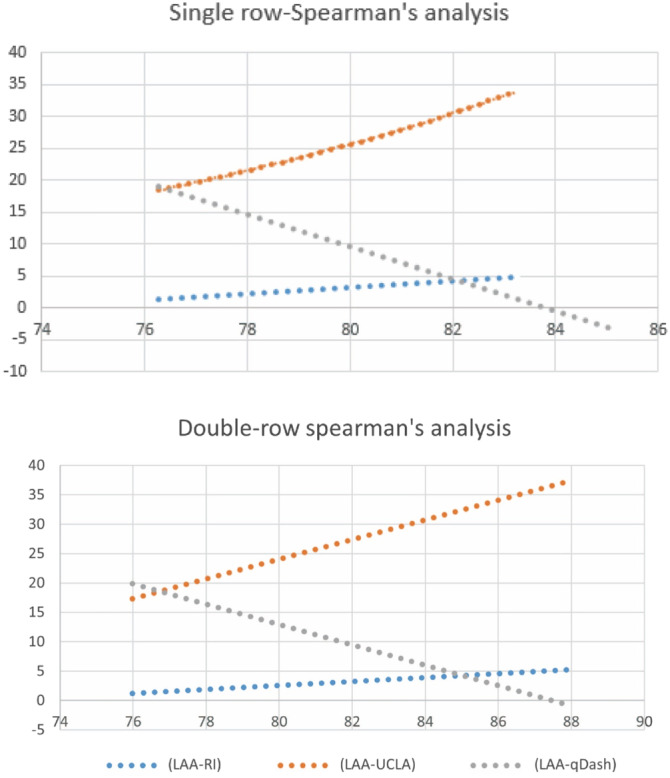
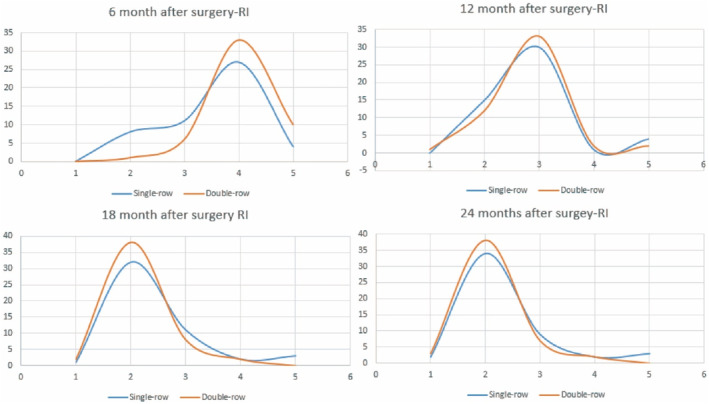
The study population consisted of 73 female patients and 27 male patients, with a mean age of 58.32 ± 5.29 years and a mean follow-up duration of 25.88 ± 8.11 months. Preoperatively, the mean LAA was 75.81° ± 11.28°, RI was 4.78 ± 0.62, UCLA score was 17.54 ± 2.44, and qDASH score was 2.45 ± 0.25. The average tear size was 8.95 ± 2.11 mm. A statistically significant difference in LAA was observed between the preoperative and postoperative measurements, with the double-row repair group exhibiting a greater LAA than the single-row repair group. Finally, a significant correlation was identified between LAA, RI, and qDASH scores after a 24-month follow-up period.
According to our findings, the utilization of double-row rivet fixation has a greater LAA angle than single-row rivet fixation. Moreover, this preservation of LAA is significantly associated with the functional recovery of the shoulder joint.
关节镜手术已被确立为治疗肩袖撕裂的有效干预措施。本研究的主要目的是分析使用单排铆钉固定和双排铆钉固定技术修复肩袖后外侧肩峰角(LAA)的变化。此外,我们还研究了 LAA 对肩袖修复手术预后的影响。
本观察性研究回顾性纳入了 2016 年至 2019 年间接受关节镜肩袖修复的 105 例退行性肩袖撕裂患者。排除了 2 例肩胛下肌或上盂唇前、后复合体(SLAP)撕裂患者和 3 例失访患者后,共有 100 例患者纳入临床和影像学评估。其中,50 例患者接受双排修复,50 例患者接受单排修复。术后至少 24 个月对所有患者进行双侧肩部磁共振成像(MRI)检查。经验丰富的关节镜外科医生对 LAA 测量值进行盲法评估,使用对照 MRI 评估旋转间隔(RI)。采用加利福尼亚大学洛杉矶分校(UCLA)的肩部和手臂快速残疾问卷(UCLA 快速残疾的肩部和手臂,UCLA)、肩和手(qDASH)评分进行功能评估。采用配对样本 Wilcoxon 符号秩检验比较干预前后组间数据。采用 Pearson 相关系数评估不同参数之间的关系。
研究人群包括 73 名女性和 27 名男性患者,平均年龄 58.32±5.29 岁,平均随访时间 25.88±8.11 个月。术前,LAA 平均为 75.81°±11.28°,RI 为 4.78±0.62,UCLA 评分为 17.54±2.44,qDASH 评分为 2.45±0.25。平均撕裂大小为 8.95±2.11mm。术前与术后 LAA 差异有统计学意义,双排修复组的 LAA 大于单排修复组。最后,在 24 个月的随访后,发现 LAA、RI 和 qDASH 评分之间存在显著相关性。
根据我们的发现,双排铆钉固定的使用比单排铆钉固定具有更大的 LAA 角度。此外,LAA 的这种保留与肩关节功能的恢复显著相关。