Department of Anesthesiology and Intensive Care Medicine, Charité-Universitätsmedizin Berlin, Corporate Member of Freie Universität Berlin and Humboldt Universität zu Berlin, Berlin, Germany.
Department of Anesthesiology and Intensive Care Medicine, University Medical Center Schleswig-Holstein, Berlin, Lübeck, Germany.
Crit Care Med. 2024 Apr 1;52(4):e182-e192. doi: 10.1097/CCM.0000000000006152. Epub 2023 Dec 19.
Nonpharmacologic delirium management is recommended by current guidelines, but studies on the impact of ICU design are still limited. The study's primary purpose was to determine if a multicomponent change in room design prevents ICU delirium. Second, the influence of lighting conditions on serum melatonin was assessed.
Prospective observational cohort pilot study.
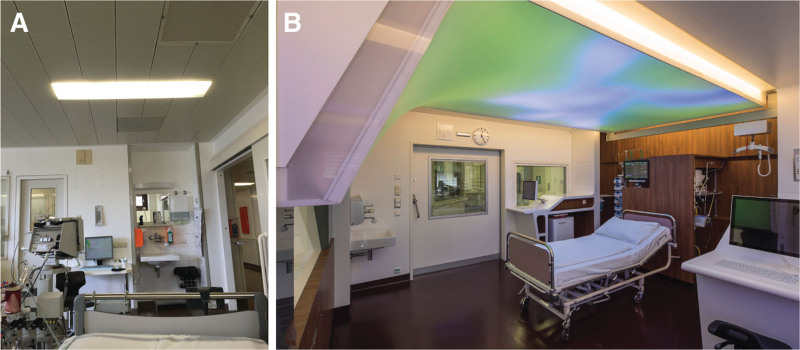
The new design concept was established in two two-bed ICU rooms of a university hospital. Besides modifications aimed at stress relief, it includes a new dynamic lighting system.
Seventy-four adult critically ill patients on mechanical ventilation with an expected ICU length of stay of at least 48 hours, treated in modified or standard rooms.
None.
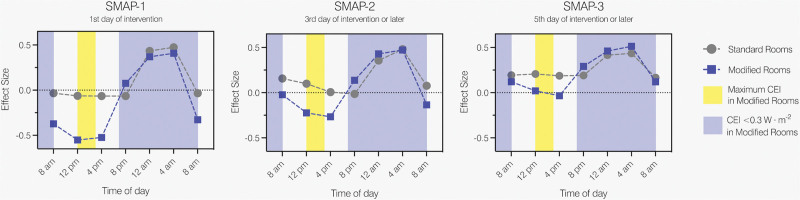
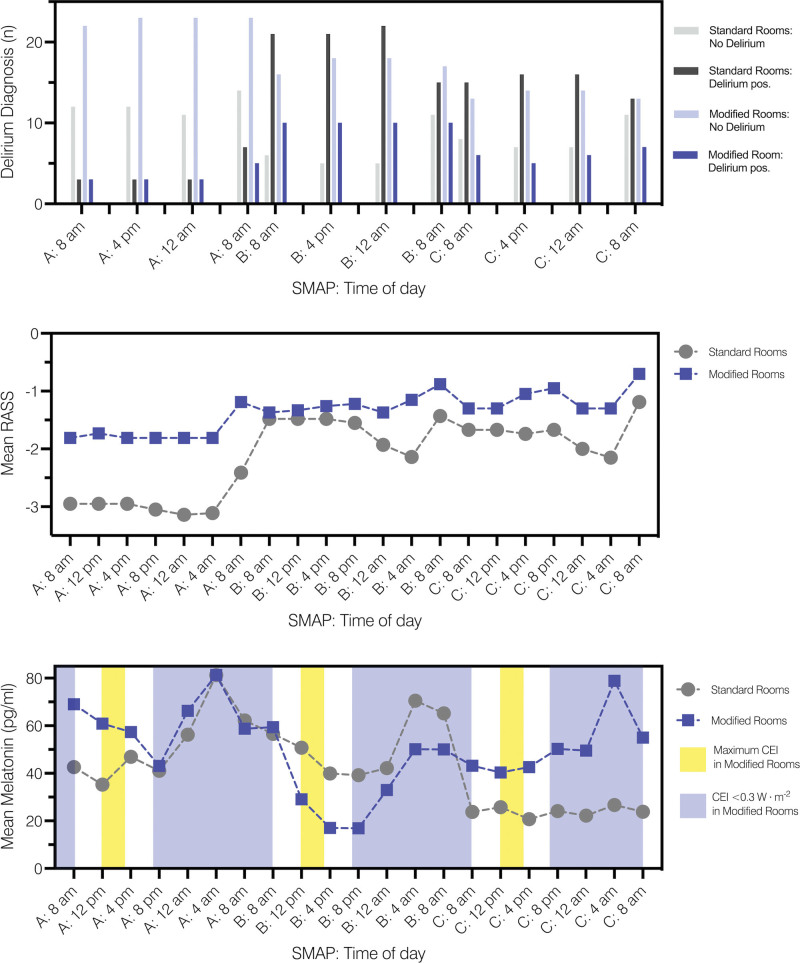
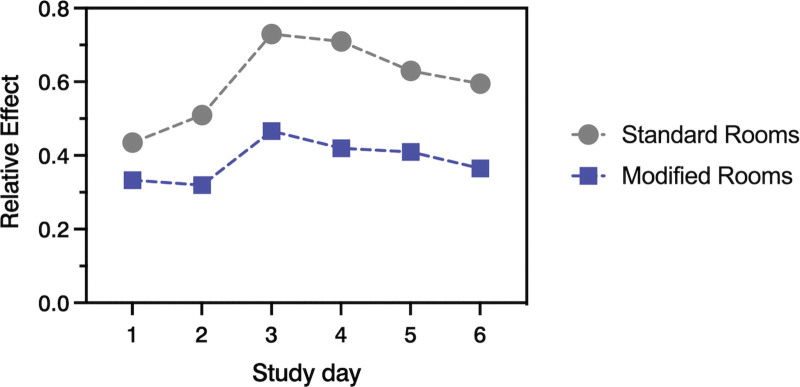
The clinical examination included a prospective assessment for depth of sedation, delirium, and pain every 8 hours using validated scores. Blood samples for serum melatonin profiles were collected every 4 hours for a maximum of three 24-hour periods. Seventy-four patients were included in the analysis. Seventy-six percent ( n = 28) of patients in the standard rooms developed delirium compared with 46% of patients ( n = 17) in the modified rooms ( p = 0.017). Patients in standard rooms (vs. modified rooms) had a 2.3-fold higher delirium severity (odds ratio = 2.292; 95% CI, 1.582-3.321; p < 0.0001). Light intensity, calculated using the measure of circadian effective irradiance, significantly influenced the course of serum melatonin ( p < 0.0001). Significant interactions ( p < 0.001) revealed that differences in serum melatonin between patients in standard and modified rooms were not the same over time but varied in specific periods of time.
Modifications in ICU room design may influence the incidence and severity of delirium. Dedicated light therapy could potentially influence delirium outcomes by modulating circadian melatonin levels.
目前的指南建议对非药物性谵妄进行管理,但关于 ICU 设计影响的研究仍然有限。本研究的主要目的是确定多因素的房间设计改变是否可以预防 ICU 谵妄。其次,评估光照条件对血清褪黑素的影响。
前瞻性观察队列初步研究。
新的设计理念在一家大学医院的两间双人 ICU 病房中建立。除了旨在缓解压力的修改外,还包括新的动态照明系统。
74 名接受机械通气且预计 ICU 入住时间至少为 48 小时的成年危重症患者,在改良或标准病房中接受治疗。
无。
临床检查包括使用经过验证的评分每 8 小时对镇静深度、谵妄和疼痛进行前瞻性评估。每隔 4 小时采集一次血清褪黑素样本,最多采集三个 24 小时周期。74 名患者纳入分析。标准病房(n = 28)的 76%患者发生谵妄,而改良病房(n = 17)的 46%患者发生谵妄(p = 0.017)。与改良病房相比,标准病房的患者发生谵妄的严重程度更高(比值比=2.292;95%置信区间,1.582-3.321;p < 0.0001)。使用昼夜有效辐照度的测量值计算出的光照强度显著影响血清褪黑素的变化过程(p < 0.0001)。显著的交互作用(p < 0.001)表明,标准病房和改良病房患者的血清褪黑素之间的差异并不是随着时间的推移而相同的,而是在特定的时间段内有所不同。
ICU 病房设计的改变可能会影响谵妄的发生率和严重程度。专门的光照疗法通过调节昼夜节律褪黑素水平,可能会影响谵妄的结局。