Department of Anesthesiology, University Medical Center Groningen, University of Groningen, Hanzeplein 1, Groningen, 9700 RB, The Netherlands.
Department of Anesthesia, Critical Care and Perioperative Medicine York Teaching Hospitals NHS Foundation Trust, Centre for Health and Population Sciences, Hull York Medical School, York, UK.
J Clin Monit Comput. 2024 Apr;38(2):325-335. doi: 10.1007/s10877-023-01097-z. Epub 2023 Dec 19.
Intraoperative hypotension (IOH) is associated with adverse outcomes. We therefore explored beliefs regarding IOH and barriers to its treatment. Secondarily, we assessed if an educational intervention and mandated mean arterial pressure (MAP), or the implementation of the Hypotension Prediction Index-software (HPI) were associated with a reduction in IOH.
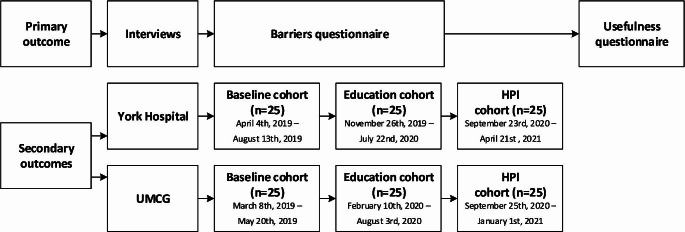
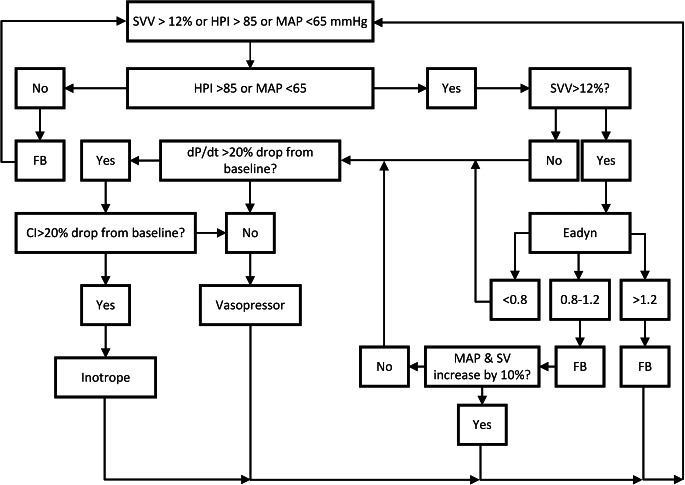
Structured interviews (n = 27) and questionnaires (n = 84) were conducted to explore clinicians' beliefs and barriers to IOH treatment, in addition to usefulness of HPI questionnaires (n = 14). 150 elective major surgical patients who required invasive blood pressure monitoring were included in three cohorts to assess incidence and time-weighted average (TWA) of hypotension (MAP < 65 mmHg). Cohort one received standard care (baseline), the clinicians of cohort two had a training on hypotension and a mandated MAP > 65 mmHg, and patients of the third cohort received protocolized care using the HPI.
Clinicians felt challenged to manage IOH in some patients, yet they reported sufficient knowledge and skills. HPI-software was considered useful and beneficial. No difference was found in incidence of IOH between cohorts. TWA was comparable between baseline and education cohort (0.15 mmHg [0.05-0.41] vs. 0.11 mmHg [0.02-0.37]), but was significantly lower in the HPI cohort (0.04 mmHg [0.00 to 0.11], p < 0.05 compared to both).
Clinicians believed they had sufficient knowledge and skills, which could explain why no difference was found after the educational intervention. In the HPI cohort, IOH was significantly reduced compared to baseline, therefore HPI-software may help prevent IOH.
ISRCTN 17,085,700 on May 9th, 2019.
术中低血压(IOH)与不良结局相关。因此,我们探讨了关于 IOH 的信念以及治疗其的障碍。其次,我们评估了教育干预和强制性平均动脉压(MAP),或实施低血压预测指数软件(HPI)是否与减少 IOH 相关。
我们进行了结构访谈(n=27)和问卷调查(n=84),以探讨临床医生对 IOH 治疗的信念和障碍,以及 HPI 问卷的有用性(n=14)。我们纳入了三个队列的 150 名接受侵入性血压监测的择期大手术患者,以评估低血压(MAP<65mmHg)的发生率和时间加权平均值(TWA)。队列 1 接受标准护理(基线),队列 2 的临床医生接受了低血压培训和强制性 MAP>65mmHg,队列 3 的患者接受了使用 HPI 的方案化护理。
临床医生认为在某些患者中管理 IOH 具有挑战性,但他们报告了足够的知识和技能。HPI 软件被认为是有用和有益的。三个队列之间 IOH 的发生率没有差异。TWA 在基线和教育队列之间是可比的(0.15mmHg[0.05-0.41]与 0.11mmHg[0.02-0.37]),但在 HPI 队列中显著降低(0.04mmHg[0.00 至 0.11],与两者相比,p<0.05)。
临床医生认为他们有足够的知识和技能,这可以解释为什么在教育干预后没有发现差异。在 HPI 队列中,与基线相比,IOH 显著降低,因此 HPI 软件可能有助于预防 IOH。
ISRCTN85708721 于 2019 年 5 月 9 日注册。