Vascular Biology Unit, IFOM ETS-The AIRC Institute of Molecular Oncology, Milan, Italy; Hematology Department, Fondazione IRCCS Cà Granda Ospedale Maggiore Policlinico, Milan, Italy.
Department of Acute Brain and Cardiovascular Injury, Institute for Pharmacological Research Mario Negri IRCCS, Milan, Italy.
EBioMedicine. 2024 Jan;99:104914. doi: 10.1016/j.ebiom.2023.104914. Epub 2023 Dec 18.
Cerebral Cavernous Malformation (CCM) is a rare cerebrovascular disease, characterized by the presence of multiple vascular malformations that may result in intracerebral hemorrhages (ICHs), seizure(s), or focal neurological deficits (FND). Familial CCM (fCCM) is due to loss of function mutations in one of the three independent genes KRIT1 (CCM1), Malcavernin (CCM2), or Programmed Cell death 10 (PDCD10/CCM3). The aim of this study was to identify plasma protein biomarkers of fCCM to assess the severity of the disease and predict its progression.
Here, we have investigated plasma samples derived from n = 71 symptomatic fCCM patients (40 female/31 male) and n = 17 healthy donors (HD) (9 female/8 male) of the Phase 1/2 Treat_CCM trial, using multiplexed protein profiling approaches.
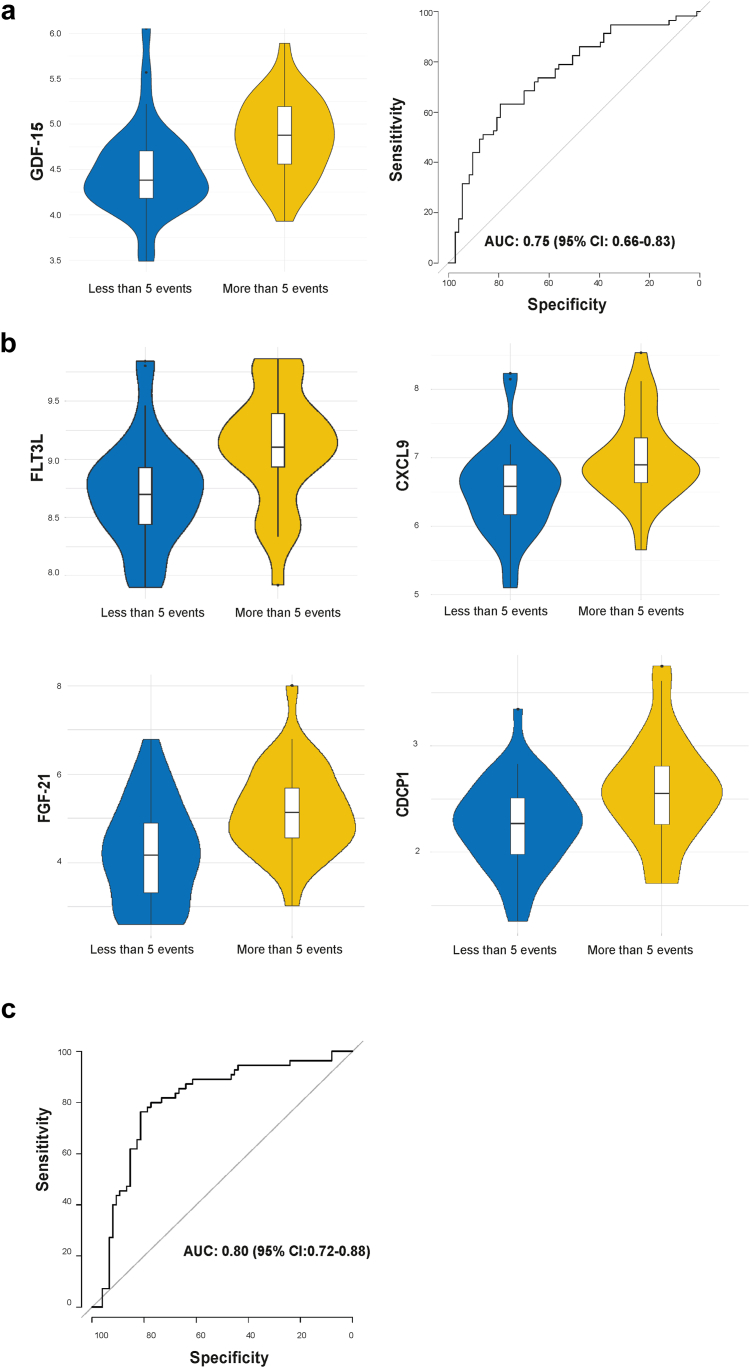
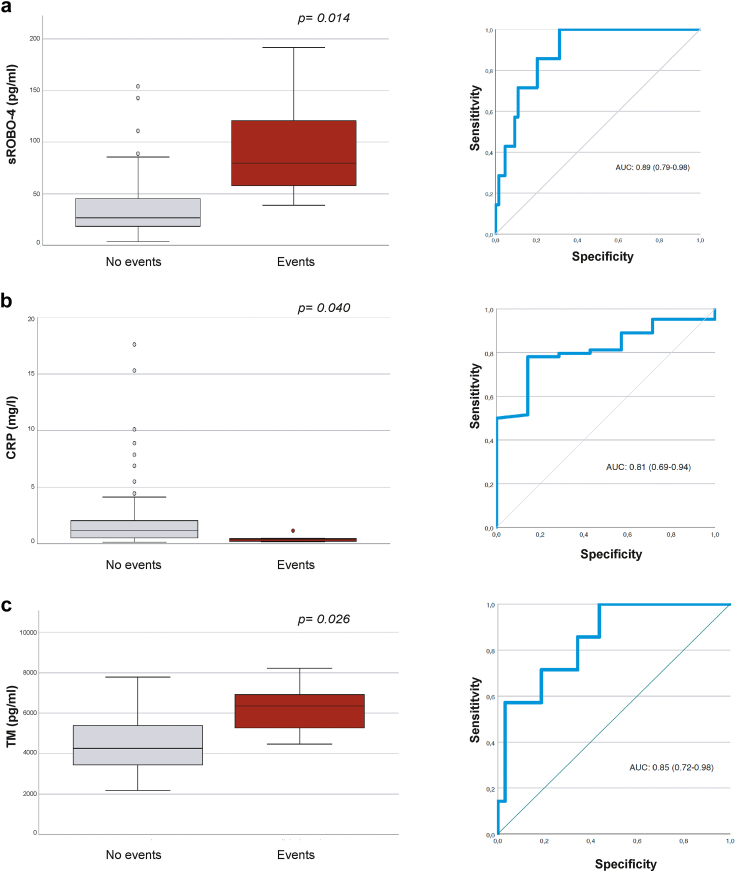
Biomarkers as sCD14 (p = 0.00409), LBP (p = 0.02911), CXCL4 (p = 0.038), ICAM-1 (p = 0.02013), ANG2 (p = 0.026), CCL5 (p = 0.00403), THBS1 (p = 0.0043), CRP (p = 0.0092), and HDL (p = 0.027), were significantly different in fCCM compared to HDs. Of note, sENG (p = 0.011), THBS1 (p = 0.011) and CXCL4 (p = 0.011), were correlated to CCM genotype. sROBO4 (p = 0.014), TM (p = 0.026) and CRP (p = 0.040) were able to predict incident adverse clinical events, such as ICH, FND or seizure. GDF-15, FLT3L, CXCL9, FGF-21 and CDCP1, were identified as predictors of the formation of new MRI-detectable lesions over 2-year follow-up. Furthermore, the functional relevance of ang2, thbs1, robo4 and cdcp1 markers was validated by zebrafish pre-clinical model of fCCM.
Overall, our study identifies a set of biochemical parameters to predict CCM progression, suggesting biological interpretations and potential therapeutic approaches to CCM disease.
Italian Medicines Agency, Associazione Italiana per la Ricerca sul Cancro (AIRC), ERC, Leducq Transatlantic Network of Excellence, Swedish Research Council.
脑静脉畸形(CCM)是一种罕见的脑血管疾病,其特征是存在多个血管畸形,可能导致颅内出血(ICH)、癫痫发作或局灶性神经功能缺损(FND)。家族性 CCM(fCCM)是由于三个独立基因 KRIT1(CCM1)、Malcavernin(CCM2)或程序性细胞死亡 10(PDCD10/CCM3)之一的功能丧失突变引起的。本研究的目的是鉴定 fCCM 的血浆蛋白生物标志物,以评估疾病的严重程度并预测其进展。
在这里,我们使用多重蛋白质谱分析方法研究了来自 n = 71 名有症状的 fCCM 患者(40 名女性/31 名男性)和 n = 17 名健康供体(HD)(9 名女性/8 名男性)的血浆样本,这些供体来自 1/2 期 Treat_CCM 试验。
与 HD 相比,fCCM 中 sCD14(p = 0.00409)、LBP(p = 0.02911)、CXCL4(p = 0.038)、ICAM-1(p = 0.02013)、ANG2(p = 0.026)、CCL5(p = 0.00403)、THBS1(p = 0.0043)、CRP(p = 0.0092)和 HDL(p = 0.027)等生物标志物存在显著差异。值得注意的是,sENG(p = 0.011)、THBS1(p = 0.011)和 CXCL4(p = 0.011)与 CCM 基因型相关。sROBO4(p = 0.014)、TM(p = 0.026)和 CRP(p = 0.040)能够预测 ICH、FND 或癫痫等不良临床事件的发生。GDF-15、FLT3L、CXCL9、FGF-21 和 CDCP1 被鉴定为 2 年随访期间新 MRI 可检测到病变形成的预测因子。此外,通过 fCCM 的斑马鱼临床前模型验证了 ang2、thbs1、robo4 和 cdcp1 标志物的功能相关性。
总的来说,我们的研究确定了一组预测 CCM 进展的生化参数,这表明了生物学解释和潜在的治疗方法对 CCM 疾病的意义。
意大利药品管理局、意大利癌症研究协会(AIRC)、ERC、Leducq 跨大西洋卓越研究网络、瑞典研究理事会。