Cell Biology and Regenerative Medicine Program, Department of Surgery, Uniformed Services University, Bethesda, MD, United States.
Henry M. Jackson Foundation for the Advancement of Military Medicine, Inc., Bethesda, MD, United States.
Front Immunol. 2023 Dec 5;14:1280884. doi: 10.3389/fimmu.2023.1280884. eCollection 2023.
Heterotopic ossification (HO) is a complex pathology often observed in combat injured casualties who have sustained severe, high energy polytraumatic extremity injuries. Once HO has developed, prophylactic therapies are limited outside of surgical excision. Tourniquet-induced ischemia injury (IR) exacerbates trauma-mediated musculoskeletal tissue injury, inflammation, osteogenic progenitor cell development and HO formation. Others have shown that focal adhesion kinase-2 (FAK2) plays a key role in regulating early inflammatory signaling events. Therefore, we hypothesized that targeting FAK2 prophylactically would mitigate extremity trauma induced IR inflammation and HO formation.
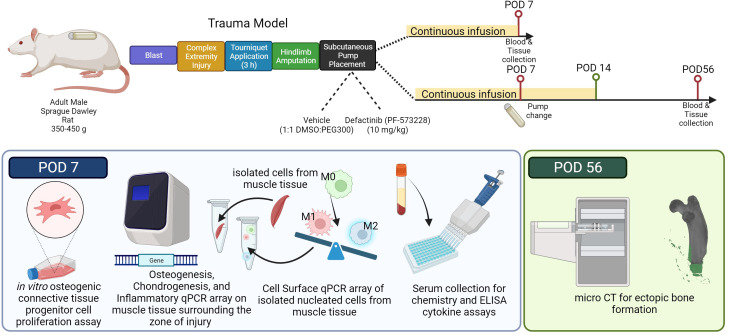
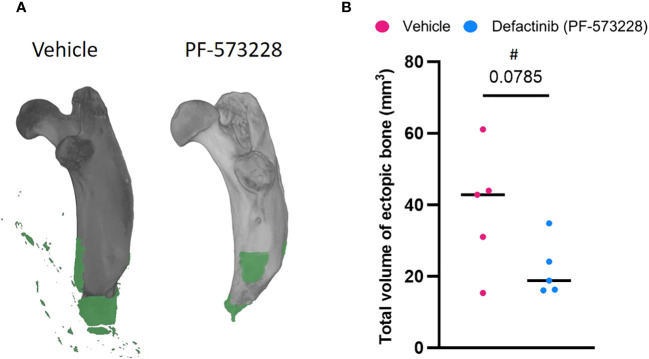
We tested whether the continuous infusion of a FAK2 inhibitor (Defactinib, PF-573228; 6.94 µg/kg/min for 14 days) can mitigate ectopic bone formation (HO) using an established blast-related extremity injury model involving femoral fracture, quadriceps crush injury, three hours of tourniquet-induced limb ischemia, and hindlimb amputation through the fracture site. Tissue inflammation, infiltrating cells, osteogenic progenitor cell content were assessed at POD-7. Micro-computed tomography imaging was used to quantify mature HO at POD-56.
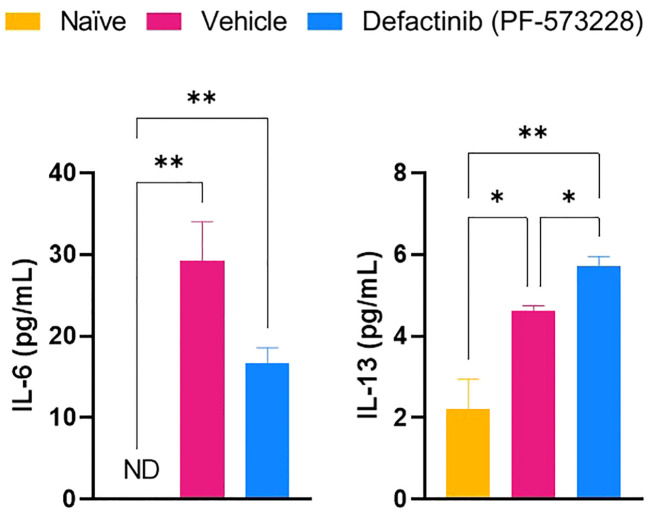
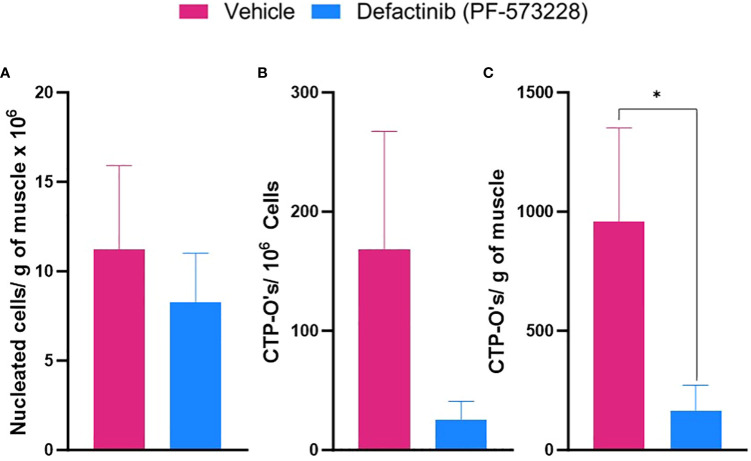
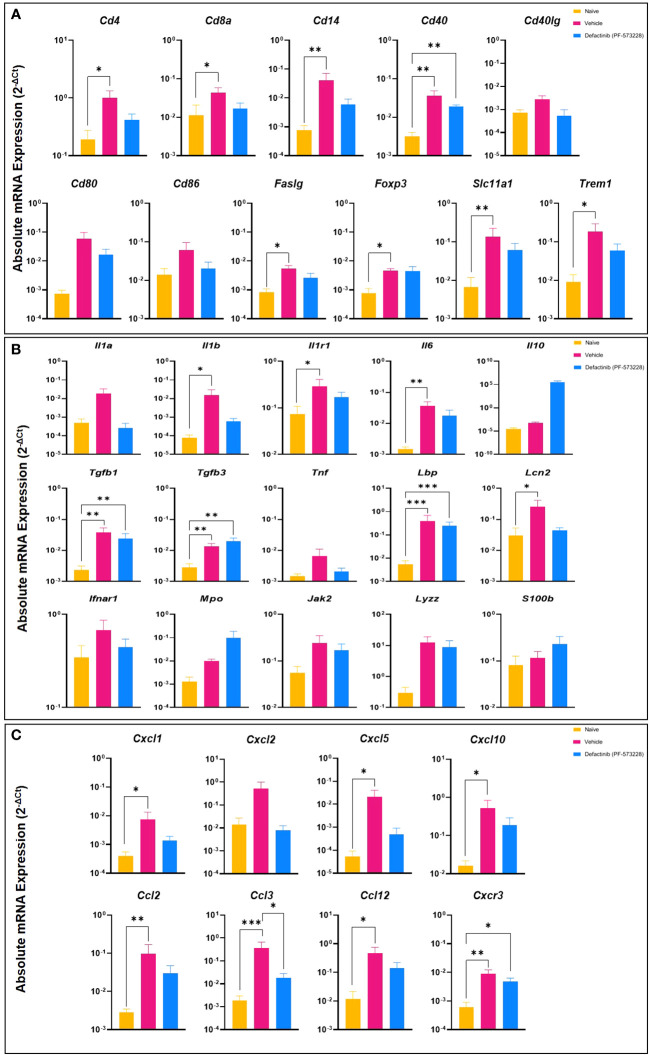
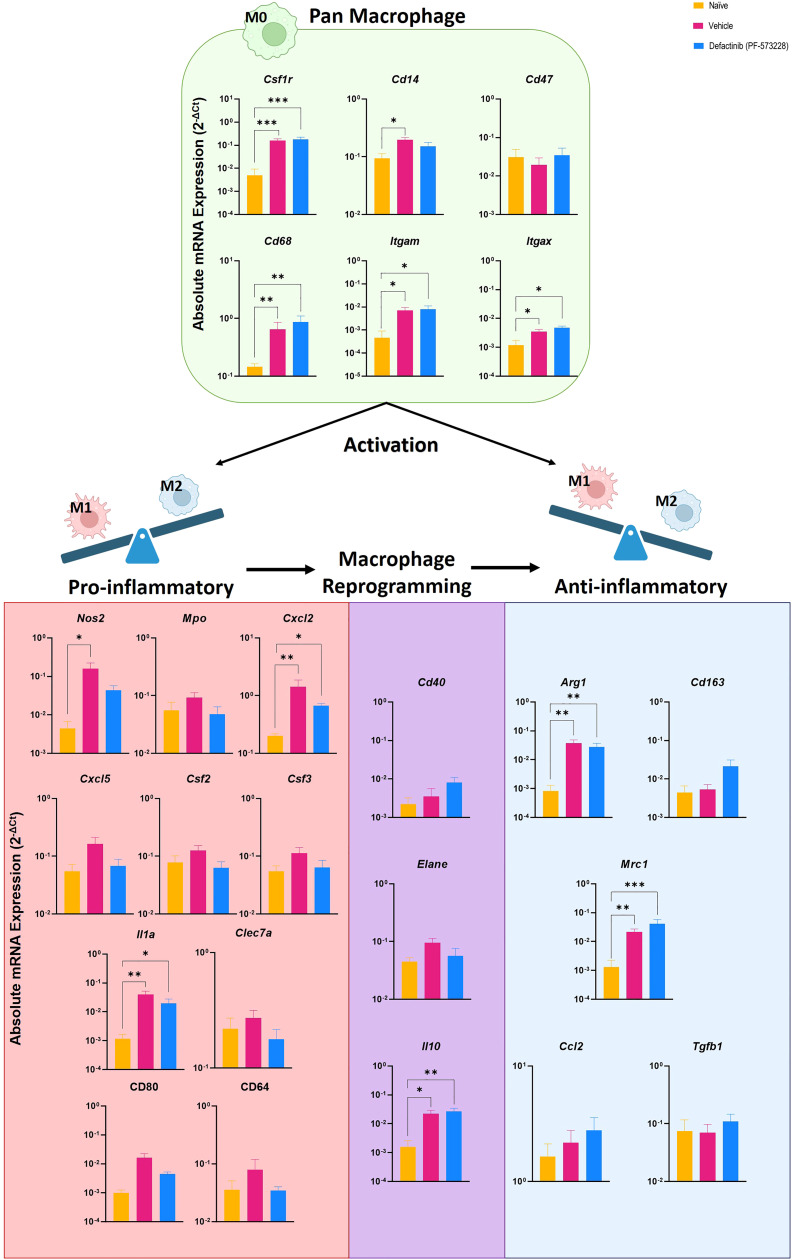
In comparison to vehicle control-treated rats, FAK2 administration resulted in no marked wound healing complications or weight loss. FAK2 treatment decreased HO by 43%. At POD-7, marked reductions in tissue proinflammatory gene expression and assayable osteogenic progenitor cells were measured, albeit no significant changes in expression patterns of angiogenic, chondrogenic and osteogenic genes. At the same timepoint, injured tissue from FAK-treated rats had fewer infiltrating cells. Additionally, gene expression analyses of tissue infiltrating cells resulted in a more measurable shift from an M1 inflammatory to an M2 anti-inflammatory macrophage phenotype in the FAK2 inhibitor-treated group.
Our findings suggest that FAK2 inhibition may be a novel strategy to dampen trauma-induced inflammation and attenuate HO in patients at high risk as a consequence of severe musculoskeletal polytrauma.
异位骨化(HO)是一种复杂的病理学,常在遭受严重高能量多发肢体创伤的战伤伤员中观察到。一旦发生 HO,除手术切除外,预防治疗的选择非常有限。止血带引起的缺血性损伤(IR)会加重创伤引起的肌肉骨骼组织损伤、炎症、成骨祖细胞的发育和 HO 的形成。其他人已经表明粘着斑激酶-2(FAK2)在调节早期炎症信号事件中起着关键作用。因此,我们假设预防性靶向 FAK2 会减轻肢体创伤引起的 IR 炎症和 HO 的形成。
我们使用已建立的爆炸相关肢体损伤模型(包括股骨骨折、股四头肌挤压伤、三小时止血带引起的肢体缺血和通过骨折部位的后肢截肢),测试了连续输注 FAK2 抑制剂(Defactinib,PF-573228;14 天内 6.94μg/kg/min)是否可以减轻异位骨形成(HO)。在术后第 7 天评估组织炎症、浸润细胞和成骨祖细胞含量。在术后第 56 天使用微计算机断层扫描成像来定量成熟的 HO。
与载体对照治疗的大鼠相比,FAK2 给药没有导致明显的伤口愈合并发症或体重减轻。FAK2 治疗使 HO 减少了 43%。在术后第 7 天,组织促炎基因表达和可检测的成骨祖细胞明显减少,尽管血管生成、软骨生成和成骨基因的表达模式没有明显变化。同时,FAK 治疗大鼠的损伤组织中浸润细胞较少。此外,组织浸润细胞的基因表达分析导致 FAK2 抑制剂治疗组中从 M1 炎症到 M2 抗炎巨噬细胞表型的更可测量的转变。
我们的研究结果表明,FAK2 抑制可能是一种新的策略,可以减轻严重肌肉骨骼多发伤患者因严重创伤引起的炎症和减弱 HO。