Department of Molecular Biotechnology and Health Sciences, Molecular Biotechnology Center, University of Torino, Via Nizza 52, 10126, Torino, Italy.
UCL, Bloomsbury Institute of Intensive Care Medicine, Division of Medicine, University College London, WC1E 6BT, London, UK.
Cell Death Dis. 2023 Dec 20;14(12):849. doi: 10.1038/s41419-023-06357-z.
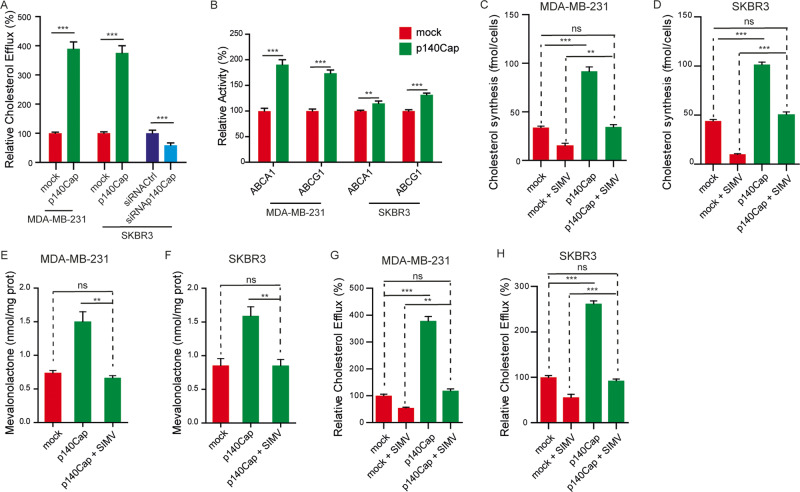
p140Cap is an adaptor protein involved in assembling multi-protein complexes regulating several cellular processes. p140Cap acts as a tumor suppressor in breast cancer (BC) and neuroblastoma patients, where its expression correlates with a better prognosis. The role of p140Cap in tumor metabolism remains largely unknown. Here we study the role of p140Cap in the modulation of the mevalonate (MVA) pathway in BC cells. The MVA pathway is responsible for the biosynthesis of cholesterol and non-sterol isoprenoids and is often deregulated in cancer. We found that both in vitro and in vivo, p140Cap cells and tumors show an increased flux through the MVA pathway by positively regulating the pace-maker enzyme of the MVA pathway, the 3-hydroxy-3-methyl-glutaryl-coenzyme A reductase (HMGCR), via transcriptional and post-translational mechanisms. The higher cholesterol synthesis is paralleled with enhanced cholesterol efflux. Moreover, p140Cap promotes increased cholesterol localization in the plasma membrane and reduces lipid rafts-associated Rac1 signalling, impairing cell membrane fluidity and cell migration in a cholesterol-dependent manner. Finally, p140Cap BC cells exhibit decreased cell viability upon treatments with statins, alone or in combination with chemotherapeutic at low concentrations in a synergistic manner. Overall, our data highlight a new perspective point on tumor suppression in BC by establishing a previously uncharacterized role of the MVA pathway in p140Cap expressing tumors, thus paving the way to the use of p140Cap as a potent biomarker to stratify patients for better tuning therapeutic options.
p140Cap 是一种衔接蛋白,参与组装调节多种细胞过程的多蛋白复合物。p140Cap 在乳腺癌 (BC) 和神经母细胞瘤患者中作为肿瘤抑制因子发挥作用,其表达与更好的预后相关。p140Cap 在肿瘤代谢中的作用在很大程度上尚不清楚。在这里,我们研究了 p140Cap 在调节 BC 细胞甲羟戊酸 (MVA) 途径中的作用。MVA 途径负责胆固醇和非甾体异戊二烯的生物合成,并且在癌症中经常失调。我们发现,无论是在体外还是体内,p140Cap 细胞和肿瘤都通过正向调节 MVA 途径的节奏酶——3-羟-3-甲基戊二酰辅酶 A 还原酶 (HMGCR),通过转录和翻译后机制显示出 MVA 途径通量的增加。更高的胆固醇合成与增强的胆固醇外排平行。此外,p140Cap 促进胆固醇在质膜中的定位增加,并减少与脂筏相关的 Rac1 信号,以胆固醇依赖性方式损害细胞膜流动性和细胞迁移。最后,p140Cap BC 细胞在用他汀类药物单独或联合化疗药物以协同方式在低浓度下处理时表现出降低的细胞活力。总的来说,我们的数据通过建立 MVA 途径在表达 p140Cap 的肿瘤中的先前未表征的作用,为理解 BC 中的肿瘤抑制提供了一个新的视角,从而为使用 p140Cap 作为一种有效的生物标志物来分层患者以获得更好的治疗选择铺平了道路。