Department of Biomedical Sciences, University of Lausanne, Lausanne, Switzerland.
Centre for Psychiatric Neuroscience, Department of Psychiatry, The Lausanne University Hospital, Lausanne, Switzerland.
Mol Psychiatry. 2024 Feb;29(2):327-341. doi: 10.1038/s41380-023-02329-z. Epub 2023 Dec 21.
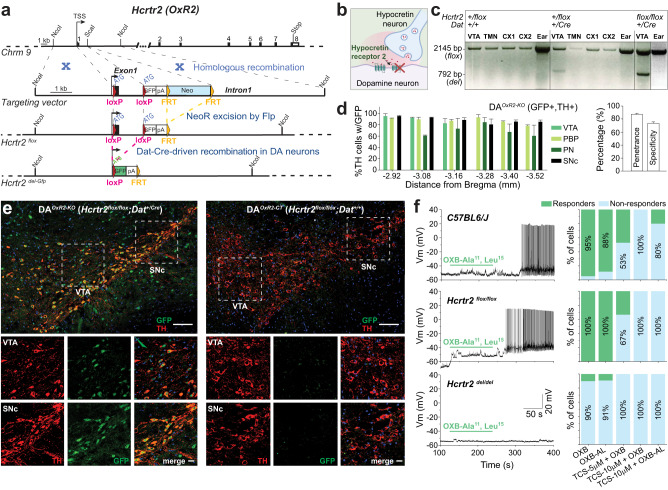
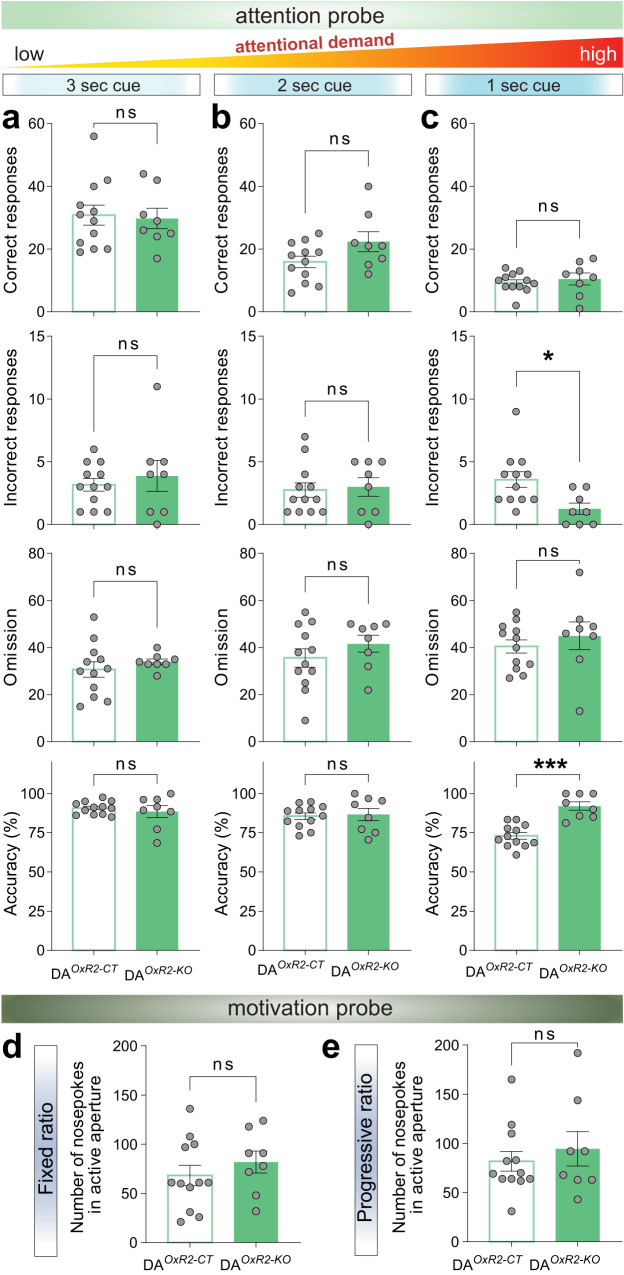
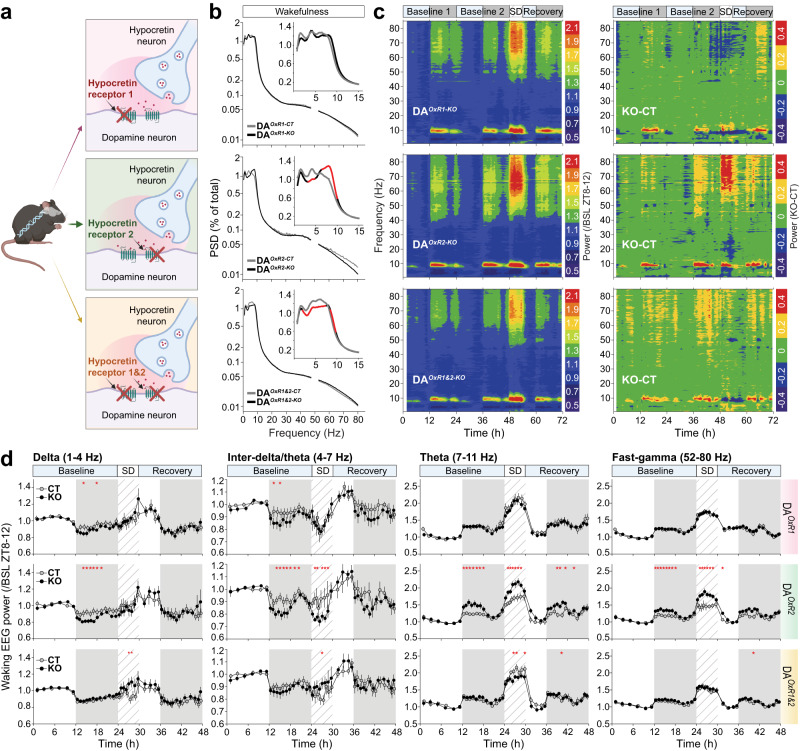
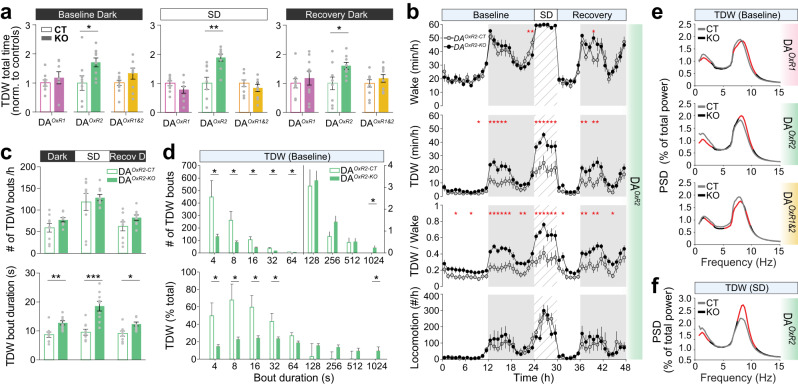
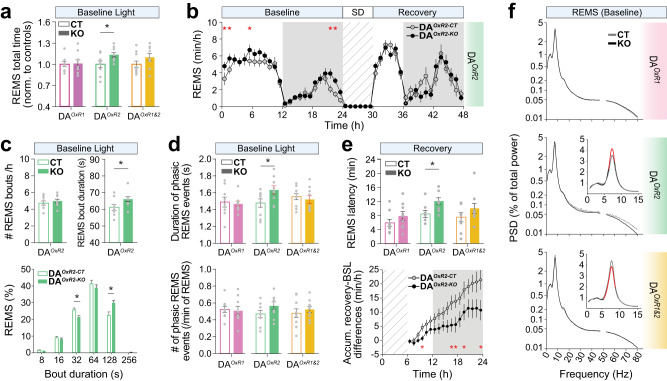
Hypocretin/Orexin (HCRT/OX) and dopamine (DA) are both key effectors of salience processing, reward and stress-related behaviors and motivational states, yet their respective roles and interactions are poorly delineated. We inactivated HCRT-to-DA connectivity by genetic disruption of Hypocretin receptor-1 (Hcrtr1), Hypocretin receptor-2 (Hcrtr2), or both receptors (Hcrtr1&2) in DA neurons and analyzed the consequences on vigilance states, brain oscillations and cognitive performance in freely behaving mice. Unexpectedly, loss of Hcrtr2, but not Hcrtr1 or Hcrtr1&2, induced a dramatic increase in theta (7-11 Hz) electroencephalographic (EEG) activity in both wakefulness and rapid-eye-movement sleep (REMS). DA-deficient mice spent more time in an active (or theta activity-enriched) substate of wakefulness, and exhibited prolonged REMS. Additionally, both wake and REMS displayed enhanced theta-gamma phase-amplitude coupling. The baseline waking EEG of DA-deficient mice exhibited diminished infra-theta, but increased theta power, two hallmarks of EEG hyperarousal, that were however uncoupled from locomotor activity. Upon exposure to novel, either rewarding or stress-inducing environments, DA-deficient mice featured more pronounced waking theta and fast-gamma (52-80 Hz) EEG activity surges compared to littermate controls, further suggesting increased alertness. Cognitive performance was evaluated in an operant conditioning paradigm, which revealed that DA-ablated mice manifest faster task acquisition and higher choice accuracy under increasingly demanding task contingencies. However, the mice concurrently displayed maladaptive patterns of reward-seeking, with behavioral indices of enhanced impulsivity and compulsivity. None of the EEG changes observed in DA-deficient mice were seen in DA-ablated mice, which tended to show opposite EEG phenotypes. Our findings establish a clear genetically-defined link between monosynaptic HCRT-to-DA neurotransmission and theta oscillations, with a differential and novel role of HCRTR2 in theta-gamma cross-frequency coupling, attentional processes, and executive functions, relevant to disorders including narcolepsy, attention-deficit/hyperactivity disorder, and Parkinson's disease.
下丘脑分泌素/食欲素 (HCRT/OX) 和多巴胺 (DA) 都是突显处理、奖励和应激相关行为和动机状态的关键效应物,但它们各自的作用和相互作用尚未得到充分描述。我们通过基因敲除下丘脑分泌素受体 1 (Hcrtr1)、下丘脑分泌素受体 2 (Hcrtr2) 或 DA 神经元中的两种受体 (Hcrtr1&2) 来破坏 HCRT-DA 连接,并分析了其对自由活动小鼠警觉状态、脑电波和认知表现的影响。出乎意料的是,与 Hcrtr1 或 Hcrtr1&2 缺失相比,Hcrtr2 的缺失会导致清醒和快速眼动睡眠 (REMS) 中θ (7-11 Hz) 脑电 (EEG) 活动显著增加。DA 缺乏的小鼠在清醒状态下处于更活跃的 (或θ活动丰富的) 亚状态,并且表现出更长的 REMS。此外,清醒和 REMS 都表现出增强的θ-γ相位-振幅耦合。DA 缺乏小鼠的基础清醒 EEG 表现出θ 下功率减小,但θ 功率增加,这是 EEG 过度唤醒的两个特征,但与运动活动无关。在暴露于新的奖励或应激诱导环境时,与同窝对照相比,DA 缺乏的小鼠表现出更明显的清醒θ 和快速γ (52-80 Hz) EEG 活动激增,进一步表明警觉性增加。在操作性条件反射范式中评估认知表现,结果表明,DA 缺失的小鼠在任务要求逐渐增加的情况下,表现出更快的任务获取和更高的选择准确性。然而,这些小鼠同时表现出奖励寻求的适应不良模式,具有增强的冲动性和强迫性的行为指标。在 DA 缺乏的小鼠中没有观察到 EEG 变化,而 DA 缺失的小鼠倾向于表现出相反的 EEG 表型。我们的研究结果在单突触 HCRT-DA 神经传递和θ 振荡之间建立了明确的遗传定义联系,HCRTR2 在θ-γ 交叉频率耦合、注意过程和执行功能中具有不同的新型作用,与包括发作性睡病、注意力缺陷/多动障碍和帕金森病在内的疾病有关。