Center for Neuroscience, Biosciences Division, SRI International, Menlo Park, California, USA.
Front Neurol Neurosci. 2021;45:22-37. doi: 10.1159/000514963. Epub 2021 May 28.
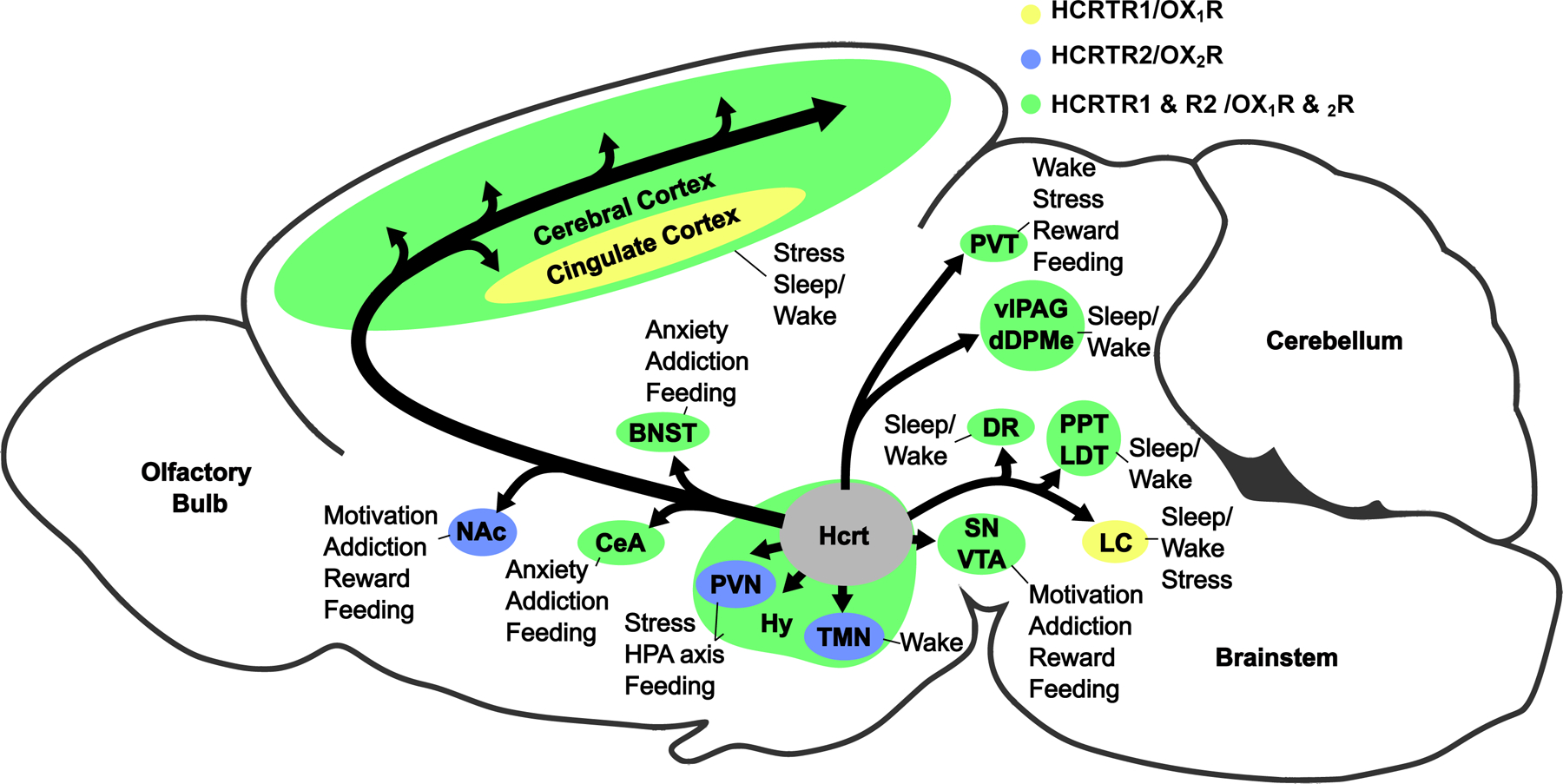
The hypocretins/orexins are two excitatory neuropeptides, alternately called HCRT1 or orexin-A and HCRT2 or orexin-B, that are the endogenous ligands for two G-protein-coupled receptors, HCRTR1/OX1R and HCRTR2/OX2R. Shortly after the discovery of this system, degeneration of hypocretin/orexin-producing neurons was implicated in the etiology of the sleep disorder narcolepsy. The involvement of this system in a disorder characterized by the loss of control over arousal state boundaries also suggested its role as a critical component of endogenous sleep-wake regulatory circuitry. The broad projections of the hypocretin/orexin-producing neurons, along with differential expression of the two receptors in the projection fields of these neurons, suggest distinct roles for these receptors. While HCRTR1/OX1R is associated with regulation of motivation, reward, and autonomic functions, HCRTR2/OX2R is strongly linked to sleep-wake control. The association of hypocretin/orexin with these physiological processes has led to intense interest in the therapeutic potential of compounds targeting these receptors. Agonists and antagonists for the hypocretin/orexin receptors have shown potential for the treatment of disorders of excessive daytime somnolence and nocturnal hyperarousal, respectively, with the first antagonists approved by the US Food and Drug Administration (FDA) in 2014 and 2019 for the treatment of insomnia. These and related compounds have also been useful tools to advance hypocretin/orexin neurobiology.
下丘脑泌素/食欲素是两种兴奋性神经肽,分别称为 HCRT1 或下丘脑泌素-A 和 HCRT2 或下丘脑泌素-B,是两种 G 蛋白偶联受体,HCRTR1/OX1R 和 HCRTR2/OX2R 的内源性配体。该系统发现后不久,下丘脑泌素/食欲素产生神经元的退化就与睡眠障碍发作性睡病的病因有关。该系统参与以觉醒状态边界失控为特征的疾病也表明其作为内源性睡眠-觉醒调节回路的关键组成部分的作用。下丘脑泌素/食欲素产生神经元的广泛投射,以及这两种受体在这些神经元投射场中的差异表达,表明这些受体具有不同的作用。虽然 HCRTR1/OX1R 与动机、奖励和自主功能的调节有关,但 HCRTR2/OX2R 与睡眠-觉醒控制密切相关。下丘脑泌素/食欲素与这些生理过程的关联导致人们对靶向这些受体的化合物的治疗潜力产生了浓厚的兴趣。下丘脑泌素/食欲素受体的激动剂和拮抗剂分别显示出治疗日间过度嗜睡和夜间过度觉醒障碍的潜力,第一种拮抗剂于 2014 年和 2019 年获得美国食品和药物管理局 (FDA) 的批准,用于治疗失眠症。这些和相关的化合物也一直是推进下丘脑泌素/食欲素神经生物学的有用工具。