Mody Aaloke, Filiatreau Lindsey M, Goss Charles W, Powell Byron J, Geng Elvin H
Division of Infectious Diseases, Department of Medicine, Washington University School of Medicine, Campus Box 8051, 4523 Clayton Avenue, St. Louis, MO, 63110, USA.
Division of Biostatistics, Washington University School of Medicine, St. Louis, MO, USA.
Implement Sci Commun. 2023 Dec 20;4(1):157. doi: 10.1186/s43058-023-00536-x.
The impact of both implementation strategies (IS) and evidence-based interventions (EBI) can vary across contexts, and a better understanding of how and why this occurs presents fundamental but challenging questions that implementation science as a field will need to grapple with. We use causal epidemiologic methods to explore the mechanisms of why sharp distinctions between implementation strategies (IS) and efficacy of an evidence-based intervention (EBI) may fail to recognize that the effect of an EBI can be deeply intertwined and dependent on the context of the IS leading to its uptake.
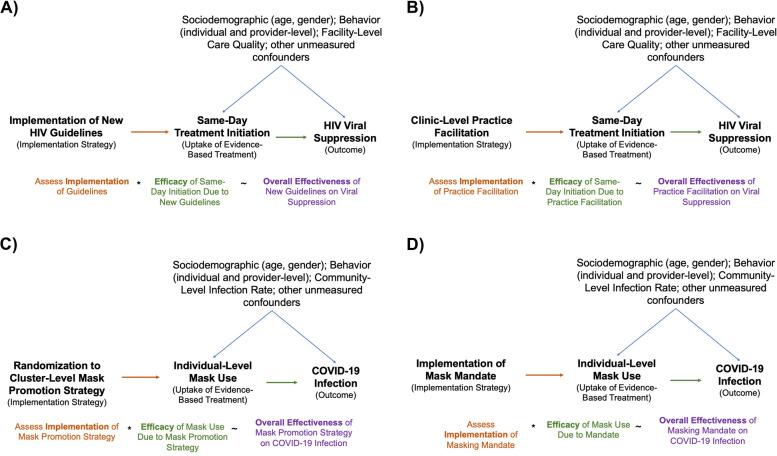
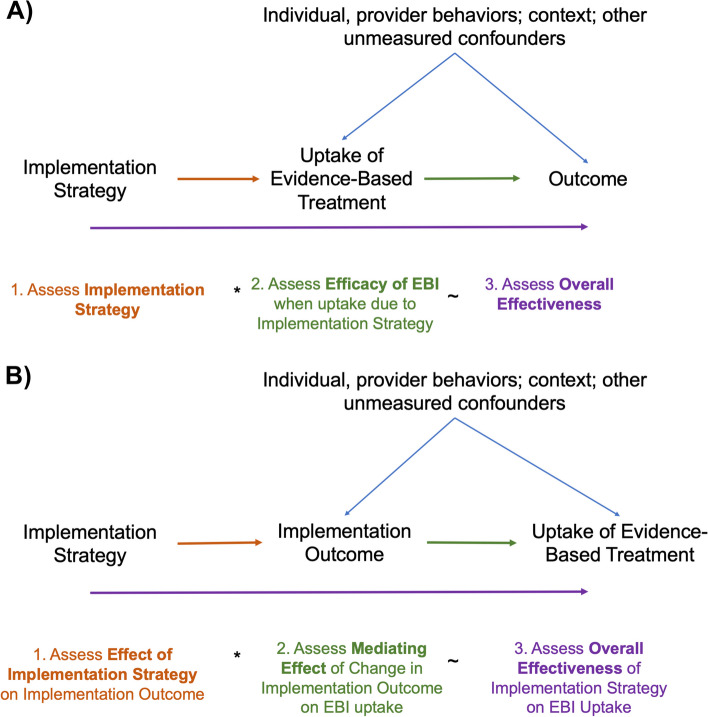
We explore the use of instrumental variable (IV) analyses as a critical tool for implementation science methods to isolate three relevant quantities within the same intervention context when exposure to an implementation strategy is random: (1) the effect of an IS on implementation outcomes (e.g., uptake), (2) effect of EBI uptake on patient outcomes, and (3) overall effectiveness of the IS (i.e., ~ implementation*efficacy). We discuss the mechanisms by which an implementation strategy can alter the context, and therefore effect, of an EBI using the underlying IV assumptions. We illustrate these concepts using examples of the implementation of new ART initiation guidelines in Zambia and community-based masking programs in Bangladesh.
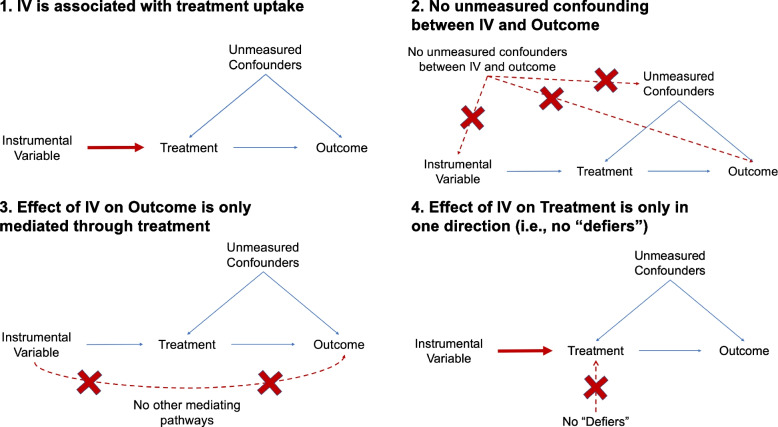
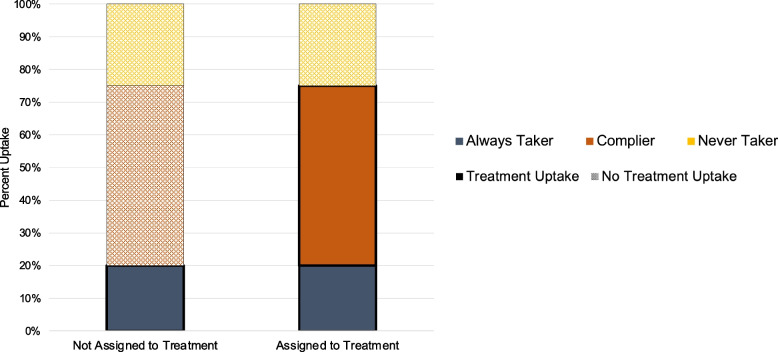
Causal questions relevant to implementation science are answered at each stage of an IV analysis. The first stage assesses the effect of the IS (e.g., new guidelines) on EBI uptake (e.g., same-day treatment initiation). The second stage leverages the IS as an IV to estimate the complier average causal effect (CACE) of the EBI on patient outcomes (e.g., effect of same-day treatment initiation on viral suppression). The underlying assumptions of CACE formalize that the causal effect of EBI may differ in the context of a different IS because (1) the mechanisms by which individuals uptake an intervention may differ and (2) the subgroup of individuals who take up an EBI may differ. IV methods thus provide a conceptual framework for how IS and EBIs are linked and that the IS itself needs to be considered a critical contextual determinant. Moreover, it also provides rigorous methodologic tools to isolate the effect of an IS, EBI, and combined effect of the IS and EBI.
Leveraging IV methods when exposure to an implementation strategy is random helps to conceptualize the context-dependent nature of implementation strategies, EBIs, and patient outcomes. IV methods formalize that the causal effect of an EBI may be specific to the context of the implementation strategy used to promote uptake. This integration of implementation science concepts and theory with rigorous causal epidemiologic methods yields novel insights and provides important tools for exploring the next generation of questions related to mechanisms and context in implementation science.

实施策略(IS)和循证干预措施(EBI)的影响可能因环境而异,更好地理解其产生方式和原因提出了一些基本但具有挑战性的问题,作为一个领域的实施科学需要应对这些问题。我们使用因果流行病学方法来探究为何实施策略(IS)与循证干预措施(EBI)的效果之间的明显区别可能未能认识到EBI的效果可能紧密相连且依赖于导致其采用的IS的背景。
我们探讨使用工具变量(IV)分析作为实施科学方法的关键工具,以便在实施策略的暴露是随机的同一干预背景下分离三个相关量:(1)IS对实施结果(如采用情况)的影响,(2)EBI采用对患者结果的影响,以及(3)IS的总体效果(即~实施*效果)。我们使用潜在的IV假设来讨论实施策略可以改变EBI的背景进而改变其效果的机制。我们使用赞比亚新的抗逆转录病毒治疗启动指南的实施以及孟加拉国基于社区的口罩计划的例子来说明这些概念。
与实施科学相关的因果问题在IV分析的每个阶段都能得到解答。第一阶段评估IS(如新指南)对EBI采用(如当日治疗启动)的影响。第二阶段将IS用作IV来估计EBI对患者结果的依从者平均因果效应(CACE)(如当日治疗启动对病毒抑制的影响)。CACE的潜在假设正式表明EBI的因果效应在不同的IS背景下可能不同,原因是(1)个体采用干预措施的机制可能不同,以及(2)采用EBI的个体亚组可能不同。因此,IV方法为IS和EBI如何联系提供了一个概念框架,并且IS本身需要被视为一个关键的背景决定因素。此外,它还提供了严格的方法学工具来分离IS、EBI的效果以及IS和EBI的综合效果。
当实施策略的暴露是随机的时,利用IV方法有助于概念化实施策略、EBI和患者结果的背景依赖性。IV方法正式表明EBI的因果效应可能特定于用于促进采用的实施策略的背景。实施科学概念和理论与严格的因果流行病学方法的这种整合产生了新颖的见解,并为探索与实施科学中的机制和背景相关的下一代问题提供了重要工具。