Rathbun Alan M, Mehta Rhea, Ryan Alice S, Dong Yu, Beamer Brock, Golden Justine, Gallo Joseph J, Luborsky Mark, Shardell Michelle D, Peer Jason E, Hochberg Marc C
University of Maryland School of Medicine, United States.
VA Maryland Health Care System, United States.
Osteoarthr Cartil Open. 2023 Dec 8;6(1):100426. doi: 10.1016/j.ocarto.2023.100426. eCollection 2024 Mar.
To assess the feasibility of a 24-week, center-based, aerobic exercise program plus duloxetine to treat symptomatic knee osteoarthritis (OA) and major depression.
Patients with symptomatic knee OA and major depression were recruited between August 2021 and November 2022 from the University of Maryland and VA Maryland Health Care Systems and Baltimore metropolitan area using medical records and advertisements. The intervention included 1) supervised treadmill walking 3 times weekly and 2) duloxetine starting at 30 mg each day and titrating up to the optimal dosage of 60 mg daily. Data collection occurred at baseline and 12- and 24-weeks follow-up. Feasibility was evaluated from recruitment rates, reasons for drop out, and treatment adherence. Clinical measures included the Knee Injury and Osteoarthritis Outcome Score (KOOS) and the Hamilton Depression Rating Scale (HAM-D).
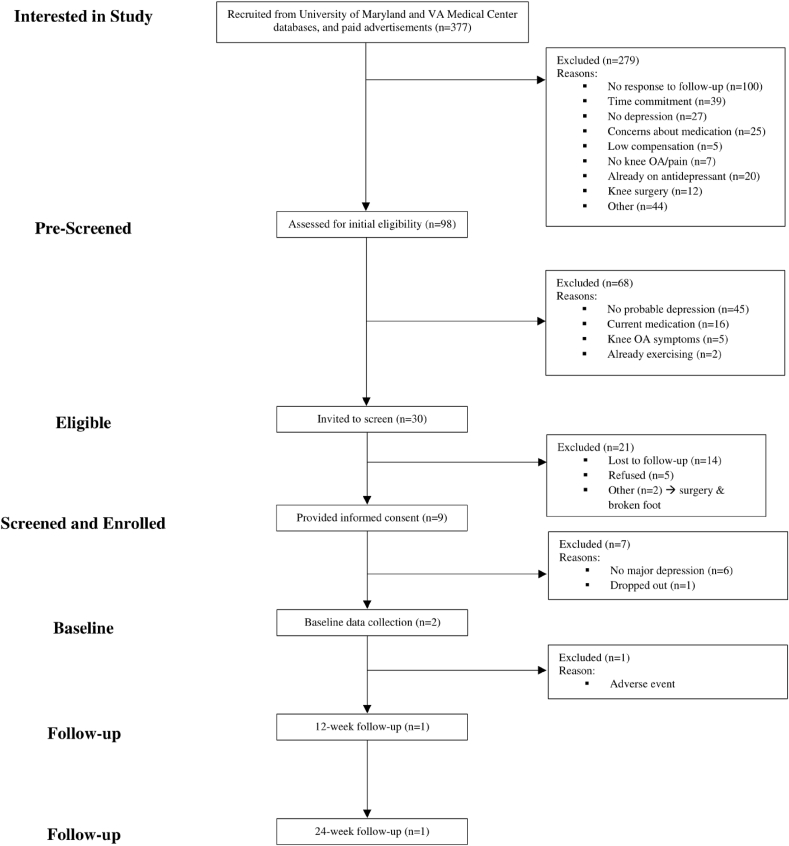
Among 377 interested participants, 9 patients were enrolled, and 1 completed treatment. The most common reason reported for not prescreening was time commitment (n = 39), many patients did not satisfy depression screening criteria (n = 45), and most enrolled participants were not experiencing a major depressive episode (n = 6). The single treated participant was 100 % adherent to duloxetine and depression severity decreased (HAM-D = 25 to 1), but compliance to supervised exercise was only 26 %, and knee pain severity changed little (KOOS = 41.7 to 44.4).
This intervention had low feasibility. Time commitment to supervised exercise sessions reduced accessibility, and depression defined by diagnostic criteria precluded knee OA patients with depressive symptoms not a meeting case-level diagnosis from receiving treatment.
NCT04111627.
评估一项为期24周、以中心为基础的有氧运动计划联合度洛西汀治疗有症状的膝关节骨关节炎(OA)和重度抑郁症的可行性。
2021年8月至2022年11月期间,从马里兰大学、马里兰退伍军人医疗保健系统以及巴尔的摩都会区,通过病历和广告招募有症状的膝关节OA和重度抑郁症患者。干预措施包括:1)每周3次在监督下进行跑步机行走;2)度洛西汀起始剂量为每日30毫克,逐渐滴定至每日60毫克的最佳剂量。在基线以及12周和24周随访时进行数据收集。从招募率、退出原因和治疗依从性方面评估可行性。临床测量指标包括膝关节损伤和骨关节炎疗效评分(KOOS)以及汉密尔顿抑郁评定量表(HAM-D)。
在377名感兴趣的参与者中,9名患者入组,1名完成治疗。报告的未进行预筛查的最常见原因是时间安排(n = 39),许多患者不符合抑郁症筛查标准(n = 45),并且大多数入组参与者未经历重度抑郁发作(n = 6)。唯一接受治疗的参与者对度洛西汀的依从性为100%,抑郁严重程度降低(HAM-D从25降至1),但对监督下运动的依从性仅为26%,膝关节疼痛严重程度变化不大(KOOS从41.7变为44.4)。
该干预措施可行性较低。监督下运动课程所需的时间投入降低了可及性,并且诊断标准所定义的抑郁症使有抑郁症状但未达到病例级诊断的膝关节OA患者无法接受治疗。
NCT04111627。