Restini Carolina, Faner Martha, Miglio Maria, Bazzi Lena, Singhal Neena
Department of Pharmacology and Toxicology, College of Osteopathic Medicine, Michigan State University, Macomb University Center (MUC), Clinton Township, MI, USA.
Detroit Medical Center (DMC), College of Osteopathic Medicine, Michigan State University, Detroit, MI, USA.
J Med Educ Curric Dev. 2023 Dec 18;10:23821205231218122. doi: 10.1177/23821205231218122. eCollection 2023 Jan-Dec.
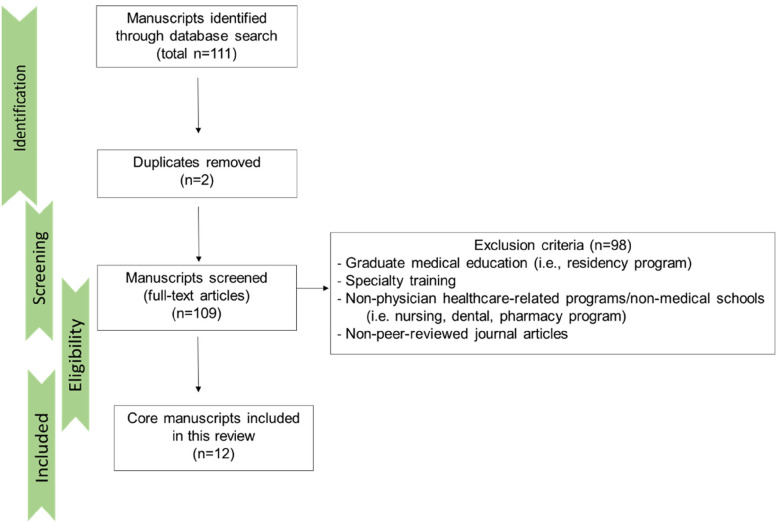
The COVID-19 pandemic presented unprecedented challenges to medical training worldwide. Many studies examining barriers, such as student safety concerns and technological issues for adaptability to a virtual learning mode, were conducted during social distancing and described the pandemic's impact on medical education. This narrative sought to review how medical schools adapted to the pandemic and to provide a unique analysis of the challenges faced in delivering medical curricula worldwide. A search of the medical education literature yielded articles describing methods employed by medical colleges from locations worldwide. All articles that met search parameters were archived on PubMed. Of 109 manuscripts, 12 describe strategies adopted by 10 countries. They support the discussion of teaching and learning at the pre-clerkship and clerkship levels during the COVID-19 pandemic. Online learning became the method adopted by medical schools worldwide to address hurdles during the pandemic. Access to technology, the internet, and appropriate infrastructure, resulted in solid indicators of medical education success. From the student's perspective, the most significant advantage of this strategy was flexibility. The compiled reports are representative approaches used during the pandemic and may serve as guidelines for medical colleges when strategic change is needed during pre-clerkship and clerkship education. Strategies based on information technology proved successful; however, more equitable access is necessary. It is crucial to consider the complexities of syndemic conditions when adjusting the curriculum in challenging situations such as a pandemic.
新冠疫情给全球医学培训带来了前所未有的挑战。在社交距离措施实施期间,开展了许多研究,探讨诸如学生安全担忧和适应虚拟学习模式的技术问题等障碍,并描述了疫情对医学教育的影响。本文旨在回顾医学院校如何适应疫情,并对全球医学课程教学中面临的挑战进行独特分析。检索医学教育文献后,得到了描述世界各地医学院校所采用方法的文章。所有符合检索参数的文章都存档于PubMed。在109篇手稿中,有12篇描述了10个国家所采用的策略。它们为讨论新冠疫情期间临床前和临床实习阶段的教学提供了支持。在线学习成为全球医学院校在疫情期间应对障碍所采用的方法。技术、互联网和适当基础设施的可及性,成为医学教育成功的可靠指标。从学生的角度来看,这一策略最显著的优势在于灵活性。汇编的报告是疫情期间所采用的代表性方法,可为医学院校在临床前和临床实习教育需要进行战略变革时提供指导。基于信息技术的策略已证明是成功的;然而,需要更公平的可及性。在诸如疫情这样具有挑战性的情况下调整课程时,考虑共病状况的复杂性至关重要。