
多年冻土区引气混凝土冻融损伤劣化模型及寿命预测
Freeze-Thaw Damage Degradation Model and Life Prediction of Air-Entrained Concrete in Multi-Year Permafrost Zone.
作者信息
Zhang Kai, Guo Aojun, Yu Yonghui, Yang Bo, Yu Bentian, Xie Chao
机构信息
Civil Engineering Department, Lanzhou Jiaotong University, Lanzhou 730070, China.
National and Provincial Joint Engineering Laboratory of Road & Bridge Disaster Prevention and Control, Lanzhou Jiaotong University, Lanzhou 730070, China.
出版信息
Materials (Basel). 2023 Dec 18;16(24):0. doi: 10.3390/ma16247703.
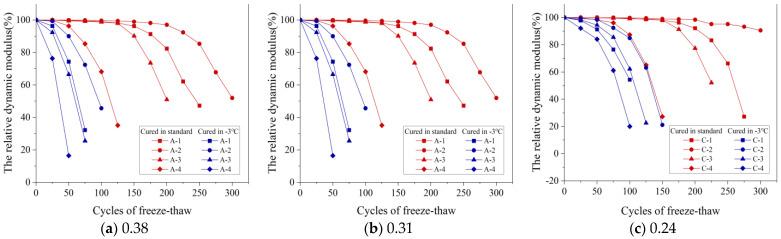
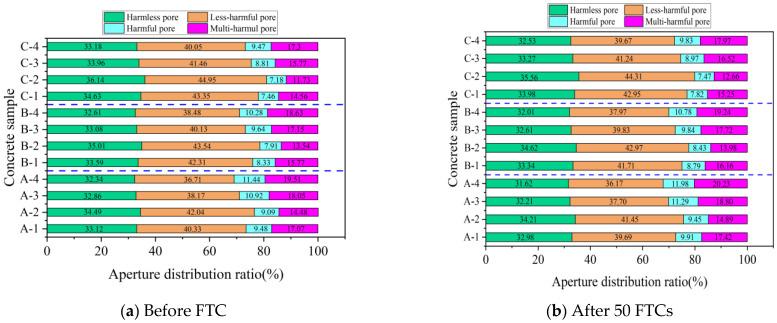
The Qinghai-Tibet Plateau is the main permafrost area in China. Concrete structures constructed on permafrost are affected by the early negative-temperature environment. In particular, the negative-temperature environment seriously affects the strength growth process and the frost resistance of concrete (FRC). Therefore, this study considered the influence of the gas content, water-binder ratio (w/b), age, and other factors on the strength variation law and FRC under -3 °C curing conditions. Nuclear magnetic resonance (NMR) was used to analyze the pore structure of concrete before and after freeze-thaw cycles (FTCs). The results showed that the compressive strength of the concrete (CSC) under -3 °C curing was only 57.8-86.4% of that cured under standard conditions. The CSC under -3 °C curing showed an obvious age-lag phenomenon. The FRC under -3 °C curing was much lower than that under standard curing. The porosity of the concrete under -3 °C curing was greater, with a higher percentage of harmful and multi-harmful pores than that under standard curing. The concrete properties deteriorated primarily because curing at -3 °C hindered the hydration reaction compared with standard methods. This hindrance resulted in diminished hydration development, weakening the concrete's structural integrity. Under both curing conditions, when the gas content was between 3.2% and 3.8%, the frost resistance was the best. This is because a gas content within this range effectively enhances the internal pore structure, therefore relieving the swelling pressure caused by FTCs. Based on the freeze-thaw damage (FTD) model proposed by previous authors, a new model for the CSC under -3 °C curing reaching that of the concrete under standard curing for 28 d was established in this study. This advanced model was capable of accurately assessing the FTD of concrete structures in permafrost regions. Finally, the life expectancy of concrete in Northwest China was predicted. The life of the concrete reached 46.9 years under standard curing, while the longest life of the concrete under -3 °C curing was only 12.9 years. Therefore, attention should be paid to constructing and curing concrete structures in cold environments.
青藏高原是中国主要的多年冻土区。在冻土上建造的混凝土结构会受到早期负温环境的影响。特别是,负温环境严重影响混凝土(FRC)的强度增长过程和抗冻性。因此,本研究考虑了气体含量、水胶比(w/b)、龄期等因素对-3℃养护条件下混凝土强度变化规律和FRC的影响。采用核磁共振(NMR)分析冻融循环(FTCs)前后混凝土的孔结构。结果表明,-3℃养护条件下混凝土的抗压强度(CSC)仅为标准养护条件下的57.8-86.4%。-3℃养护条件下的CSC呈现明显的龄期滞后现象。-3℃养护条件下的FRC远低于标准养护条件下的FRC。-3℃养护条件下混凝土的孔隙率更大,有害孔和多害孔的比例高于标准养护条件下的混凝土。混凝土性能恶化主要是因为与标准方法相比,-3℃养护阻碍了水化反应。这种阻碍导致水化发展减弱,削弱了混凝土的结构完整性。在两种养护条件下,当气体含量在3.2%至3.8%之间时,抗冻性最佳。这是因为该范围内的气体含量有效地改善了内部孔结构,从而减轻了FTCs引起的膨胀压力。基于前人提出的冻融损伤(FTD)模型,本研究建立了-3℃养护条件下CSC达到标准养护28 d混凝土强度的新模型。该先进模型能够准确评估多年冻土区混凝土结构的FTD。最后,预测了中国西北地区混凝土的使用寿命。标准养护条件下混凝土的使用寿命达到46.9年,而-3℃养护条件下混凝土的最长使用寿命仅为12.9年。因此,在寒冷环境中施工和养护混凝土结构时应予以重视。





 Zotero 插件