Barbateskovic Marija, Klingenberg Sarah Louise, Krauss Sara Russo, Kong Dezhao, Wu Zhangtong, Petersen Sesilje B, Kenfelt Mette, Gluud Christian
Copenhagen Trial Unit, Centre for Clinical Intervention Research, The Capital Region, Copenhagen University Hospital-Rigshospitalet, 2100 Copenhagen, Denmark.
The Evidence-Based Medicine Research Center of Traditional Chinese Medicine, Liaoning University of Traditional Chinese Medicine, Shenyang 110032, China.
Vaccines (Basel). 2023 Nov 27;11(12):1763. doi: 10.3390/vaccines11121763.
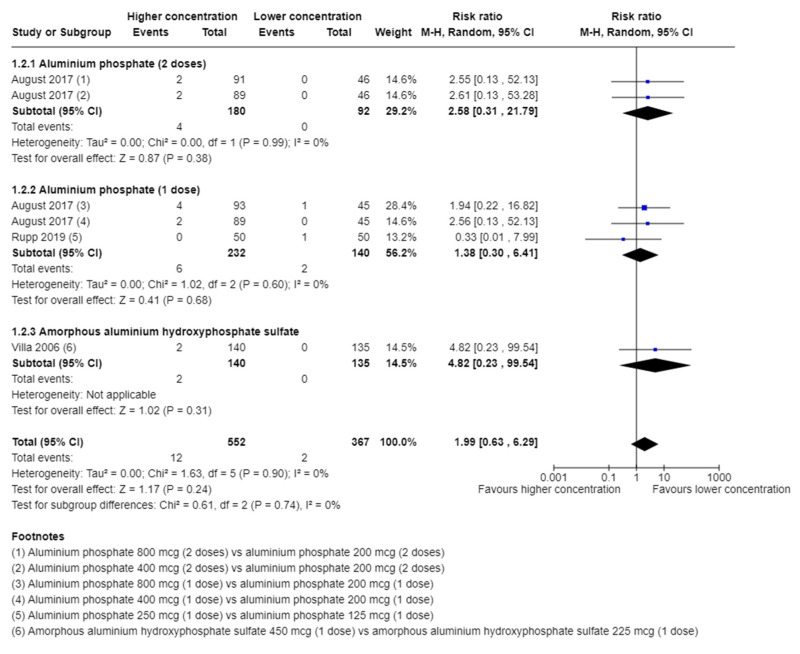
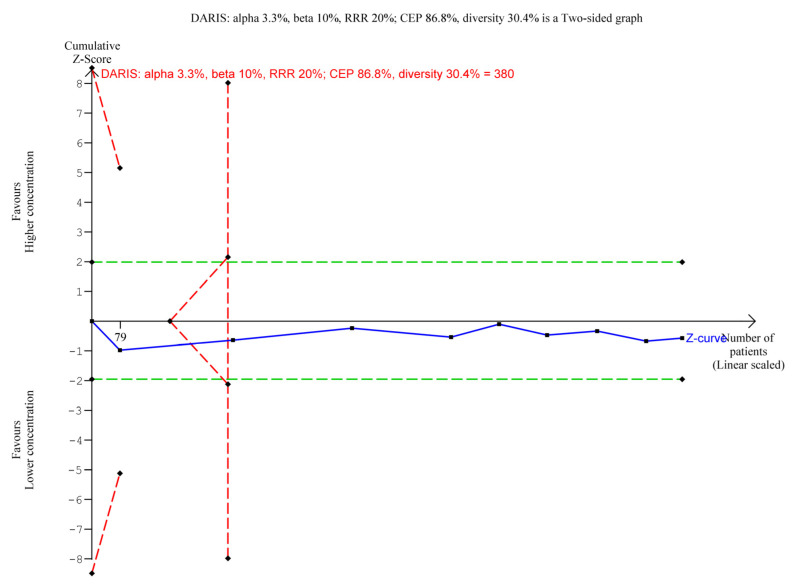
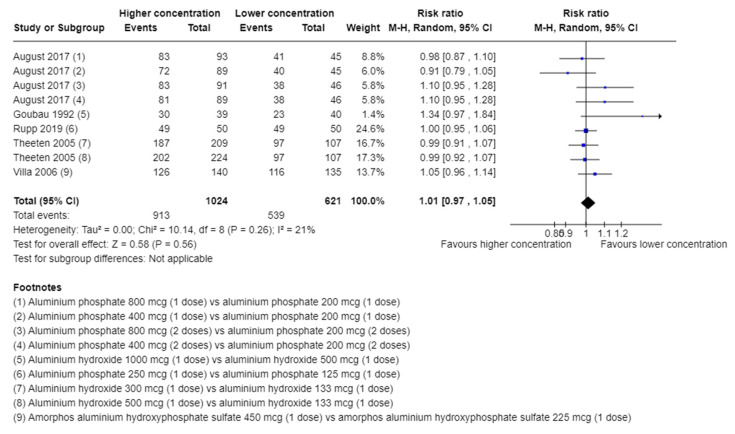
Aluminium adjuvants are commonly used in vaccines to boost the effects of vaccination. Here, we assessed the benefits and harms of different aluminium adjuvants vs. other aluminium adjuvants or vs. the same aluminium adjuvant at other concentrations, administered a different number of doses, or at different particle sizes used in vaccines or vaccine excipients. We conducted a systematic review with meta-analysis and Trial Sequential Analysis to assess the certainty of evidence with Grading of Recommendations Assessment, Development and Evaluation (GRADE). We obtained data from major medical databases until 20 January 2023 and included 10 randomized clinical trials of healthy volunteers. The comparisons assessed higher vs. lower aluminium adjuvant concentrations; higher vs. lower number of doses of aluminium adjuvant; and aluminium phosphate adjuvant vs. aluminium hydroxide adjuvant. For all three comparisons, meta-analyses showed no evidence of a difference on all-cause mortality, serious adverse events, and adverse events considered non-serious. The certainty of evidence was low to very low. None of the included trials reported on quality of life or proportion of participants who developed the disease being vaccinated against. The benefits and harms of different types of aluminium adjuvants, different aluminium concentrations, different number of doses, or different particle sizes, therefore, remain uncertain.
铝佐剂常用于疫苗中以增强疫苗接种效果。在此,我们评估了不同铝佐剂与其他铝佐剂相比,或与相同铝佐剂在其他浓度、不同接种剂量或疫苗或疫苗赋形剂中使用的不同粒径情况下的利弊。我们进行了一项系统评价并结合Meta分析和试验序贯分析,以使用推荐分级的评估、制定与评价(GRADE)来评估证据的确定性。我们从主要医学数据库获取数据至2023年1月20日,并纳入了10项针对健康志愿者的随机临床试验。比较内容包括高铝佐剂浓度与低铝佐剂浓度;高铝佐剂接种剂量与低铝佐剂接种剂量;以及磷酸铝佐剂与氢氧化铝佐剂。对于所有这三项比较,Meta分析均未显示在全因死亡率、严重不良事件以及非严重不良事件方面存在差异的证据。证据的确定性为低至极低。纳入的试验均未报告生活质量或接种疫苗所预防疾病的发病参与者比例。因此,不同类型铝佐剂、不同铝浓度、不同接种剂量或不同粒径的利弊仍不确定。