Osuka Satoko, Kasahara Yukiyo, Iyoshi Shohei, Sonehara Reina, Myake Natsuki, Muraoka Ayako, Nakamura Tomoko, Iwase Akira, Kajiyama Hiroaki
Department of Obstetrics and Gynecology Nagoya University Graduate School of Medicine Nagoya Japan.
Tokoname City Hospital Tokoname-shi Japan.
Reprod Med Biol. 2023 Dec 22;22(1):e12556. doi: 10.1002/rmb2.12556. eCollection 2023 Jan-Dec.
Primary ovarian insufficiency (POI) is characterized by the development of hypergonadotropic hypogonadism before 40 years of age and leads to intractable infertility. Although in vitro fertilization and embryo transfer with donated eggs enables pregnancy, not a few patients desire pregnancy using their oocytes. However, follicular development is rare and unpredictable in patients with POI. Thus, there is a need for treatments that promote the development of residual follicles and methods to accurately predict infrequent ovulation.
This review discusses the effects of various treatments for obtaining eggs from POI patients. Furthermore, this study focused a potential marker for predicting follicular growth in patients with POI.
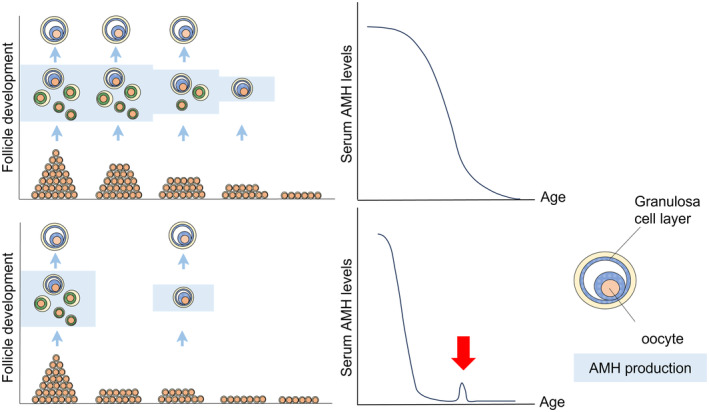
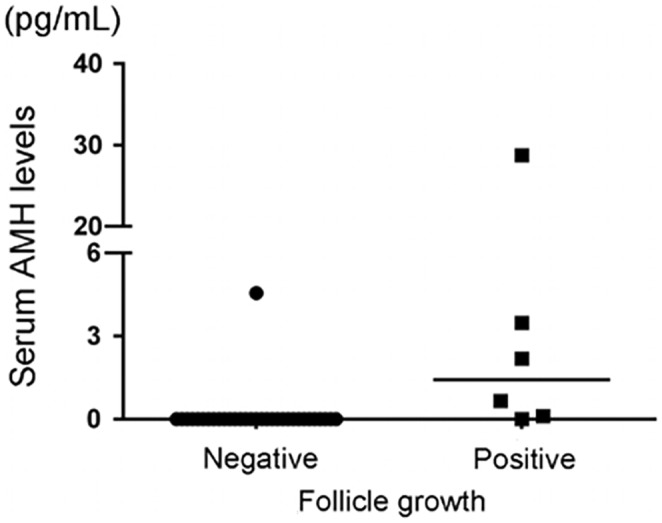
Different treatments such as hormone-replacement therapy, dehydroepiandrosterone supplementation, platelet-rich plasma injection, and in vitro activation have shown varying degrees of effectiveness in retrieving oocytes from patients with POI. To predict follicle development in the cycle, elevated serum estradiol and reduced follicle-stimulating hormone (FSH) levels are important. However, these markers are not always reliable under continuous estradiol-replacement therapy. As a novel marker for predicting follicle growth, serum anti-Müllerian hormone (AMH) levels, measured using the picoAMH enzyme-linked immunosorbent assay, were found to predict follicle growth in patients and the cycle.
This review highlights the challenges and available interventions for achieving pregnancy using a patient's oocytes in cases of POI. We believe that a combination of currently available treatments and prediction methods is the best strategy to enable patients with POI to conceive using their own eggs. Although AMH levels may predict follicle growth, further research is necessary to improve the chances of successful follicular development and conception in patients with POI.
原发性卵巢功能不全(POI)的特征是在40岁之前出现高促性腺激素性性腺功能减退,并导致难以治疗的不孕症。尽管体外受精和捐赠卵子的胚胎移植能够实现妊娠,但不少患者希望使用自己的卵母细胞妊娠。然而,POI患者的卵泡发育罕见且不可预测。因此,需要促进残余卵泡发育的治疗方法以及准确预测罕见排卵的方法。
本综述讨论了从POI患者获取卵子的各种治疗方法的效果。此外,本研究聚焦于预测POI患者卵泡生长的潜在标志物。
激素替代疗法、脱氢表雄酮补充疗法、富血小板血浆注射和体外激活等不同治疗方法在从POI患者获取卵母细胞方面显示出不同程度的有效性。为了预测周期中的卵泡发育,血清雌二醇升高和促卵泡激素(FSH)水平降低很重要。然而,在持续雌二醇替代治疗下,这些标志物并不总是可靠的。作为预测卵泡生长的一种新标志物,使用picoAMH酶联免疫吸附测定法测量的血清抗苗勒管激素(AMH)水平被发现可预测患者和周期中的卵泡生长。
本综述强调了在POI病例中使用患者自身卵母细胞实现妊娠所面临的挑战和可用的干预措施。我们认为,将目前可用的治疗方法和预测方法结合起来是使POI患者能够使用自己的卵子受孕的最佳策略。尽管AMH水平可能预测卵泡生长,但仍需要进一步研究以提高POI患者卵泡发育成功和受孕的几率。