
阳性淋巴结比例是预测接受R0切除的晚期食管鳞癌(II至III期)患者长期生存的重要指标——一项基于监测、流行病学和最终结果(SEER)数据库的分析
Positive lymph node ratio is an important index to predict long-term survival for advanced esophageal squamous carcinoma patients (II∼III) with R0 resection--a SEER-based analysis.
作者信息
Hou Bin, Yuan Jinyan, Kang Shuge, Yang Yuanye, Huang Xing, Xu Hui, Guo Kai, Tian Wei
机构信息
Department of Thoracic Surgery, Shaanxi Provincial People's Hospital, Youyi Road, Xi'an, Shaanxi, 710068, China.
出版信息
Heliyon. 2023 Nov 27;9(12):e22600. doi: 10.1016/j.heliyon.2023.e22600. eCollection 2023 Dec.
BACKGROUND
Esophageal squamous carcinoma (ESCC) is one of the most malignant cancers in the world due to nodal metastasis. Therefore, a reasonable nodal staging system is extremely important for further treatment strategies. Recently the positive lymph node ratio (PLNR) is an important prognostic factor in various solid tumors.
METHOD
In this study, we investigated the clinical significance of the PLNR in stage II∼III ESCC patients. We collected the pathological characteristics of 272 stage II∼III ESCC patients from the SEER database from 2004-2016. ROC curves were used to calculate the best cutoff value of the PLNR; Pearson's Chi-square (χ2) and Fisher's exact probability tests were used to compare the clinical baseline and characteristics of patients. For continuous variables, Student's -test and ANOVA were performed to evaluate statistical significance. Clinical outcomes were estimated by using the Kaplan‒Meier method and log-rank test. Furthermore, univariate and multivariate Cox regression models were utilized to analyze independent prognostic factors of ESCC patients.
RESULTS
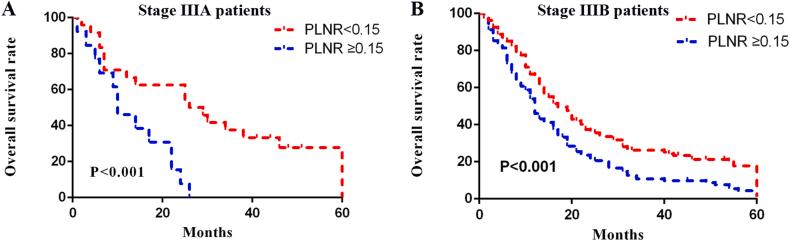
Consequently, advanced ESCC patients were effectively stratified into two groups by prognosis using a PLNR cutoff value of 0.15 (P value = 0.04). The median survival time of patients with PLNR <0.15 (n = 145) was much higher than that of patients (n = 127) in the PLNR ≥0.15 group (20.0 vs. 13.0 months, P value < 0.0001). Notably, the PLNR significantly predicted the prognosis of ESCC patients with stage N1 (P value 0.01) and stage III (P value < 0.001) disease. The multivariate Cox proportional hazard model showed that T stage (HR 1.33, 95 % CI 0.97-1.82), tumor size >45 mm (HR 1.32, 95 % CI 1.02-1.70), N stage (HR 1.41, 95 % CI 0.98-2.01) and PLNR ≥0.15 (HR 1.35, 95 % CI 0.87-1.74) were independent risk factors for prognostic prediction in ESCC patients. Meanwhile, 117 II∼III ESCC patients from Shaanxi Provincial People's Hospital shown that the overall survival with a PLNR <0.15 (n = 96) was significantly longer than that with a PLNR ≥0.15 (n = 21) .
CONCLUSIONS
The PLNR is useful for accurately predicting clinical outcomes and determining postoperative strategies.
背景
由于淋巴结转移,食管鳞状细胞癌(ESCC)是世界上最恶性的癌症之一。因此,合理的淋巴结分期系统对于进一步的治疗策略极为重要。最近,阳性淋巴结比率(PLNR)是各种实体瘤的一个重要预后因素。
方法
在本研究中,我们调查了PLNR在IIIII期ESCC患者中的临床意义。我们从2004年至2016年的SEER数据库中收集了272例IIIII期ESCC患者的病理特征。使用ROC曲线计算PLNR的最佳截断值;采用Pearson卡方(χ2)检验和Fisher精确概率检验比较患者的临床基线和特征。对于连续变量,进行Student's -检验和方差分析以评估统计学意义。使用Kaplan-Meier法和对数秩检验评估临床结局。此外,利用单因素和多因素Cox回归模型分析ESCC患者的独立预后因素。
结果
因此,使用0.15的PLNR截断值可有效地将晚期ESCC患者按预后分为两组(P值 = 0.04)。PLNR <0.15(n = 145)组患者的中位生存时间远高于PLNR≥0.15组患者(n = 127)(20.0个月对13.0个月,P值<0.0001)。值得注意的是,PLNR显著预测了N1期(P值0.01)和III期(P值<0.001)ESCC患者的预后。多因素Cox比例风险模型显示,T分期(HR 1.33,95%CI 0.97 - 1.82)、肿瘤大小>45 mm(HR 1.32,95%CI 1.02 - 1.70)、N分期(HR 1.41,95%CI 0.98 - 2.01)和PLNR≥0.15(HR 1.35,95%CI 0.87 - 1.74)是ESCC患者预后预测的独立危险因素。同时,来自陕西省人民医院的117例II~III期ESCC患者显示,PLNR <0.15(n = 96)组的总生存期明显长于PLNR≥0.15(n = 21)组。
结论
PLNR有助于准确预测临床结局并确定术后策略。



 Zotero 插件