Liao Yi, Yin Guofang, Fan Xianming
Department of Respiratory and Critical Care Medicine, The Affiliated Hospital of Southwest Medical University, Luzhou, China.
Inflammation & Allergic Diseases Research Unit, The Affiliated Hospital of Southwest Medical University, Luzhou, China.
Front Oncol. 2020 Aug 5;10:1356. doi: 10.3389/fonc.2020.01356. eCollection 2020.
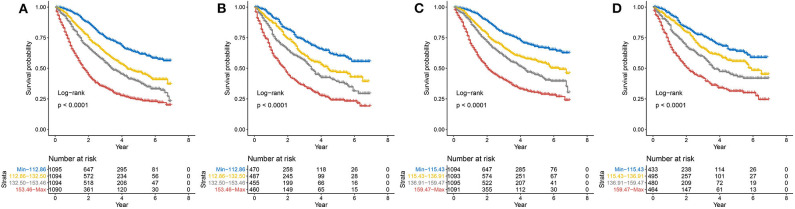
An increasing number of studies have shown that the positive lymph node ratio (pLNR) can be used to evaluate the prognosis of non-small cell lung cancer (NSCLC) patients. To determine the predictive value of the pLNR, we collected data from the Surveillance, Epidemiology, and End Results (SEER) database and performed a retrospective analysis. We collected survival and clinical information on patients with NSCLC diagnosed between 2010 and 2016 from the SEER database and screened them according to inclusion and exclusion criteria. X-tile software was used to obtain the best cut-off value for the pLNR. Then, we randomly divided patients into a training set and a validation set at a ratio of 7:3. Pearson's correlation coefficient, tolerance and the variance inflation factor (VIF) were used to detect collinearity between variables. Univariate and multivariate Cox regression analyses were used to identify significant prognostic factors, and nomograms was constructed to visualize the results. The concordance index (C-index), calibration curves, and decision curve analysis (DCA) were used to assess the predictive ability of the nomogram. We divided the patient scores into four groups according to the interquartile interval and constructed a survival curve using Kaplan-Meier analysis. A total of 6,245 patients were initially enrolled. The best cut-off value for the pLNR was determined to be 0.55. The nomogram contained 13 prognostic factors, including the pLNR. The pLNR was identified as an independent prognostic factor for both overall survival (OS) and cancer-specific survival (CSS). The C-index was 0.703 (95% CI, 0.695-0.711) in the training set and 0.711 (95% CI, 0.699-0.723) in the validation set. The calibration curves and DCA also indicated the good predictability of the nomogram. Risk stratification revealed a statistically significant difference among the four groups of patients divided according to quartiles of risk score. The nomogram containing the pLNR can accurately predict survival in patients with NSCLC.
越来越多的研究表明,阳性淋巴结比率(pLNR)可用于评估非小细胞肺癌(NSCLC)患者的预后。为了确定pLNR的预测价值,我们从监测、流行病学和最终结果(SEER)数据库收集数据并进行了回顾性分析。我们从SEER数据库收集了2010年至2016年间诊断为NSCLC的患者的生存和临床信息,并根据纳入和排除标准对其进行筛选。使用X-tile软件获得pLNR的最佳临界值。然后,我们以7:3的比例将患者随机分为训练集和验证集。使用Pearson相关系数、容忍度和方差膨胀因子(VIF)检测变量之间的共线性。采用单因素和多因素Cox回归分析确定显著的预后因素,并构建列线图以直观显示结果。使用一致性指数(C-index)、校准曲线和决策曲线分析(DCA)评估列线图的预测能力。我们根据四分位数间距将患者得分分为四组,并使用Kaplan-Meier分析构建生存曲线。最初共纳入6245例患者。确定pLNR的最佳临界值为0.55。列线图包含13个预后因素,包括pLNR。pLNR被确定为总生存期(OS)和癌症特异性生存期(CSS)的独立预后因素。训练集中的C-index为0.703(95%CI,0.695-0.711),验证集中为0.711(95%CI,0.699-0.723)。校准曲线和DCA也表明列线图具有良好的预测性。风险分层显示,根据风险评分四分位数划分的四组患者之间存在统计学显著差异。包含pLNR的列线图可以准确预测NSCLC患者的生存期。