Park Kristen E, Mehta Preeya, Kherani Femida, Lee Wendy W, Woodward Julie A, Foster Jill A, Zhang-Nunes Sandy
Department of Ophthalmology, Ohio State University, Columbus, Ohio.
Department of Ophthalmology, New York University, New York City, N.Y.
Plast Reconstr Surg Glob Open. 2023 Dec 22;11(12):e5457. doi: 10.1097/GOX.0000000000005457. eCollection 2023 Dec.
One benefit of hyaluronic acid fillers is the ability to dissolve them using hyaluronidase. With the increasing number of fillers entering the market, it is crucial to understand each of these fillers' responsiveness to hyaluronidase.
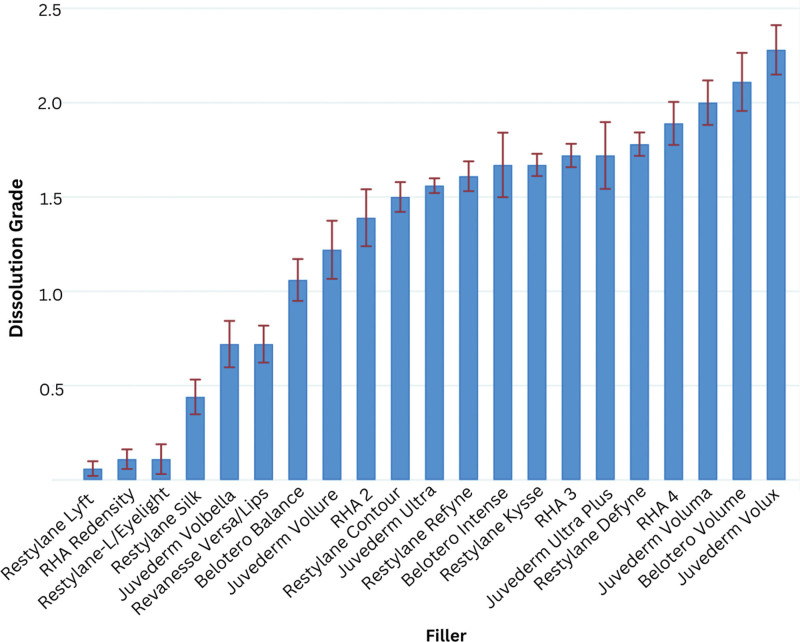
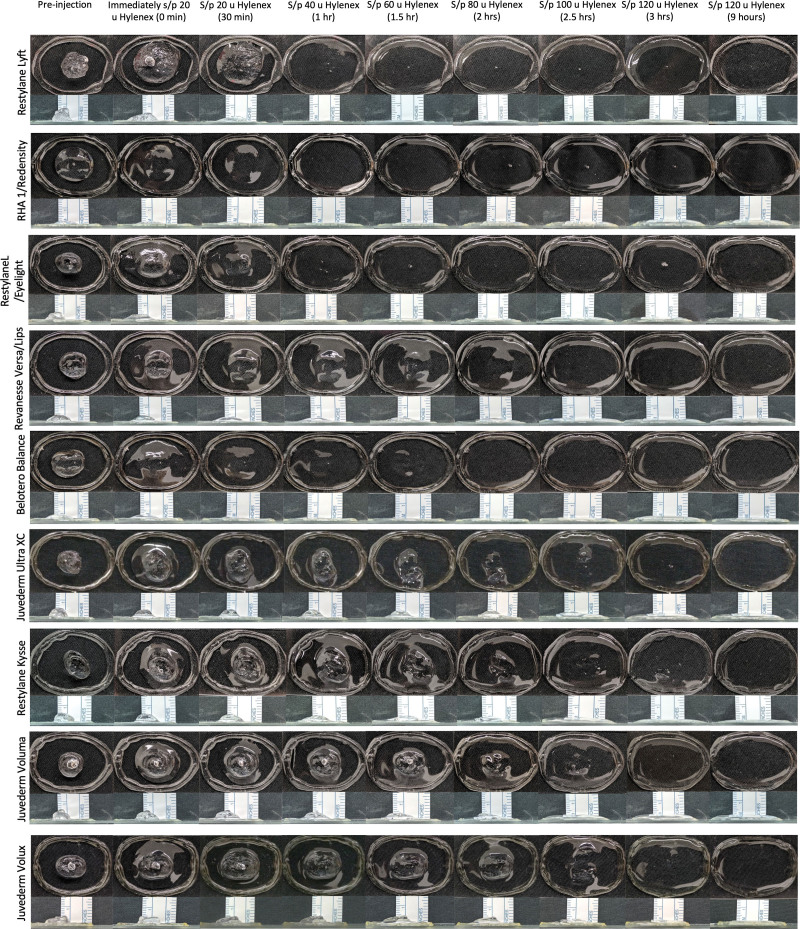
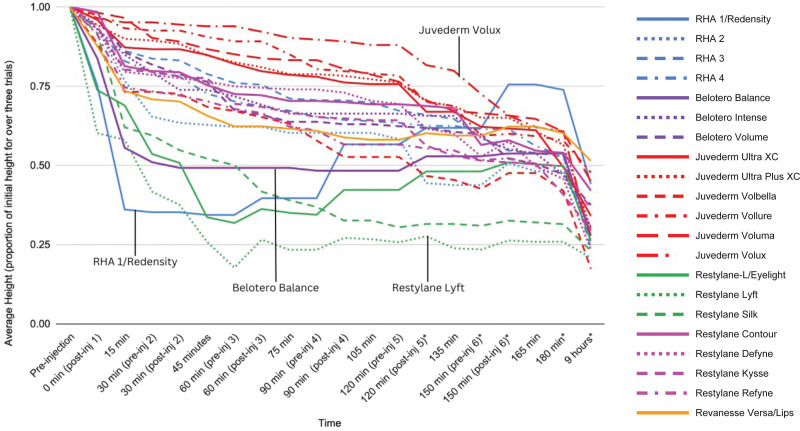
Twenty-one hyaluronic acid fillers of 0.2 mL aliquots each were placed on slides. Twenty units of recombinant human hyaluronidase were injected into the aliquots every 30 minutes for a total of 120 units recombinant human hyaluronidase injected over 3 hours. With each injection, videos and photographs were taken from bird's eye and lateral views to measure aliquot height. Stirring videos were graded by three oculoplastic surgeons, and these grades were used to categorize each filler's responsiveness.
Restylane Lyft, Restylane-L/Eyelight, and Resilient Hyaluronic Acid (RHA) 1/Redensity were the least resistant. The moderately resistant group comprised of Restylane Silk, Juvéderm Volbella, Revanesse Versa/Lips, and Belotero Balance on the less resistant side to Juvéderm Vollure, RHA 2, Restylane Contour, Juvéderm Ultra, Restylane Refyne, Belotero Intense, Restylane Kysse, RHA 3, Juvéderm Ultra Plus, and Restylane Defyne on the more resistant side. The most resistant were RHA 4, Juvéderm Voluma, Belotero Volume, and Juvéderm Volux. The most resistant fillers required 120 units of hyaluronidase per 0.2 mL filler to dissolve.
With the increasing popularity of fillers comes the increasing need to dissolve them for both ischemic and nonischemic complications. The majority of hyaluronic acid fillers available on the market are very resistant to hyaluronidase, which must be considered when determining the amount of hyaluronidase to dissolve a particular filler.
透明质酸填充剂的一个优点是能够使用透明质酸酶将其溶解。随着越来越多的填充剂进入市场,了解每种填充剂对透明质酸酶的反应至关重要。
将21份每份0.2 mL的透明质酸填充剂置于载玻片上。每30分钟向每份填充剂中注射20单位重组人透明质酸酶,3小时内共注射120单位重组人透明质酸酶。每次注射时,从鸟瞰和侧视图拍摄视频和照片,以测量每份填充剂的高度。由三位眼整形医生对搅拌视频进行评分,这些评分用于对每种填充剂的反应性进行分类。
瑞蓝丽芙、瑞蓝-L/明眸、弹性透明质酸(RHA)1/瑞得喜是最不耐受的。中等耐受组包括瑞蓝丝柔、乔雅登雅致、瑞婉致/唇部、贝洛特罗平衡,它们对透明质酸酶的耐受性稍低,而乔雅登极致、RHA 2、瑞蓝塑形、乔雅登经典版、瑞蓝柔致、贝洛特罗深层、瑞蓝吻痕、RHA 3、乔雅登极致加强版和瑞蓝定致对透明质酸酶的耐受性稍高则在更耐受的一侧。最耐受的是RHA 4、乔雅登丰颜、贝洛特罗大容量和乔雅登极塑。最耐受的填充剂每0.2 mL填充剂需要120单位透明质酸酶才能溶解。
随着填充剂越来越受欢迎,如果出现缺血性和非缺血性并发症时溶解填充剂的需求也日益增加。市场上大多数可用的透明质酸填充剂对透明质酸酶具有很强抗性,在确定溶解特定填充剂所需透明质酸酶量时必须考虑这一点。