Department of Biochemistry and Molecular Biology, University of Miami Miller School of Medicine, Miami, Florida, United States.
Am J Physiol Cell Physiol. 2024 Feb 1;326(2):C487-C504. doi: 10.1152/ajpcell.00600.2023. Epub 2023 Dec 25.
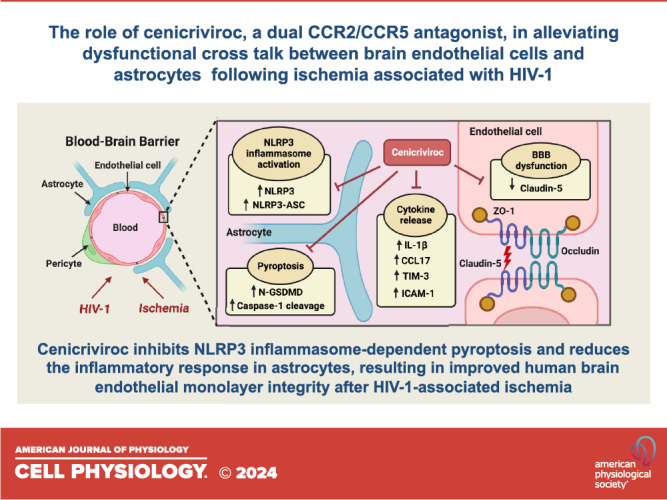
Blood-brain barrier (BBB) breakdown is one of the pathophysiological characteristics of ischemic stroke, which may contribute to the progression of brain tissue damage and subsequent neurological impairment. Human immunodeficiency virus (HIV)-infected individuals are at greater risk for ischemic stroke due to diminished immune function and HIV-associated vasculopathy. Studies have shown that astrocytes are involved in maintaining BBB integrity and facilitating HIV-1 infection in the brain. The present study investigated whether targeting astrocyte-endothelial cell signaling with cenicriviroc (CVC), a dual chemokine receptor (CCR)2 and CCR5 antagonist, may protect against dysregulation of cross talk between these cells after oxygen-glucose deprivation/reoxygenation (OGD/R) combined with HIV-1 infection. Permeability assay with 10 kDa fluorescein isothiocyanate (FITC)-dextran demonstrated that CVC alleviated endothelial barrier disruption in noncontact coculture of human brain microvascular endothelial cells (HBMECs) with HIV-1-infected human astrocytes, and reversed downregulation of tight junction protein claudin-5 induced by OGD/R- and HIV-1. Moreover, CVC attenuated OGD/R- and HIV-1-triggered upregulation of the NOD-like receptor protein-3 (NLRP3) inflammasome and IL-1β secretion. Treatment with CVC also suppressed astrocyte pyroptosis by attenuating cleaved caspase-1 levels and the formation of cleaved N-terminal GSDMD (N-GSDMD). Secretome profiling revealed that CVC ameliorated secretion levels of chemokine CC chemokine ligand 17 (CCL17), adhesion molecule intercellular adhesion molecule-1 (ICAM-1), and T cell activation modulator T cell immunoglobulin and mucin domain 3 (TIM-3) by astrocytes synergistically induced by OGD/R and HIV-1. Overall, these results suggest that CVC contributes to restoring astrocyte-endothelial cross interactions in an astrocyte-dependent manner via protection against NLRP3 activation and pyroptosis. The present study reveals the role of astrocytic NOD-like receptor protein-3 (NLRP3) inflammasome in dysfunctional astrocyte-endothelial cross interactions triggered in response to oxygen/glucose deprivation injury associated with human immunodeficiency virus type 1 (HIV-1) infection. Our results suggest that blocking NLRP3 inflammasome activation and pyroptosis-mediated inflammation with cenicriviroc (CVC) may constitute a potentially effective therapeutic strategy for blood-brain barrier (BBB) protection during HIV-1-associated ischemic stroke.
血脑屏障(BBB)破坏是缺血性中风的病理生理特征之一,可能导致脑组织损伤和随后的神经功能障碍加重。由于免疫功能下降和 HIV 相关血管病变,人类免疫缺陷病毒(HIV)感染者发生缺血性中风的风险更高。研究表明,星形胶质细胞参与维持 BBB 完整性,并促进 HIV-1 在大脑中的感染。本研究探讨了靶向星形胶质细胞-内皮细胞信号通路的药物 cenicriviroc(CVC),即双重趋化因子受体(CCR)2 和 CCR5 拮抗剂,是否可以防止氧葡萄糖剥夺/复氧(OGD/R)联合 HIV-1 感染后这些细胞之间的异常对话。用 10 kDa 荧光素异硫氰酸酯(FITC)-葡聚糖进行的通透性测定表明,CVC 减轻了 HIV-1 感染的人星形胶质细胞与人类脑微血管内皮细胞(HBMEC)非接触共培养中内皮屏障的破坏,并逆转了 OGD/R 和 HIV-1 诱导的紧密连接蛋白 Claudin-5 的下调。此外,CVC 减弱了 OGD/R 和 HIV-1 触发的 NOD 样受体蛋白-3(NLRP3)炎性小体和 IL-1β 的分泌。CVC 治疗还通过减弱切割半胱氨酸天冬氨酸蛋白酶-1(Caspase-1)水平和切割的 N 端 GSDMD(N-GSDMD)的形成来抑制星形胶质细胞细胞焦亡。分泌组谱分析显示,CVC 通过减轻由 OGD/R 和 HIV-1 协同诱导的星形胶质细胞中趋化因子 CC 趋化因子配体 17(CCL17)、粘附分子细胞间粘附分子-1(ICAM-1)和 T 细胞激活调节剂 T 细胞免疫球蛋白和粘蛋白结构域 3(TIM-3)的分泌水平,改善了星形胶质细胞-内皮细胞的相互作用。总的来说,这些结果表明,CVC 通过防止 NLRP3 激活和细胞焦亡,以星形胶质细胞依赖性的方式有助于恢复星形胶质细胞-内皮细胞的相互作用。本研究揭示了星形胶质细胞 NOD 样受体蛋白-3(NLRP3)炎性小体在与人类免疫缺陷病毒 1(HIV-1)感染相关的氧/葡萄糖剥夺损伤引起的星形胶质细胞-内皮细胞交叉相互作用功能障碍中的作用。我们的研究结果表明,用 cenicriviroc(CVC)阻断 NLRP3 炎性小体激活和细胞焦亡介导的炎症可能是 HIV-1 相关缺血性中风期间血脑屏障(BBB)保护的一种潜在有效治疗策略。