School of Public Health, Shanxi Medical University, Taiyuan, China.
School of Pharmacy, Shanxi Medical University, Taiyuan, China.
J Cell Mol Med. 2024 Jan;28(1):e18023. doi: 10.1111/jcmm.18023. Epub 2023 Dec 25.
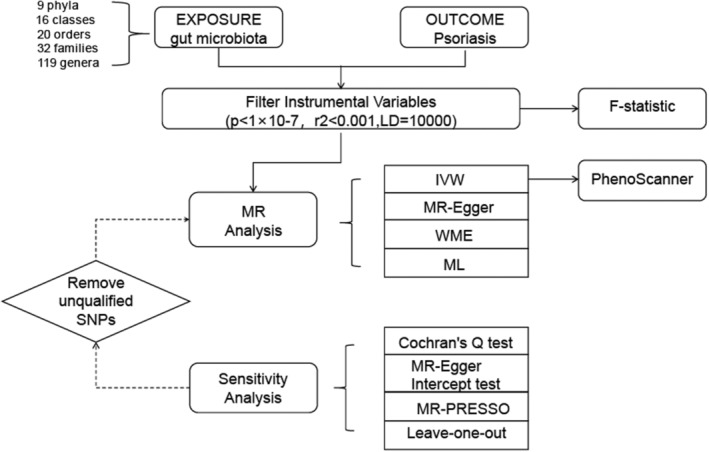
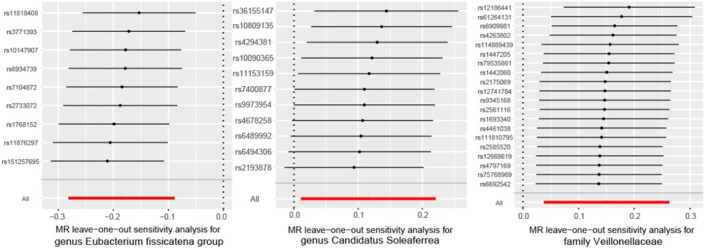
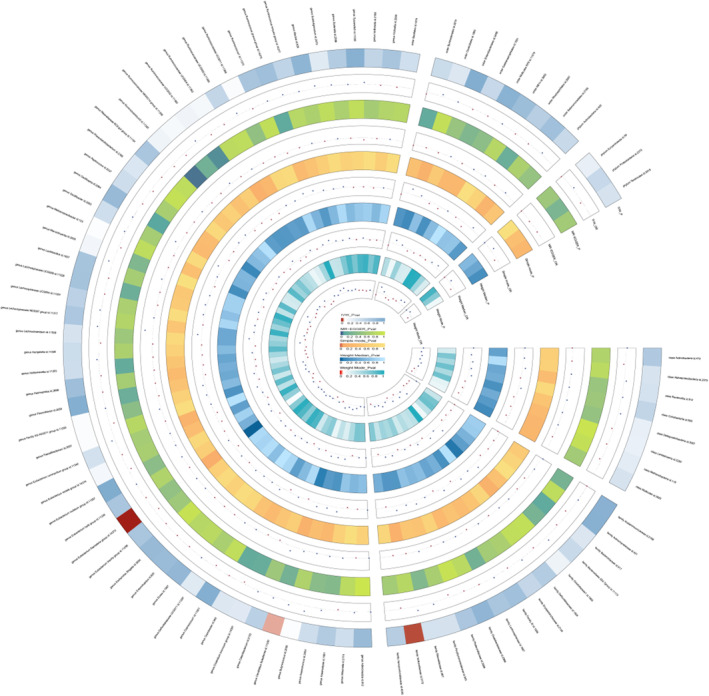
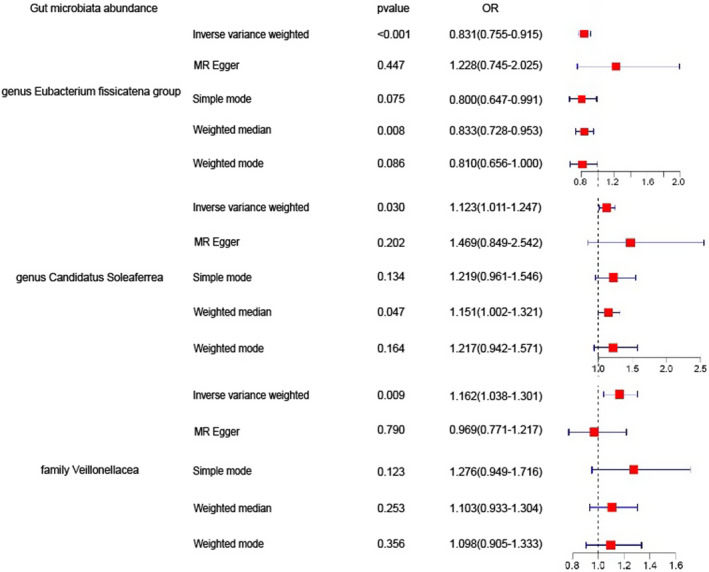
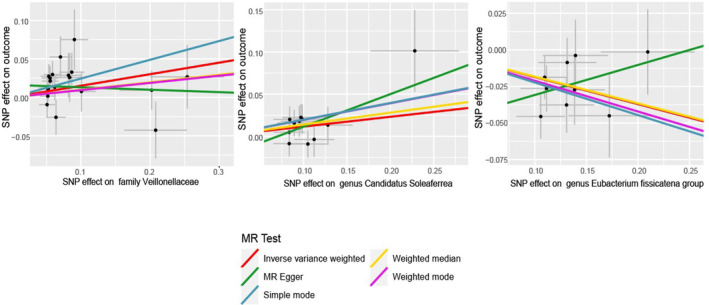
In recent years, an increasing number of observational studies have revealed an association between gut microbiota composition and psoriasis patients. However, whether this association reflects a causal relationship remains unclear. This study aimed to identify the causal relationship between gut microbiota and psoriasis through relevant research. In order to determine whether gut microbiota and psoriasis are causally related, we conducted a Mendelian randomization analysis using summary statistics from genome-wide association studies (GWAS). As the exposure factor, we used summary statistics data from a GWAS study conducted by the MiBioGen Consortium, including 18,340 individuals with whole-genome gut microbiota composition, and data from the FinnGen GWAS study on psoriasis, including 9267 patients and 364,071 controls as the disease outcome. Two-sample Mendelian randomization analysis was subsequently performed with inverse variance weighted, MR-Egger and weighted median, while sensitivity analyses were conducted to address heterogeneity and horizontal pleiotropy. The IVW results confirmed the causal relationship between certain gut microbiota groups and psoriasis. Specifically, family Veillonellaceae (OR = 1.162, 95% CI: 1.038-1.301, p = 0.009), genus Candidatus Soleaferrea (OR = 1.123, 95% CI: 1.011-1.247, p = 0.030) and genus Eubacterium fissicatena group (OR = 0.831, 95% CI: 0.755-0.915, p = 0.00016) showed significant associations. Sensitivity analysis did not reveal any abnormalities in SNPs. Currently, we have found some causal relationship between the gut microbiota and psoriasis. However, the study needs further RCTs for further validation.
近年来,越来越多的观察性研究揭示了肠道微生物群落组成与银屑病患者之间的关联。然而,这种关联是否反映了因果关系尚不清楚。本研究旨在通过相关研究确定肠道微生物群与银屑病之间的因果关系。为了确定肠道微生物群和银屑病是否存在因果关系,我们使用来自全基因组关联研究(GWAS)的汇总统计数据进行了孟德尔随机化分析。作为暴露因素,我们使用了 MiBioGen 联盟进行的 GWAS 研究的汇总统计数据,该研究包括 18340 名个体的全基因组肠道微生物群落组成,以及 FinnGen GWAS 研究中银屑病的数据,包括 9267 名患者和 364071 名对照作为疾病结局。随后进行了两样本孟德尔随机化分析,采用逆方差加权、MR-Egger 和加权中位数,同时进行敏感性分析以解决异质性和水平多效性。IVW 结果证实了某些肠道微生物群与银屑病之间存在因果关系。具体而言,家族 Veillonellaceae(OR=1.162,95%CI:1.038-1.301,p=0.009)、属 Candidatus Soleaferrea(OR=1.123,95%CI:1.011-1.247,p=0.030)和属 Eubacterium fissicatena 组(OR=0.831,95%CI:0.755-0.915,p=0.00016)与银屑病显著相关。敏感性分析未发现 SNP 异常。目前,我们已经发现肠道微生物群与银屑病之间存在一些因果关系。然而,该研究需要进一步的 RCT 来进一步验证。