Department of Community Ecology, Helmholtz-Centre for Environmental Research-UFZ, Halle (Saale), Germany.
Johann-Friedrich-Blumenbach Institute of Zoology and Anthropology, University of Göttingen, Göttingen, Germany.
Oecologia. 2024 Jan;204(1):133-146. doi: 10.1007/s00442-023-05493-9. Epub 2023 Dec 26.
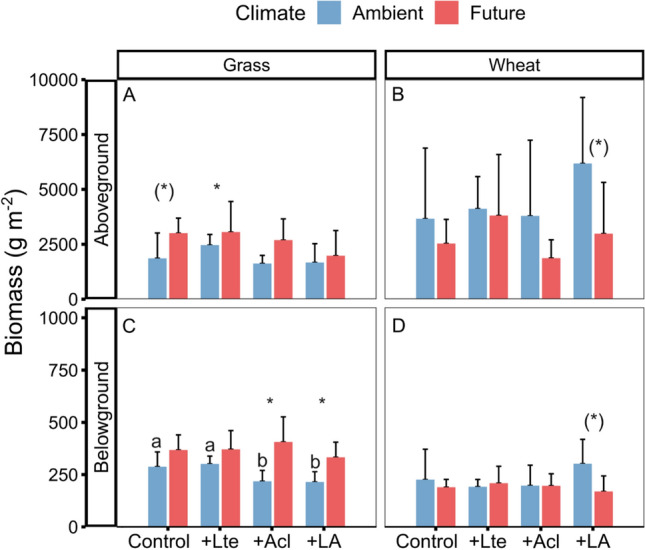
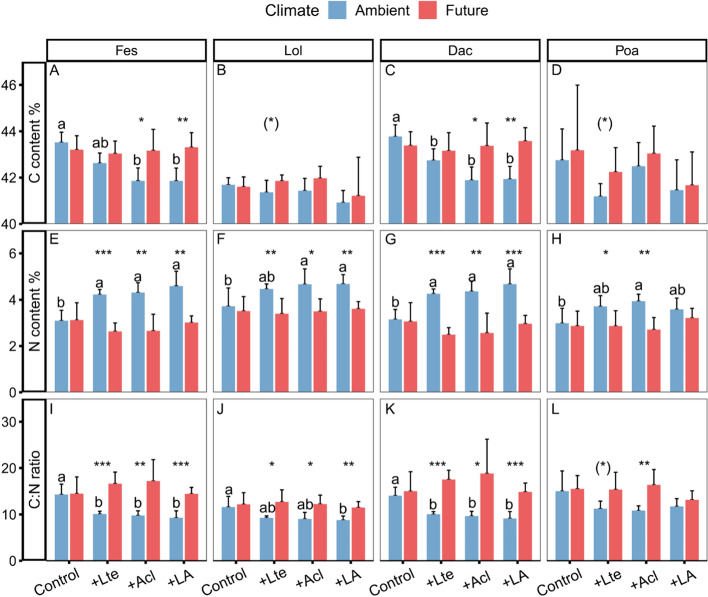
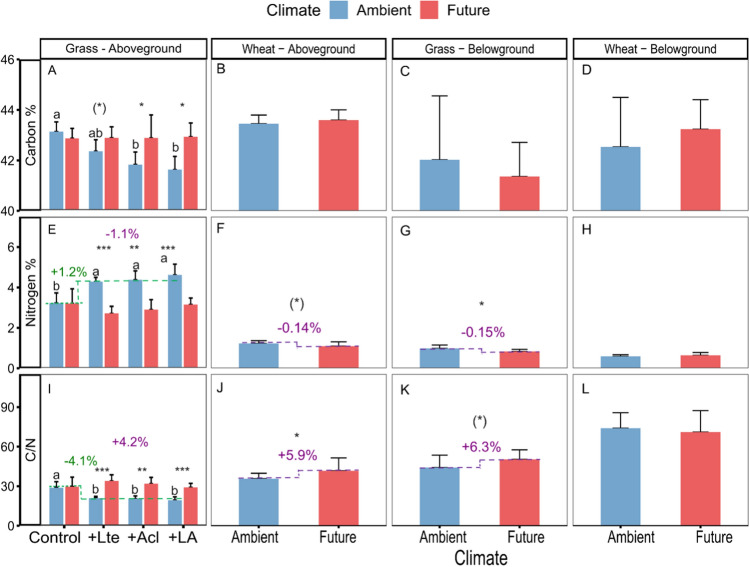
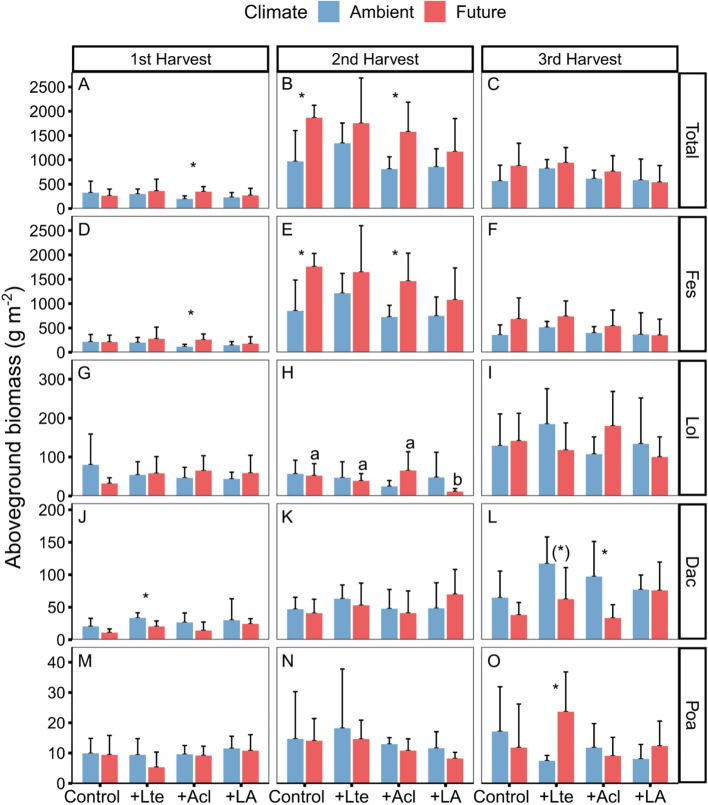
Plant nutrient uptake and productivity are driven by a multitude of factors that have been modified by human activities, like climate change and the activity of decomposers. However, interactive effects of climate change and key decomposer groups like earthworms have rarely been studied. In a field microcosm experiment, we investigated the effects of a mean future climate scenario with warming (+ 0.50 °C to + 0.62 °C) and altered precipitation (+ 10% in spring and autumn, - 20% in summer) and earthworms (anecic-two Lumbricus terrestris, endogeic-four Allolobophora chlorotica and both together within 10 cm diameter tubes) on plant biomass and stoichiometry in two land-use types (intensively used meadow and conventional farming). We found little evidence for earthworm effects on aboveground biomass. However, future climate increased above- (+40.9%) and belowground biomass (+44.7%) of grass communities, which was mainly driven by production of the dominant Festulolium species during non-summer drought periods, but decreased the aboveground biomass (- 36.9%) of winter wheat. Projected climate change and earthworms interactively affected the N content and C:N ratio of grasses. Earthworms enhanced the N content (+1.2%) thereby decreasing the C:N ratio (- 4.1%) in grasses, but only under ambient climate conditions. The future climate treatment generally decreased the N content of grasses (aboveground: - 1.1%, belowground: - 0.15%) and winter wheat (- 0.14%), resulting in an increase in C:N ratio of grasses (aboveground: + 4.2%, belowground: +6.3%) and wheat (+5.9%). Our results suggest that climate change diminishes the positive effects of earthworms on plant nutrient uptakes due to soil water deficit, especially during summer drought.
植物养分吸收和生产力受多种因素驱动,这些因素已经被人类活动改变,如气候变化和分解者的活动。然而,气候变化和关键分解者群体(如蚯蚓)的相互作用影响很少被研究过。在一个野外微宇宙实验中,我们调查了一个未来平均气候情景的影响,该情景包括变暖(+0.50°C 至+0.62°C)和改变降水(春季和秋季增加 10%,夏季减少 20%)以及蚯蚓(两种蚯蚓(Lumbricus terrestris),两种蚯蚓(Allolobophora chlorotica)和两者都在 10cm 直径的管内)对两种土地利用类型(集约利用草地和传统农业)中植物生物量和化学计量的影响。我们发现蚯蚓对地上生物量几乎没有影响。然而,未来气候增加了草地群落的地上(+40.9%)和地下生物量(+44.7%),这主要是由主导物种 Festulolium 在非夏季干旱期的生产力驱动的,但减少了冬小麦的地上生物量(-36.9%)。预测的气候变化和蚯蚓相互作用影响了草地的 N 含量和 C:N 比。蚯蚓增加了 N 含量(+1.2%),从而降低了草地的 C:N 比(-4.1%),但仅在环境气候条件下。未来气候处理通常会降低草地(地上:-1.1%,地下:-0.15%)和冬小麦(-0.14%)的 N 含量,导致草地的 C:N 比增加(地上:+4.2%,地下:+6.3%)和小麦(+5.9%)。我们的结果表明,由于土壤水分亏缺,特别是在夏季干旱期间,气候变化会降低蚯蚓对植物养分吸收的积极影响。