Department of Gastroenterology, Division of Hepatobiliary and Pancreatic Disease, Hyogo Medical University, 1-1 Mukogawacho, Nishinomiyashi, Hyogo, 663-8501, Japan.
Department of Internal Medicine, Himeji St. Mary's Hospital, Himeji, Hyogo, Japan.
J Med Ultrason (2001). 2024 Apr;51(2):293-300. doi: 10.1007/s10396-023-01398-5. Epub 2023 Dec 26.
Risk factors for the development of hepatocellular carcinoma (HCC) remain unclear in patients with hepatitis C virus (HCV) who achieve sustained virological response (SVR) after direct-acting antiviral (DAA) therapy. This study investigated the usefulness of the VFMAP scoring system for predicting the development of HCC in these patients.
This study included 358 patients with HCV who achieved SVR after DAA treatment. The VFMAP system defines and scores cutoff values for virtual touch quantification (VTQ), fasting plasma glucose, sex, age, and alpha-fetoprotein values. All patients were grouped according to their VFMAP scores as follows: 0 or 1 point, low-score group; 2 or 3 points, intermediate-score group; and 4 or 5 points, high-score group.
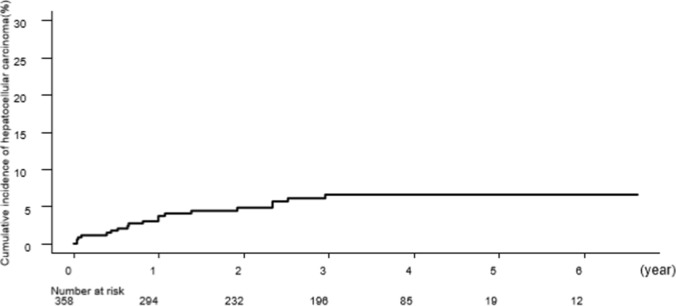
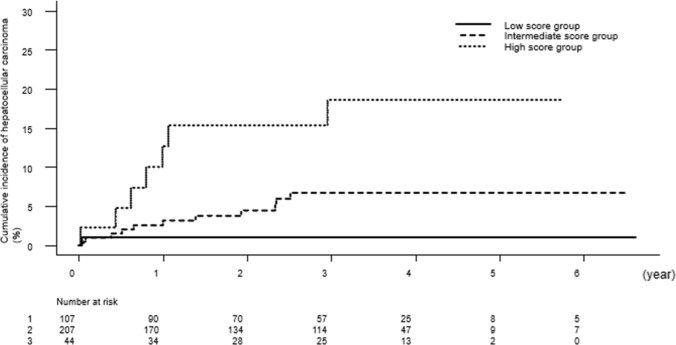
Nineteen patients developed HCC. The median follow-up duration was 3.2 (1.5-4.0) years. The respective cumulative incidence rates of HCC at 12, 24, and 36 months were as follows in different subgroups: all study patients, 3.0%, 4.8%, and 6.6%; low-score group, 0.96%, 0.96%, and 0.96%; intermediate-score group, 2.6%, 4.5%, and 6.8%; and high-score group, 10.0%, 15.3%, and 18.5%. The cumulative incidence rates of HCC in the high-score group were significantly higher than those in the low- and intermediate-score groups (p < 0.001 and < 0.05, respectively).
VFMAP accurately predicted the development of HCC in HCV patients who achieved SVR following treatment with DAAs.
在接受直接作用抗病毒(DAA)治疗后获得持续病毒学应答(SVR)的丙型肝炎病毒(HCV)患者中,肝细胞癌(HCC)发生的危险因素仍不清楚。本研究旨在探讨 VFMAP 评分系统在预测这些患者 HCC 发生中的作用。
本研究纳入了 358 例接受 DAA 治疗后获得 SVR 的 HCV 患者。VFMAP 系统定义并评分虚拟触诊定量(VTQ)、空腹血糖、性别、年龄和甲胎蛋白值的截断值。所有患者根据其 VFMAP 评分分为以下三组:0 或 1 分,低分组;2 或 3 分,中分组;4 或 5 分,高分组。
19 例患者发生 HCC。中位随访时间为 3.2(1.5-4.0)年。不同亚组 12、24 和 36 个月 HCC 的累积发生率如下:所有研究患者分别为 3.0%、4.8%和 6.6%;低分组分别为 0.96%、0.96%和 0.96%;中分组分别为 2.6%、4.5%和 6.8%;高分组分别为 10.0%、15.3%和 18.5%。高分组 HCC 的累积发生率明显高于低分组和中分组(p<0.001 和 p<0.05)。
VFMAP 能准确预测 DAA 治疗后获得 SVR 的 HCV 患者 HCC 的发生。