First Department of Internal Medicine, School of Medicine, University of Occupational and Environmental Health, Japan, Kitakyushu, Japan.
Clinical Research Center, Hospital of the University of Occupational and Environmental Health, Japan, Kitakyushu, Japan.
J Diabetes Investig. 2024 Apr;15(4):449-458. doi: 10.1111/jdi.14138. Epub 2023 Dec 27.
The aim of this study was to compare the effects of mitiglinide/voglibose with those of glimepiride on glycemic variability and vascular endothelial function in patients with type 2 diabetes.
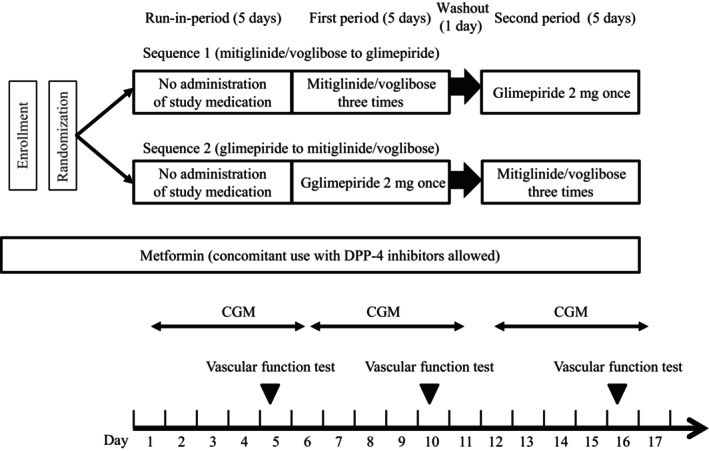
It was a multicenter, open-label, randomized, crossover study. Hospitalized patients received either mitiglinide/voglibose (three times daily administration of 10 mg mitiglinide and 0.2 mg voglibose) or glimepiride (once-daily 2 mg) in random order, each for 5 days. The reactive hyperemia index (RHI) and the mean amplitude of glycemic excursions (MAGE) were measured as co-primary endpoints using reactive hyperemia peripheral arterial tonometry and continuous glucose monitoring.
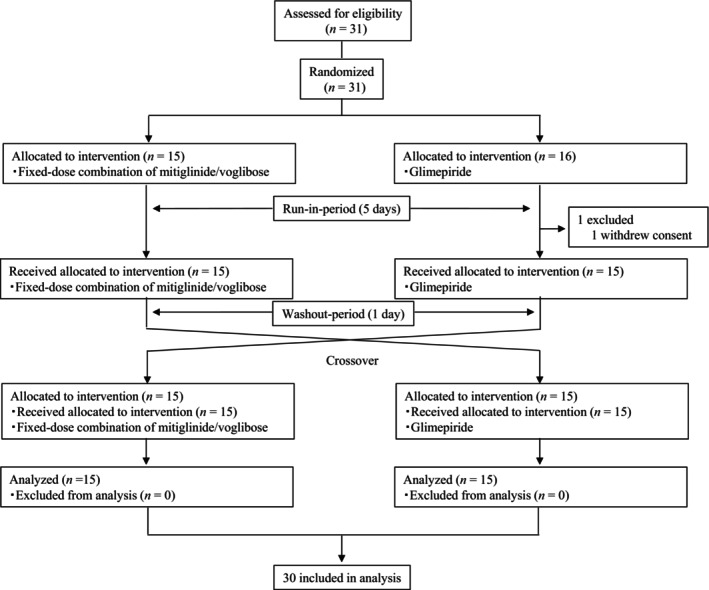
The analysis included 30 patients (15 in each group). The RHI was 1.670 ± 0.369 during treatment with mitiglinide/voglibose and 1.716 ± 0.492 during treatment with glimepiride, with no significant difference between the two. MAGE was significantly lower in the mitiglinide/voglibose group (47.6 ± 18.5 mg/dL) than in the glimepiride group (100.6 ± 32.2 mg/dL). Although the mean blood glucose levels over the entire 24 h period were comparable between the two groups, the use of mitiglinide/voglibose was associated with a lower standard deviation of mean glucose, coefficient of variation, and mean postprandial glucose excursion compared with glimepiride. The time below range (<70 mg/dL) and the time above range (>180, >200, and 250 mg/dL) were lower in the mitiglinide/voglibose group, while the time in range (70-180 mg/dL) was higher.
In our short-duration randomized crossover study, although not impacting vascular endothelial function, mitiglinide/voglibose demonstrated potential benefits in reducing glycemic variability, postprandial hyperglycemia, and hypoglycemia in patients with type 2 diabetes.
本研究旨在比较米格列醇/伏格列波糖与格列美脲对 2 型糖尿病患者血糖变异性和血管内皮功能的影响。
这是一项多中心、开放标签、随机、交叉研究。住院患者随机接受米格列醇/伏格列波糖(每日三次,每次 10mg 米格列醇和 0.2mg 伏格列波糖)或格列美脲(每日一次 2mg)治疗,每种治疗持续 5 天。使用反应性充血外周动脉张力测定和连续血糖监测测量反应性充血指数(RHI)和平均血糖波动幅度(MAGE)作为共同主要终点。
该分析包括 30 名患者(每组 15 名)。米格列醇/伏格列波糖治疗时的 RHI 为 1.670±0.369,格列美脲治疗时为 1.716±0.492,两组间无显著差异。米格列醇/伏格列波糖组的 MAGE 明显低于格列美脲组(47.6±18.5mg/dL 与 100.6±32.2mg/dL)。尽管两组 24 小时内平均血糖水平相当,但与格列美脲相比,使用米格列醇/伏格列波糖与平均血糖标准差、变异系数和平均餐后血糖波动降低相关。米格列醇/伏格列波糖组血糖低于 70mg/dL 的时间、血糖高于 180、200 和 250mg/dL 的时间以及血糖处于 70-180mg/dL 的时间均较低。
在我们的短期随机交叉研究中,米格列醇/伏格列波糖虽然对血管内皮功能没有影响,但在降低 2 型糖尿病患者血糖变异性、餐后高血糖和低血糖方面显示出潜在的益处。